
Skip to content
Sample deep readingComplete sample · about 15,557 words

Sample Deep Reading: See Exactly What You Get

This is a complete sample, exactly as a deep reading is delivered. Yours will be written from scratch for your question, your cards, and your answers.

Download the full sample (PDF)

Sample question: Should I take the job offer in another city, or stay where I am?

Your cards

  1. Four of Pentacles

    Past Influences

    Four of Pentacles

  2. Two of Pentacles

    Present Situation

    Two of Pentacles

  3. The Chariot

    Future Outcome

    The Chariot

Between the Fortress You Built and the Horizon Calling: A Time-Flow Reading for Your Relocation Crossroads

Breaking out of guarded safety toward a journey that demands total commitment.

Your spread traces a distinct shift from holding tightly to what is safe toward an undeniable push into forward momentum. Right now, you are caught in a demanding balancing act, trying to protect familiar ground while sizing up a fresh opportunity. The trajectory points directly toward decisive motion, but the terms of that shift require you to confront what you are really trying to preserve.

This reading traces a deliberate progression from protective containment (Four of Pentacles) through active equilibrium (Two of Pentacles) into directed momentum (The Chariot), revealing that the true dilemma is not career versus friendships, but whether you can trust your bonds to stretch across distance as your life expands.

The complete outline: 17 sections

  1. 1Standing Between a Safe Harbor and an Unwritten Map: The Architecture of Your CrossroadsSection
  2. 2What Your Own Words Reveal: The Fear of Losing People vs. the Flatness of Repeating YourselfYour questions
  3. 3From Earthbound Grip to Armored Motion: The Three-Card Trajectory Across TimeNear-future arc
  4. 4The Past Foundation — Four of Pentacles: How Building a Sanctuary Slowly Became a CeilingCard dynamics
  5. 5The Anatomy of 'Safe, But Flat': Why Outgrowing a Chapter Feels Like Betraying ItIn-depth
  6. 6The Present Pivot — Two of Pentacles: Juggling Two Futures Without Dropping Your HeartCard dynamics
  7. 7The Hidden Truth of the Two of Pentacles: You Are Not Choosing Between Career and LoveKey insight
  8. 8The Future Trajectory — The Chariot: The Unmistakable Call to Leave the City Walls BehindCard dynamics
  9. 9Harnessing the Two Sphinxes: Pulling Grief and Ambition in the Same DirectionIn-depth
  10. 10Two Paths Compared: The Energetic Reality of Staying vs. Relocating Over the Next 18 MonthsLife areas
  11. 11Deconstructing the Quiet Drift: Why Some Friendships Fade with Miles and How Yours Can Refuse ToIn-depth
  12. 12The Numerology of Your Spread: Why 4 → 2 → VII Is a Countdown to LaunchThemes
  13. 13The Long-Distance Covenant: Five Concrete Rituals to Protect Your Inner Circle When You MoveAction plan
  14. 14Stepping Into the New Role Without Using Work to Numb the HomesicknessIn-depth
  15. 15The 72-Hour Embodied Trial: Living Inside the Decision Before You Sign the OfferAction plan
  16. 16How to Tell the People You Love That You Are Leaving (Without Apologizing for Growing)Themes
  17. 17The Parting Oracle: Carrying Your City Inside Your ArmorReflection

The complete reading, in full

1

Standing Between a Safe Harbor and an Unwritten Map: The Architecture of Your Crossroads

Between the Fortress You Built and the Horizon Calling

You already know how to build a career from scratch. That is not what keeps you awake at night as you stare at this job offer in another city. What stops you cold is a much quieter, far more tender calculation: the fear that taking a step forward professionally will slowly, invisibly cost you the people who make your current life worth living. When you look at the option of staying where you are, you see something safe, warm, and deeply familiar, yet undeniably flat. You called it the good version of a life you have already lived. That single observation holds the entire emotional weight of this reading. You are standing in a home and a routine that have served their purpose completely, yet the price of admission to your next chapter feels like it might be the slow erosion of your closest friendships.

The cards you have drawn for this Time-Flow spread do not treat your hesitation as cowardice, nor do they treat your ambition as a betrayal of your loved ones. Instead, the sequence of the Four of Pentacles, the Two of Pentacles, and The Chariot maps out a very specific psychological and practical evolution. Look first at the progression of the numbers and suits. You begin in the heavy, grounded, protective grip of the Four of Pentacles, move into the kinetic, adaptable rhythm of the Two of Pentacles, and culminate in the Major Arcana force of The Chariot. Notice what happens between the first two cards: you move from a Fourdown to a Two within the suit of earth. In physical life, moving forward usually requires accumulating more, building higher walls, and securing heavier anchors. Here, the tarot shows that your immediate transition requires loosening your grip and reducing the weight you carry so that movement becomes possible again.

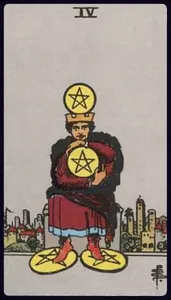
The central tension surfaced by these three cards is not actually a choice between professional ambition and personal loyalty. That is a false binary created by the anxiety of the Four of Pentacles. In the past and foundational position, the Four of Pentacles shows a figure sitting inside a walled city, arms and legs wrapped tightly around four gold coins. One coin rests on his crown, two are clutched to his chest, and one is pinned beneath his feet. He is completely secure, entirely protected from loss, and totally unable to move an inch. This is the exact portrait of staying in the life you have already lived out of fear that distance will ruin your relationships. When you try to preserve a living thing by locking it in a vault, you do not save it; you flatten it. The flatness you feel when you imagine staying is the direct result of outgrowing the container while continuing to guard its walls.

The true question before you is not whether you value your career more than your friends, but whether you believe the love you have built is strong enough to survive motion, or so fragile that it only exists within shared zip codes.

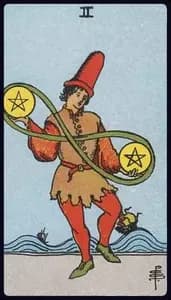
As the spread moves into the present with the Two of Pentacles, the posture changes completely. The figure is no longer sitting on a stone block clutching coins; he is on his feet, dancing as he juggles two pentacles bound together by a continuous infinity loop, while tall ships ride high waves in the background. Those two pentacles are your two worlds: the deep, established roots of the friendships you cherish here, and the tangible demands of the new role waiting for you in another city. Notice the infinity ribbon wrapping around both coins. They are not separate, mutually exclusive lives where picking up one forces you to drop the other into the sea. They are part of a single, continuous loop of energy that requires active, rhythmic attention. Keeping friendships alive across state lines or city limits is not a passive state of being; it is an ongoing practice of showing up, scheduling the flight, making the long phone call on the walk home, and letting your people into the reality of your new days.

Then comes the undeniable pull of your future position: The Chariot. Unlike the first two cards, which belong to the Minor Arcana and reflect daily habits and practical choices, The Chariot is a Major Arcana archetype. It represents a structural shift in your life trajectory that cannot be ignored without a deep sense of self-betrayal. In traditional imagery, the Charioteer stands beneath a canopy of stars, driving a vehicle pulled by two contrasting sphinxes, one black and one white, while a walled city sits firmly behind his back. He has left the fortress of the Four of Pentacles. He is no longer endlessly weighing the options of the Two of Pentacles. He has chosen a direction, and he uses sheer willpower and clear intention to keep two opposing forces moving along the same road.

Those two sphinxes are the exact desires pulling at your heart right now: the desire for deep, enduring intimacy with the people who know your history, and the desire for growth, novelty, and a life you have not already lived. The Chariot promises that these two desires do not have to tear you apart, provided you take the reins and direct them both with intention. You do not lose the city behind you just because you drive out of its gates; you carry its armor on your shoulders.

In the sections that follow, we will examine each of these three stages in detail. First, we will look closely at each card in its specific time-flow position, examining how your current sense of safety is subtly turning into stagnation, what the daily reality of straddling two cities will actually ask of your calendar and your nervous system, and how The Chariot redefines success in this move. From there, we will examine the hidden assumption underneath your fear of losing your friends, and conclude with concrete, grounded steps to help you make this decision and structure your relationships so they expand right alongside your horizon.

2

What Your Own Words Reveal: The Fear of Losing People vs. the Flatness of Repeating Yourself

The Emotional Baseline: Unpacking Your Clarifying Reflections

What matters most to you in this decision?
Your Stated Reality: "Not losing the people I have here. I can rebuild a career anywhere, but I am afraid the move quietly costs me my closest friendships."This confession cuts straight to the core of your emotional posture, exposing the exact psychological posture mirrored by the Four of Pentacles. You are not primarily bargaining with professional risk or financial viability. By your own admission, you possess the competence and resilience to reconstruct a career in any environment. Your actual hesitation stems from an acute fear of loss, specifically the subtle, gradual drift of intimacy that physical distance so often brings. In your mind, geographic relocation is not simply an address change; it registers as a slow leak in the foundation of your personal life. You picture phone calls becoming less frequent, shared references fading, and the daily warmth of spontaneous encounters replaced by polite, scheduled updates. This makes the new job offer feel less like an adventure and more like an expensive trade, one where you surrender irreplaceable human bonds in exchange for a title or a salary you already know how to attain elsewhere.This protective instinct is natural, yet it reveals an unspoken premise: you are treating your friendships as fragile artifacts rather than living currents. Under the influence of the Four of Pentacles, you view community as a fixed hoard that must be guarded by proximity. You worry that if you stop physically standing watch over these relationships, they will wither or dissolve. Yet friendship that depends solely on physical convenience is often weaker than it appears, while bonds tested by intentional effort can discover an entirely new depth. The real tension you face here is between containment and trust. You are bracing against the grief of being forgotten, and in doing so, you risk allowing anxiety to dictate the boundaries of your world before distance has even had the chance to test what you and your friends have actually built.
When you imagine staying, what does it feel like?
Your Stated Reality: "Safe, but flat. Like the good version of a life I have already lived."Your response captures the quiet tragedy of outgrown comfort with remarkable clarity. You do not describe your current environment as hostile, exhausting, or miserable. On the contrary, you recognize it as a "good version" of your life, which makes walking away significantly harder. There is no active crisis pushing you out the door, no toxic workplace or broken home forcing a sudden departure. Instead, you are confronted with a comfortable plateau. The Four of Pentacles explains this perfectly: it is the archetype of the well-built fortress where nothing enters and nothing leaves. Within these walls, you are completely shielded from sudden disruption, yet the air has grown still. The safety you enjoy has reached its diminishing returns, slipping into emotional flatness because you have already extracted the growth, discovery, and surprise this chapter had to offer.Choosing to stay under these conditions is not a neutral preservation of happiness; it is an active decision to repeat a finished cycle. When you stay inside a reality you have already mastered, safety subtly shifts into self-limitation. You preserve your proximity to friends, but you do so at the cost of your own forward momentum. This flatness is the warning sign that precedes resentment. Over time, living out a finished script breeds quiet dissatisfaction, and that frustration can eventually poison the very connections you stayed to protect. Your awareness of this flatness shows that your inner compass is already registering the pull of The Chariot. You know that remaining in place will keep you secure, but it will also require you to pretend that you are still the person who fit inside this city three years ago. The question before you is whether you are willing to accept stagnation as the price of convenience, or whether you are ready to let your life move forward into uncharted ground.
3

From Earthbound Grip to Armored Motion: The Three-Card Trajectory Across Time

The Elemental Progression: From Protective Enclosure to Directed Velocity

  1. Foundation: Static Earth (Four of Pentacles)

    The baseline of your spread is anchored in the heavy, compacted density of the Four of Pentacles. In traditional tarot cosmology, the number four represents structural finality, boundary lines, and consolidation. Here, Earth acts as a locked gate. The figure seated in the card clutches a golden coin to his chest, pins two beneath the soles of his feet, and balances a fourth directly upon his crown. Every limb is recruited into the act of defense; nothing can enter, and nothing can escape. In the context of your current city, this card reflects a relational ecosystem you have spent years carefully assembling and fortifying. You know the exact streets, the reliable rhythms of your social circle, and the unspoken understandings that keep your friendships alive. That familiarity provides authentic safety, yet the card warns of how easily protection curdles into stasis.

    You named this condition precisely when you described staying as "safe, but flat... the good version of a life I have already lived." In the Four of Pentacles, safety comes with an invisible tax: total immobility. To keep every coin firmly in place, the figure cannot turn his head, take a step, or reach outward. The psychic energy required to maintain this version of your life is quietly monopolized by preservation rather than generation. Your fear that a geographic relocation will quietly erode your closest friendships is an exact manifestation of this defensive posture. You are treating social connection as an fragile, finite hoard that can only survive if you physically sit on top of it. This card exposes the root truth of your hesitation: you are not lingering because you still have uncharted growth to harvest in your current environment; you are lingering because leaving demands opening hands that have been tightly closed around what is known.

  2. Crux: Kinetic Earth (Two of Pentacles)

    At the center of the timeline stands the Two of Pentacles, marking a necessary elemental transition from fixed Earth into motion. Where the four stood rigid, the two dances upon shifting tides. The figure here handles two golden disks looped inside an infinity symbol (the lemniscate), balancing them with rhythmic agility while merchant ships rise and fall upon choppy waves in the background. This card captures the exact psychological threshold you occupy right now. The arrival of the job offer broke the seal of your fortress, forcing you to recognize that stability is not a permanent stone monument, but an ongoing juggling act between competing loyalties and practical realities.

    The Two of Pentacles does not ask you to eliminate tension; it demands that you master rhythm. One disk represents your vocational ceiling and the call to step into unfamiliar territory; the other represents your vital human network back home. You have been treating this crossroads as an absolute, catastrophic trade: career ascension bought with social abandonment, or social preservation bought with professional stagnation. The Two of Pentacles rejects that binary. Notice the waves behind the juggler: the ocean is volatile, yet the ships remain buoyant because they adjust their sails rather than attempting to freeze the water. You are realizing that maintaining meaningful ties across state lines or city limits does not mean letting them decay; it requires converting static proximity into deliberate, coordinated effort. This card tests your dexterity, asking whether you can hold the weight of personal ambition in one hand and the thread of enduring loyalty in the other without dropping either.

  3. Trajectory: Directed Willpower (The Chariot)

    The trajectory resolves not into another minor card of incremental adjustments, but into the seismic momentum of The Chariot, the seventh archetype of the Major Arcana. This shift marks a dramatic evolution across your spread: the narrative leaves the realm of Earth (physical shelter, tangible routines, cautious balancing) and plunges into the armored, water-ruled drive of Cancer. The Chariot is defined by an armored driver steering a vehicle pulled by two opposing sphinxes, holding no reins, directing his route entirely through focused intention, mental discipline, and sovereign decision.

    In your timeline, The Chariot represents the inevitable breakdown of your hesitation. You cannot balance the disks of the Two of Pentacles indefinitely; sooner or later, equilibrium must yield to forward vector. This card does not depict a casual stroll, but an active departure from the city gates. The urban skyline stands firmly behind the chariot driver, exactly like the settled town you contemplate leaving behind. The Chariot confirms that choosing the new city requires cutting through ambient doubts and assuming full ownership of your momentum. The opposing black and white sphinxes beneath the car symbolize your dual inner drives: the desire for comfort and the hunger for expansion. They pull in opposite directions until the driver asserts an uncompromising course.

    Crucially, because The Chariot belongs to the astrological sign of Cancer, its armored exterior guards an intensely emotional core. This archetype does not abandon home; it carries its shell, its values, and its foundational bonds forward as armor. Your closest friendships will not vanish through geographic distance unless you surrender your active will to maintain them. The Chariot demonstrates that stepping into the relocation is not a betrayal of your community, but an act of courage that proves your relationships possess the structural integrity to survive movement. The future calls for clear direction: you leave the static plateau behind, align your conflicting fears into singular drive, and steer resolutely toward the unfamiliar horizon.

4

The Past Foundation — Four of Pentacles: How Building a Sanctuary Slowly Became a Ceiling

Foundation and Past: The Architecture of Security

Pentacles04
Position 1: The Past (Root of the Situation)

In the traditional imagery of the Four of Pentacles, a crowned figure perches on a stone ledge outside the bustling gates of a city. One coin rests firmly beneath his feet, another is clamped under both forearms across his chest, and a fourth sits squarely balanced atop his crown. Every limb is engaged in the work of retention. He is entirely unmoving, not out of lethargy, but out of total vigilance. Nothing slips from his grasp, nothing enters to disturb his stance, and nothing leaves to dilute his store.

In the context of your question, this card anchors your past not as a cautionary tale of greed, but as the hard-won architecture of emotional sanctuary. When you speak about not losing the people you have where you live, you are describing the very real work it took to establish that circle. Deep, dependable friendships do not simply appear by accident. You invested your time, shared vulnerabilities, weathered personal transitions, and built a trusted micro-community block by block. The Four of Pentacles validates that investment: the loyalty you cherish was carved out intentionally, giving you a firm base of physical and emotional belonging when you needed stability most.

Yet the defining tension of the Four of Pentacles is the exact paradox you voiced in your clarifying words: safe, but flat. When every resource is locked down to prevent loss, circulation stops. The figure cannot take a single forward step without dropping the coin underfoot; he cannot reach out a hand in greeting or curiosity without letting go of the coin held against his heart. The stone walls around him keep danger at bay, but they also block the wind, the noise of new life, and the unpredictable encounters that generate vitality.

What felt like necessary protection two or three years ago has gradually calcified into an unwritten rule that life must remain exactly as it is to remain good. You noted that staying feels like the good version of a life I have already lived. The Four of Pentacles represents precisely that moment when preservation slips into confinement. You are guarding a fortress whose construction is already complete. The structure does its job admirably, but there is no unfinished room left inside it to explore, and the energy required to police its perimeter is quietly starving you of fresh momentum.

Crucially, this card in the foundation position explains the subterranean root of your fear. You are operating on the implicit belief that intimacy is strictly geographical: that if you stop holding your friends within immediate reach, the bond will inevitably disintegrate. The Four of Pentacles confuses holding on tightly with keeping something alive. Living things, however, do not thrive under permanent lock and key. The security you established was a vital developmental stage, but treating that stage as a permanent ceiling turns genuine care into an anxious vigil.

5

The Anatomy of 'Safe, But Flat': Why Outgrowing a Chapter Feels Like Betraying It

The Heavy Cost of Preservation

Guilt is often the quiet tax we pay for outgrowing places that once kept us safe. When you describe your current city as safe, but flat and confess that it resembles the good version of a life I have already lived, you identify an ache common to anyone standing at the edge of necessary departure. You have built something genuine where you are. The friendships you cherish were not accidental conveniences; they were forged through shared dinners, mundane routines, mutual crises, and years of regular presence. Because those bonds represent the emotional wealth of your adult life, the prospect of packing your belongings and boarding a train or plane feels less like professional ambition and more like an act of quiet betrayal.

This emotional friction is the psychological core of the Four of Pentacles. Traditionally depicted as a seated figure clutching a coin with both arms, resting his feet upon two others, and balancing a fourth upon his crown, the image depicts an instinctive, protective reflex. When something has cost us significant labor to secure, our immediate impulse is to freeze the frame, batten down the hatches, and prevent anything from changing. In material matters, this protects savings and establishes emergency funds. In relational matters, however, this same instinct turns toxic. It fosters the belief that love, connection, and loyalty can survive only inside an airless vault where nobody moves, nobody shifts schedules, and nobody dares cross a state line.

The Illusion of Physical Proximity as Moral Devotion

The core mistake the Four of Pentacles tempts you to make is the false equation between geographical proximity and emotional fidelity. You are operating under a quiet assumption: that staying within driving distance proves you love your friends, while accepting an offer elsewhere implies they were expendable. This conflation is understandable, but it is fundamentally untrue. Physical closeness makes intimacy easy, not necessarily durable. When proximity does the heavy lifting of maintaining a relationship, friendships can easily cruise on convenience, shared geography, and habitual presence rather than active intention.

By clutching the coin of your social circle so tightly to your chest, you treat those relationships as delicate antiques that will shatter if exposed to a postal code change. Consider the hidden message that protective grip communicates to the people who care about you:

  • It assumes your bonds lack structural integrity. If a friendship of five or ten years requires identical zip codes to stay alive, then it was never an anchor; it was merely a carpool. Believing that your friends will vanish into thin air the moment you relocate undermines the years of genuine loyalty you have already invested in each other.
  • It casts personal growth as a selfish indulgence. The Four of Pentacles convinces you that desiring challenge, novelty, or career momentum is an affront to the collective harmony of your peer group. It tells you that staying small and unchallenged is the price of admission for being a reliable friend.
  • It builds silent, corrosive resentment. If you decline this job offer solely to keep your social circle physically intact, you will not remain the warm, present friend you currently are. Every time work feels stagnant, every time you walk down a familiar street feeling that low hum of boredom, you will secretly blame the very people you stayed to protect. Sacrificing your own expansion on the altar of preservation guarantees that warmth turns into bitter resignation.
To stay in a life you have already finished living, purely to protect other people from missing you, is not loyalty. It is fear dressed up as virtue.

Outgrowing the Container

There is a distinct kind of grief that arrives when an environment has done its job completely. Your current town or city gave you security, structure, and a sanctuary where you could establish yourself. It gave you the friendships that now make leaving so painful. In the language of tarot, Earth represents containment, shelter, and substance. The Four of Pentacles shows what happens when that shelter becomes a cage. A container must expand, or whatever lives inside it will choke.

Your clarifying answer reveals that you are not running away from hardship or fleeing a toxic job. You are facing the harder, more mature dilemma of having outgrown a good thing. Leaving a bad situation is easy because misery provides its own momentum. Leaving a good situation requires deliberate will, because you must actively choose the cold uncertainty of the unknown over the warm, dull comfort of the familiar. You already know what the next three years look like if you stay: pleasant dinners at familiar restaurants, comfortable conversations about familiar problems, and a quiet, persistent voice asking why you let fear keep you sitting in the corner with your coins locked between your knees.

The Four of Pentacles sits motionless because movement requires unclenching. To take a step, the figure must lift his feet off the coins on the ground. To open a door, he must drop the coin held over his heart. To lift his gaze to the horizon, he must risk the coin balanced on his head falling into the grass. That risk feels catastrophic to a mind conditioned by scarcity. You worry that if you let go of daily access to these people, the void will never fill, and the bonds will wither. Yet true emotional security is not the absence of distance; it is the confidence that what is real will withstand the stretch.

The Contract of Adult Friendship

Adulthood inevitably demands that we renegotiate how we love people across distance, career transitions, and divergent paths. When we are younger, friendship is largely a matter of shared time and identical routines. In mature life, friendship becomes an intentional practice. It relies on scheduled calls, dedicated travel, mutual honesty, and the emotional maturity to understand that being in different phases or different cities does not diminish mutual devotion.

When you look closely at the fear of quietly costing me my closest friendships, recognize whose agency you are discounting. You are assuming that you and your friends are helpless spectators to geography. You are assuming that distance is an active acid that dissolves affection, rather than a logistical hurdle that adults navigate every single day. If you move, the cadence of your friendships will change. That part is undeniable. You will not have spontaneous Tuesday evening drinks. You will not share the casual, passing moments that make up local coexistence. But an altered cadence is not an ending. Often, physical separation strips away the superficial clutter of convenience and reveals the real architecture of a bond.

The friends who truly matter, the ones you are terrified of losing, are not keeping you hostage. If you reversed the situation and watched one of your dearest friends receive a compelling offer in another city, would you demand they turn it down so your weekends remained convenient? Would you expect them to live in a flat, safe holding pattern just to keep your routine undisturbed? You would celebrate their momentum. You would help them pack, plan visits, and insist that your bond is strong enough to cross state borders. The Four of Pentacles invites you to offer yourself that exact same generosity.

Releasing the Grip

Loyalty is not measured by physical stillness. The figure in the Four of Pentacles believes that if he remains frozen, time cannot steal what he has gathered. But time moves regardless, and stagnation is merely decay in slow motion. Staying in place will not freeze your friendships in amber. People marry, change careers, buy houses, have children, and develop new interests regardless of where you live. If you stay solely to maintain a static picture of your social life, you will watch that picture change around you anyway, while you remain stuck in a job that no longer challenges you.

Acknowledge the guilt for what it is: proof that you have loved deeply and built well. Do not treat that guilt as a command to stop moving. The Four of Pentacles shows you the boundary of what hoarding your energy can accomplish. It preserved what you needed while you grew into the person you are now. But honoring the foundation you built does not require living inside it forever. It requires trusting that the foundation is solid enough to stand on its own while you step forward.

6

The Present Pivot — Two of Pentacles: Juggling Two Futures Without Dropping Your Heart

The Present Threshold: The Two of Pentacles and the Work of Sustained Balance

Pentacles02
Position 2: Present (The Tension of Two Worlds)

In the present position, the Two of Pentacles captures the exact physical and mental friction of your current days. You are holding two heavy, solid realities, one in each hand, connected by the looping lemniscate: the green lemniscate that traces infinity, continuity, and the endless circulation of energy. On one side sits the life you know, characterized by the friendships you have cultivated over years, your neighborhood rhythms, and the emotional baseline that feels reassuringly secure yet unmistakably flat. In the other hand sits the job offer in another city, bringing professional momentum, unfamiliar streets, and the daunting demand to begin again. The figure on the card does not stand on stable bedrock; behind him, ships ride high, surging waves upon a turbulent sea. This card acknowledges that your internal equilibrium is currently being tested by tidal shifts, yet you have not dropped either coin.

The Reality of Cognitive Fatigue

It is easy to misread this card as simple indecision or chronic procrastination, but that misdiagnosis does an injustice to what you are enduring. What you are experiencing right now is not passivity; it is acute cognitive exhaustion. Running parallel lives in your imagination requires enormous daily labor. In the morning, you review compensation packages, evaluate transit maps in a new city, and calculate moving logistics. By evening, sitting across from a close friend at dinner, your chest tightens with grief as you picture their absence from your everyday Tuesday routine. You are constantly toggling between two distinct futures, testing the weight of each, trying to predict which loss will cost you more. Because both possibilities carry legitimate value, your nervous system remains switched on, balancing the ledger around the clock.

Reframing Juggling as Dynamic Capacity

Traditional readings often frame the Two of Pentacles as a cautionary sign of overextension, warning the querent that they cannot keep all plates spinning forever. In this specific spread, sandwiched between the tight containment of the Four of Pentacles and the decisive forward strike of The Chariot, the Two of Pentacles tells a far more encouraging truth: you are discovering your dynamic capacity. Juggling is not stalling. To keep two heavy pentacles in motion without dropping either requires exceptional dexterity, alertness, and physical responsiveness. The card proves that you possess the agility to handle complexity. You are not frozen in fear; you are actively testing whether your life is large enough to contain both ambition and deep affection.

Notice the figure's feet: he is engaged in a rhythmic, dancing step. He shifts his center of gravity from one foot to the other in response to the changing weight of the coins. You are learning that stability does not mean standing rigid like a statue. The safety of the Four of Pentacles was motionless, which is why it began to feel flat, like a script already memorized. The Two of Pentacles introduces rhythm back into your story. It demonstrates that you can hold career aspirations and tender devotion to your circle simultaneously without letting one annihilate the other.

Addressing the Fear of Quiet Erosion

Your first clarifying response laid bare the true core of this crisis: the fear that relocation will quietly cost you your closest friendships. The Two of Pentacles speaks directly to this anxiety through the figure of the infinity loop. An infinity loop does not sever connection; it cycles fluidly from one node to the other and back again. The card indicates that friendship and geography do not have to be an all-or-nothing trade. The fear that physical distance will lead to emotional decay comes from treating relationships like fragile china that can only survive inside a sealed display cabinet. In truth, mature bonds are supple. They can bend, stretch across state lines, and adapt to scheduled phone calls and intentional weekend visits.

When you fear that moving will destroy your community, look closely at the coin in the figure's left hand. That coin represents your relational investments. It is not turning to dust as you tilt toward the new job. It remains solid, durable gold. The real work of the present moment is recognizing that maintaining connections while accepting a promotion is an exercise in conscious coordination, not an inevitable tragedy. It will demand new systems, deliberate communication, and honest vulnerability about missing each other, but it does not mean abandoning what you built.

Outgrowing the Flat Plateau

Your second clarifying response described staying put as safe, but flat: the good version of a life you have already lived. The Two of Pentacles appears precisely when a person has exhausted the growth available on their current plateau. In the background of the card, the ocean is choppy because life is demanding movement from you. Remaining motionless in an environment that has run out of new lessons does not keep you safe; it slowly numbs you. The flatness you describe is the price of keeping both feet glued to the floor when your spirit is asking for a change of pace.

The Two of Pentacles reminds you that living in motion will always feel slightly precarious compared to sitting still in a familiar room. The swaying deck beneath your feet is not a warning to retreat; it is simply what expansion feels like while it is underway. You are currently learning how to handle momentum. Do not mistake the natural dizziness of weighing major choices for a sign that you are making a catastrophic mistake. You are simply practicing the balance required for the journey ahead.

7

The Hidden Truth of the Two of Pentacles: You Are Not Choosing Between Career and Love

8

The Future Trajectory — The Chariot: The Unmistakable Call to Leave the City Walls Behind

The Outcome: The Chariot and the Departure from the Citadel

07-TheChariot
Position 3: Future

The Visual Anatomy of Departure: Leaving the Walled City Behind

In the traditional iconography of Key VII, a golden-armored figure stands upright within a covered canopy, leaving behind a heavily fortified stone metropolis. Behind his shoulders rise the towers, spires, and battlements of an established civil domain, separated from his path by a river. The symbolism is deliberate: the city in the background represents the sanctuary of everything already built, governed, and rendered secure. It is the architectural equivalent of the Four of Pentacles you inhabited in your past, where safety was purchased through containment, thick perimeter walls, and careful preservation.

Notice, however, where the charioteer is facing. His gaze does not linger over his shoulder at the hearths of the citadel. His vehicle is already outside the gates, planted firmly on the open road. When you reflected on your present circumstances, you noted that staying where you are feels 'safe, but flat. Like the good version of a life I have already lived.' The Chariot arrives in your future position as a direct visual echo of that confession. The city behind the figure is indeed complete, orderly, and comfortable; there is nothing left to conquer within its walls. Remaining inside those gates would mean circling the same courtyards, guarding territory you have already secured, and mistaking familiar routine for living vitality. The card demonstrates that staying does not protect your life; it merely seals you inside a museum of your previous achievements.

The Major Arcana Shift: Moving from Logistical Hesitation to Irreversible Will

The transition from the Four and Two of Pentacles into The Chariot marks a profound change in the energy of your spread. Pentacles belong to the Minor Arcana, representing practical realities, tangible resources, and daily negotiations. In those cards, you were calculating rent, measuring distance, and worrying over the mechanics of regular phone calls versus spontaneous dinners. Those were valid concerns, but they kept your mind locked in the small arithmetic of cost versus benefit.

With The Chariot, the reading breaks free from the Minor Arcana entirely. Major Arcana cards denote archetypal milestones, defining thresholds, and turning points in personal character. Their appearance signals that your current crossroads cannot be resolved through mere scheduling or incremental compromises. A career change across state lines is not simply an administrative transfer; it is a test of your autonomy. By moving from the fluctuating Earth of the Two of Pentacles into the focused water and armor of The Chariot, the cards state unequivocally that you have outgrown the cycle of continuous balancing. The decision to accept the offer is not one among many lateral options. It is an evolutionary demand to take command of your own trajectory.

The charioteer carries no reins in his hands; the black and white sphinxes crouched at the front of his vehicle move solely through the focused intent of his mind.

Reconciling the Opposing Pulls: Why Career and Connection Are Not at War

The central anxiety holding you back is the fear of attrition: 'I can rebuild a career anywhere, but I am afraid the move quietly costs me my closest friendships.' This anxiety is represented directly by the two opposing beasts stationed before the chariot, traditionally depicted as black and white sphinxes. One pulls toward preservation, emotional memory, and the community you have nurtured. The other pulls toward ambition, fresh territory, and professional distinction. Left unguided, these two impulses pull in opposite directions, freezing the vehicle in place and keeping you trapped in the exhaustion of the Two of Pentacles.

Observe closely how the charioteer directs them. He does not beat them into submission, nor does he cut one loose to satisfy the other. He stands between them with quiet, unwavering authority, channeling their opposing polarities into forward momentum. The Chariot teaches that loyalty to your friends and devotion to your growth do not cancel each other out. You do not have to diminish your career to remain a faithful friend, nor do you have to abandon your relational commitments to become a leader in your field. Mature friendships do not demand that you arrest your own development just to remain within walking distance. By stepping into this relocation with clear intentions, you challenge your bonds to prove their resilience across geography rather than relying on the easy crutch of sheer physical proximity.

The Mandate of the Armor: Protection Through Forward Motion

The charioteer is clad in plate armor, his shoulders adorned with lunar crescents, his chest bearing a square of earth-rooted balance, and his head crowned with a laurel wreath and an eight-pointed star. This is not the garment of an aimless wanderer or a reckless runaway; it is the uniform of someone who has prepared extensively for the road ahead. In the Four of Pentacles, your instinct was to protect yourself by clutching what you had close to your chest, freezing in place so nothing could slip through your fingers. The Chariot overturns that defensive logic completely. It shows that true protection comes from momentum, discipline, and active stewardship.

Leaving your city will inevitably alter the cadence of your daily life. You will no longer run into your dearest friends at the local grocery store or gather on someone's sofa without planning weeks in advance. That change is real, but change is not the same as decay. The Chariot carries a protective canopy of blue cloth decorated with stars, reminding you that your spiritual and emotional bonds travel with you under the same sky. The people who genuinely love you do not want you to live a life that feels flat simply to keep them company in the fortress. They want to see you mount your chariot and cross the river. When you visit them, or when they travel to your new city, your conversations will be fueled by mutual respect, fresh stories, and the vitality of two lives growing in parallel rather than slowly withering in mutual stagnation.

The Unambiguous Verdict: Take the Offer

If you were hoping for a gentle sign that staying put would magically spark new excitement in your current town, this spread delivers the opposite conclusion. The Chariot is one of the most assertive, forward-moving symbols in the entire tarot system. It does not counsel waiting for a better time, lingering for another evaluation cycle, or hiding inside familiar routines. It demands that you pack your belongings, take the reins of your intent, and cross the threshold of your comfort zone.

The job offer in the other city is not a trap designed to isolate you from love; it is the external vehicle your ambition has summoned to pull you out of an emotional plateau. Take the offer. Leave the fortress. Trust that the relationships you forged in the stone city possess enough strength, depth, and maturity to survive the journey into your future.

9

Harnessing the Two Sphinxes: Pulling Grief and Ambition in the Same Direction

The Opposing Pulls at the Base of the Car

Look closely at the lower half of The Chariot. Resting on the road ahead of the stone vehicle are two sphinxes, one draped in dark shadow and the other illuminated in white. Traditional decks depict them looking in slightly different directions, their bodies pulled by conflicting instincts. Most telling of all is the absence of physical reins. The driver holds neither leather strap nor bit in his hands. He does not force these beasts into submission through sheer physical violence, nor does he attempt to merge them into a single, uniform color. The vehicle advances because the driver understands an uncomfortable law of human movement: great leaps are never made from single-minded peace. They are driven by the unresolved tension between two opposing truths, held together under a single, unwavering intention.

In your situation, these two sphinxes are not abstract archetypes. They are the exact, competing voices you articulated when weighing this relocation. One sphinx represents the acute ache of abandoning daily proximity with the people who anchor you. The other represents the fierce, urgent hunger for an unfamiliar horizon, an appetite born from the sickening realization that staying where you are means playing out the repeat cycle of an already finished chapter. If you wait to act until these two forces agree with one another, you will never move. They are not meant to agree. They are meant to pull together, side by side, under your deliberate command.

The Dark Sphinx: Honoring the Weight of Daily Attachment

It is easy for conventional career advice to treat your personal reservations as simple fear to be conquered or discarded. That approach is shortsighted, and The Chariot rejects it outright. The dark sphinx at your wheel represents something vital: your reverence for the fortress you established in the Four of Pentacles. You were explicit about what matters most to you in this decision. You stated plainly that you can rebuild a career anywhere, but that you fear the move will quietly cost you your closest friendships.

That fear is not a weakness, and it is not an irrational anxiety. It is the natural, honorable weight of love. When you live in the same neighborhood or city as your core people, connection is maintained by friction-free habits. You share spontaneous dinners, borrow tools, cross paths on random weeknights, and exchange silent glances across crowded rooms that require no preliminary scheduling. Physical presence provides an effortless cushion. Moving to a new city strips away that passive maintenance. It demands that every interaction become a scheduled, intentional act across time zones, phone screens, and flight bookings.

The dark sphinx embodies the grief of losing that casual intimacy. It pulls backward toward the familiar streets, toward the porch conversations, toward the comfort of being recognized without having to reintroduce yourself. If you try to silence this voice, if you tell yourself that friendships do not matter compared to a title or a salary increase, the vehicle will veer violently off course. Suppressing your grief will only breed sudden resentment once you arrive in your new apartment and the initial novelty wears off. The Chariot demands that you acknowledge this grief as genuine value. The dark sphinx sits at the front of your life because your ties are deep, and any choice you make must respect the true weight of what you are putting at a distance.

The White Sphinx: The Insistence on an Unlived Horizon

Beside that grief sits the white sphinx, looking outward into the wide, unsettled territory ahead. This is your hunger for expansion, and its power comes directly from your second answer: that when you imagine staying, life feels "safe, but flat. Like the good version of a life I have already lived."

Linger on that description, because it cuts through the illusion that staying put is a harmless, neutral choice. A life that feels like the good version of something already completed is a life that has quietly turned into an archive. You know every street corner, you know how every social gathering will unfold, you know the ceiling of your current role, and you know how you will feel three years from now if you remain in the exact same rooms. The Four of Pentacles creates stability, but unbroken stability inevitably becomes stagnant sediment. Safety without friction breeds numbness.

The white sphinx is the animal inside you that refuses to spend the next five years rehearsing old victories. It is the appetite that was sparked the moment this job offer landed on your desk. This part of you wants the sharp air of an unfamiliar commute. It wants problems you do not yet know how to solve, colleagues who do not yet know your predictable patterns, and an environment that forces your mind to wake up and adapt. Denying the white sphinx does not preserve your friendships; it slowly poisons them. If you stay solely to protect your social circle, you will inevitably look at those very friends on an ordinary, flat Tuesday night and harbor a silent, toxic grievance. You will quietly blame them for the horizon you denied yourself, turning the warmth of your bonds into an unspoken prison.

Forward Motion Is Born from Parallel Friction

The core error people make when facing a major crossroads is believing they must achieve internal harmony before taking a step. They search for a magical headspace where they feel one hundred percent excited about the move and zero percent sad about leaving, or where staying feels entirely fulfilling without a drop of regret. That state does not exist on this earth.

The Chariot does not wait for its beasts to become identical. The dark sphinx pulls toward the sanctuary of the past; the white sphinx pulls toward the risk of the future. True momentum occurs when you direct both toward a single horizon without asking either to die.

Consider how this dynamic functions in practice. When you accept the offer and step into the vehicle, you do not leave your devotion to your friends behind. Instead, the dark sphinx acts as the ballast that stabilizes your journey. Because you carry the ache of leaving, you will not take those relationships for granted. You will not let months drift by in casual neglect. The very pain of separation will sharpen your discipline: you will set dedicated dates on your calendar, you will write substantive letters, you will book the cross-country travel, and you will show up with focused, deliberate attention whenever you reconnect. The grief keeps you grounded in who you are, preventing you from becoming an arrogant, hollow professional who traded their roots for corporate prestige.

Simultaneously, the white sphinx provides the raw velocity required to establish a foothold in the new city. It pulls your focus onto the new work, drives you to learn the rhythm of a different workplace culture, and urges you to walk out your front door on a Friday evening to explore new streets rather than hiding under your covers streaming old shows. It carries you past the initial awkwardness of being an outsider.

Directing the Vehicle Without Hesitation

You do not need to resolve the contradiction between loving what you have built and wanting what lies beyond it. You only need to refuse to let the contradiction paralyze you. The two pentacles you have been juggling in the present moment are ready to be set into the rolling wheels of this vehicle.

  • Acknowledge the split instinct daily: Accept that feeling homesick on your third week in the new city does not mean you made a mistake. It simply means the dark sphinx is speaking, reminding you of the quality of love you left behind.
  • Feed the forward pull without shame: Do not dim your professional ambition out of guilt toward those who remain in the old city. Your growth does not diminish their worth, and true friends do not demand that you keep your life flat so they can feel comfortable.
  • Hold the reins with steady intent: Direct both creatures toward the road ahead. Your grief will keep your character intact; your hunger will ensure you build a life worthy of the sacrifice.

The driver of The Chariot stands upright inside the armor, crowned with stars, flanked by the river and the road. The walled town is already receding in the background. Stop asking your heart to choose between loyalty to the people you love and loyalty to your own unlived potential. Take the reins, let both truths pull with full force, and ride out through the gates.

10

Two Paths Compared: The Energetic Reality of Staying vs. Relocating Over the Next 18 Months

Crossroads Across Four Core Dimensions: Four of Pentacles vs. The Chariot

Love

Relational Depth and Friendship: The Four of Pentacles anchors you to physical proximity as an emotional guarantee. In this position, staying preserves the spontaneous shared meals, the effortless drop-in conversations, and the comfort of existing inside the same square mile as your inner circle. Yet this card warns that proximity does not inherently equal deepening intimacy. When you choose an environment simply because you fear what distance might erode, you risk quietly resenting the very people you stayed to protect. Friendship can become a gilded cage if your presence is motivated by anxiety rather than active fulfillment.

The Chariot, by contrast, tests whether your relational bonds possess structural integrity across geographic boundaries. Taking the offer in the new city strips away the lazy convenience of shared geography, demanding conscious, deliberate maintenance of your connections. Long phone calls, planned weekend visits, and vulnerability across state lines replace casual weeknight dinners. While the Four of Pentacles keeps your friends within arm reach, The Chariot proves which relationships are rooted in genuine alignment rather than mere habit. You discover that love does not dissolve when bodies relocate; instead, your world expands to contain both your independent path and the people who truly champion it.

Career

Vocational Vitality and Stagnation: Remaining where you are keeps your professional life pinned under the four coins of the Four of Pentacles. You already know how to perform this role, you understand the organizational landscape, and you have mastered the daily rhythms of your current workplace. There is real competency here, but little vitality. As you noted, it is the good version of a life you have already lived. By clutching what is secure, you cap your potential at the ceiling of your current environment, turning your career into an asset you defend rather than a territory you explore.

Accepting the relocation steps you directly into the forward drive of The Chariot. This card represents decisive advancement, executive will, and the thrill of meeting an unfamiliar challenge with your full capabilities. The new role forces you out of habitual comfort and asks you to establish authority in an untested setting. Where the Four of Pentacles hoards safety, The Chariot builds leverage through action. You move from tending an old harvest to steering an active expedition, reawakening your ambition and proving your capacity to build respect from the ground up.

Health

Nervous System and Somatic Identity: Staying offers low acute stress but high chronic dullness. Under the Four of Pentacles, your physical self recognizes every street corner and routine, keeping your nervous system in a state of calm predictability. However, over time, that safety curdles into the numbness you described as flat. The body settles into an energy-saving mode, dampening your curiosity and shrinking your threshold for risk. You avoid the shock of change, but you inherit the heavy, sluggish fatigue of an under-stimulated life.

Choosing The Chariot introduces immediate, acute friction: packing boxes, learning a new city grid, navigating foreign social circles, and managing early loneliness. Yet this friction is clean and purposeful. The Chariot is drawn by opposing sphinxes that demand active focus from the driver. Your senses sharpen, your adrenaline mobilizes for constructive adaptation, and your identity shifts from a passive resident of a familiar room into an active agent steering their own trajectory. The stress of relocation is temporary and developmental, whereas the quiet flattening of staying is permanent and eroding.

Spirit

Existential Momentum: Regret vs. Nostalgia: Choosing to stay yields an insidious form of spiritual stagnation. When you look back five years from now from the fortress of the Four of Pentacles, you will likely carry the quiet ache of wondering what you could have become if you had accepted the summons. Regret is an abrasive companion because it mourns an unlived life that you chose not to test. You would possess your current friendships intact, but you would carry the unvoiced knowledge that you compromised your own trajectory out of fear.

Choosing The Chariot trades bitter regret for sweet, honorable nostalgia. As you depart the walled city in the card background, you will undoubtedly miss your friends and mourn the effortless chapter you leave behind. But nostalgia carries warmth; it honors a completed phase of life without invalidating your forward momentum. The Chariot demands that you recognize when a container has finished serving its purpose. Departing allows your time in your current city to remain complete, golden, and respected, rather than allowing it to decay slowly into boredom and silent compromise.

11

Deconstructing the Quiet Drift: Why Some Friendships Fade with Miles and How Yours Can Refuse To

The Mechanics of Friendship Drift

When you confess that you are terrified the move will quietly cost you your closest friendships, you are naming a very specific, quiet catastrophe. You are not worried about explosive arguments, sudden falling-outs, or bitter betrayals. You are worried about attrition. You are imagining the slow bleed of intimacy: unanswered group texts that linger for three days instead of three minutes, birthdays marked by hurried digital cards instead of shared dinners, and the terrifying realization, two years from now, that the people who currently know the daily texture of your thoughts have become polite acquaintances who only know your resume highlights. This fear is reasonable because adult life is full of friendships that faded exactly this way. Yet your diagnosis of why it happens is backwards. You are treating geographical proximity as the glue that holds love together, when in truth, unexamined proximity is often the very thing that conceals an underlying decay.

The Four of Pentacles sitting in your past position illustrates this trap with clinical precision. In traditional decks, the figure in the card sits rigidly on a stone block outside the city walls, pinning one pentacle beneath his feet, clutching another to his chest with locked arms, and balancing a third on top of his head. He does not move because movement risks dropping what he holds. In relational terms, this is what happens when we rely on physical convenience to do the heavy emotional lifting of connection. You see your friends every weekend because you live ten minutes away, because you go to the same neighborhood grocery store, because you attend the same Friday night dinners out of habit. That is comforting, but it is passive. When proximity handles the logistical labor of staying in touch, we mistake mere access for active devotion.

Friendships do not quietly erode because one person packs their belongings into a moving truck and crosses state lines. Adult friendships erode through creeping complacency, through the assumption that bonds do not require deliberate structure, and through the slow accumulation of unspoken emotional drift. If you stay where you are, trapped in the rigid posture of the Four of Pentacles, your relationships will not remain frozen in amber. They will change anyway. People marry, take demanding jobs, buy homes across town, have children, or fall into private crises that pull them away from the group. If your commitment to them is built on the convenience of shared territory, you will eventually watch those friendships thin out right in front of you, while you sit in a life that feels safe, but completely flat.

Convenience Versus Devotion: The Lesson of the Four of Pentacles

To dismantle your fear, you have to look honestly at what current proximity gives you versus what it disguises. The Four of Pentacles protects what it already possesses because it operates from deep scarcity. It whispers that intimacy is fragile, that you cannot afford to perturb the container, and that if you let go of your physical grip on these people, you will never find anything comparable again. That scarcity mindset creates a silent pressure cooker within your community. When you subordinate your own professional vitality and personal growth to maintain the physical perimeter of a friend group, you secretly hand those friends an emotional debt they never asked to carry.

Imagine the emotional reality of staying for their sake over the next three to five years:

  • The Resentment of the Preserved Life: Every time work feels routine, uninspiring, or confined, a small, toxic part of your mind will whisper that you sacrificed your horizon to keep Tuesday night trivia dinners intact. Even if you never voice it, that quiet martyr complex alters the way you look across the table at the people you love.
  • The Illusion of Permanent Availability: When you are always physically around, your presence loses its weight. Intimacy becomes atmospheric rather than chosen. Conversations stay on the surface of local gossip and logistical updates because there is no urgent need to ask deeper questions when you know you will see each other next weekend.
  • The Stagnation of the Entire Ecosystem: Healthy adult friend groups need new inputs. When one person steps out into the wider world, they bring back fresh stories, different perspectives, and expanded horizons to the table. When everyone stays inside the fortress, the conversations slowly circle the same familiar drain.

Physical closeness can easily become a substitute for emotional vigilance. When staying in touch costs you nothing in terms of time, scheduling, or effort, you rarely discover how resilient the bond actually is.

The Four of Pentacles holds on so tightly because it confuses keeping something safe with keeping something alive. A plant kept in a sealed glass box out of the wind does not grow; it suffocates on its own expired air. If your friendships are as genuine and profound as you know them to be, they are not delicate porcelain figures that shatter the moment they are placed in different zip codes. They are living networks of shared history, mutual respect, and emotional trust. Treating them as though they cannot survive an interstate relocation does not honor them; it underestimates them.

The Chariot and the Architecture of Long-Distance Care

Now look at the card waiting in your future position. The Chariot represents an absolute break from the stationary posture of the Four of Pentacles. The Charioteer does not sit clutching gold coins on a stone bench. He stands upright inside an armored vehicle, holding the reins of two distinct forces, driving forward with deliberate, focused intent. Crucially, in the traditional Rider-Waite-Smith image, the Chariot is depicted leaving the stone walls of the city behind. The towers, battlements, and comfortable fortresses are in the background, while the open road lies ahead. This is not an image of loss; it is an image of commanded momentum.

When applied to adult friendship, The Chariot provides the exact blueprint for how bonds survive and deepen across distance. The Chariot succeeds not by eliminating friction, but by applying conscious will to direct it. Where the Four of Pentacles relies on passive circumstance, The Chariot relies on rigorous, deliberate intention. Long-distance relationships of any kind do not thrive by accident. They survive because someone refuses to leave them to chance.

Consider how the energy of The Chariot fundamentally restructures the way you practice friendship:

  • Calendar Vigilance Over Casual Drift: The Charioteer knows that momentum requires steering. In a long-distance dynamic, this means scheduling phone calls with the same seriousness you bring to work commitments, booking flights months in advance, and treating annual reunions as sacred, non-negotiable milestones rather than vague possibilities.
  • Depth Over Frequency: When you no longer share the incidental thirty-second interactions of running into each other on the street, your communication shifts into concentrated substance. A sixty-minute phone call where you speak without distraction about what is truly haunting or exciting you carries ten times the emotional nutrient value of three hours spent sitting on a couch scrolling phones together.
  • Active Mutual Investment: When two people must actively work to bridge fifty or five hundred miles to see each other, every visit becomes an intentional act of love. You realize very quickly who is willing to drive, who is willing to answer the phone, and who values the connection enough to preserve it. The friendships that survive this transition stop being habits and become lifelong alliances.

The Chariot does not ask you to pretend that moving carries zero relational friction. There will be weekends when you miss an inside joke, an impromptu gathering, or a casual Sunday breakfast. The transition requires real labor. But that labor is precisely what saves the relationship from the quiet erosion you fear. Distance forces you to wake up to your friendships. It strips away the passive convenience of the Four of Pentacles and demands that you practice your love as an active, deliberate discipline.

Outgrowing the Container Without Abandoning the People

Your clarifying answers reveal that staying feels like 'safe, but flat, like the good version of a life I have already lived.' Notice the exact phrase you chose: you have already lived it. The chapter has reached its narrative conclusion. You already know what happens if you stay in this apartment, at this job, walking these exact streets. You get stability, you get low emotional risk, and you get a slow, creeping numbness that eventually turns your days into background noise. You are contemplating sacrificing the unwritten chapters of your career and your self-discovery solely to act as an anchor for a social dynamic that is already asking to mature.

True friends do not want you to live a flat life so that you remain convenient to them. If you were to sit down with your two closest friends tonight and tell them: 'I have an extraordinary offer in another city that could expand my life, but I am going to turn it down and stay here in a job that bores me just so we can keep hanging out on weekends,' how would they react? If they love you, they would be horrified. They would recognize immediately that you were shrinking yourself out of fear, and they would carry the terrible weight of knowing their presence was the excuse you used to stay small.

The move does not cost you your friendships unless you allow the Four of Pentacles to dictate how you leave. If you leave with guilt, shame, and defensive withdrawal, you will create the very distance you dread. But if you take the reins of The Chariot, you invite your friends into your expansion. You make your new city a place for them to visit, an outpost where they can escape their own routines, and a testament to the fact that your bond is strong enough to conquer geography. The question is not whether the move will take them away from you. The question is whether you trust the foundation you built enough to drive forward into the life that is waiting for you.

12

The Numerology of Your Spread: Why 4 → 2 → VII Is a Countdown to Launch

The Numerological Progression: From Stagnant Earth to Kinetic Will

  • The Number Four (Four of Pentacles): The Architecture of the Closed Box. In tarot numerology, four is the number of solid matter, perimeter, structural order, and the square. It establishes boundaries that protect what has been cultivated, which perfectly describes the deep network of local friendships and career foundations you established over years of hard work. Yet four carries an inherent danger: it possesses no open vectors. When a foundation remains closed for too long, structural protection calcifies into stagnation. This mathematical truth explains why the thought of remaining where you are registers internally as safe, but flat, like the good version of a life already lived. The four does not permit new organic growth; it merely guards what has already been claimed. Staying in the current city out of fear of loss means attempting to live permanently inside a sealed chamber where stability slowly strangles vitality.
  • The Number Two (Two of Pentacles): The Rupture of Duality and Restless Motion. Moving from four to two is not a regression, but an intentional halving of rigid certainty to reintroduce movement. The number two introduces the dialectic: here versus there, professional expansion versus relational loyalty, the life already mastered versus the unknown terrain calling for courage. In the Two of Pentacles, the solid ground of the four yields to fluid, rhythmic juggling. The cards illustrate that balance is never static stillness; it is active oscillation. You are feeling the acute mental and emotional tension of holding two distinct futures in your hands simultaneously. This two confirms that your present life cannot remain frozen in comfortable habit. The system has already been disrupted by the arrival of the offer, and the only way to avoid dropping either coin is to accept continuous motion.
  • The Omission of Six and the Leap Over Comfort: Four Plus Two Towards Seven. In standard numerological sequences, combining the four of material foundation with the two of dual possibilities yields six, the number of familiar harmony, communal shelter, and domestic sweetness. Had your spread concluded with a six, such as the Six of Cups or the Six of Pentacles, the tarot would have advised anchoring yourself firmly inside your established community and letting familiar comforts sustain you. Instead, the spread completely skips the tranquil domesticity of six and leaps directly into the Major Arcana trump of Seven (The Chariot). This deliberate numerical rupture demonstrates that the solution to your dilemma cannot be found by seeking a quiet middle ground or playing it safe. The cards refuse to validate an easy, stationary compromise because your spirit has outgrown the domestic containment of six.
  • The Number Seven (The Chariot): Prime Direction, Solitary Will, and Departure. Seven is an indivisible, odd, catalytic number that signifies the completion of the first cycle of self-actualization. In the Major Arcana, Card VII represents the individual stepping out from behind ancestral walls to direct powerful, contradictory forces along a single highway. The shift from minor suit pip cards (Pentacles) to a Major Arcana archetype indicates that this relocation is not a lateral career trade, but a non-negotiable threshold of personal maturation. Seven cannot sit still; its entire purpose is forward motion that alters the querent's relationship with their environment. The sequence 4-2-7 establishes an undeniable momentum: the fortress of four has already unlocked, the balancing act of two is demanding a choice, and the sovereign vehicle of seven is already rolling through the open gates.
13

The Long-Distance Covenant: Five Concrete Rituals to Protect Your Inner Circle When You Move

Architecting the Bridge: Concrete Protocols for Long-Distance Friendship

  1. 1

    Shift from Coincidental Proximity to Scheduled Stewardship

    In your current city, your friendships survive partly on low-friction osmosis. You run into each other, you share mutual circles, and you absorb each other's updates simply by existing in the same physical orbit. That passive buffer belongs to the static world of the Four of Pentacles, where mere physical containment mimics relational intimacy. When you step into the momentum of The Chariot, that convenience vanishes. Long-distance bonds do not dissolve because love disappears; they dissolve because nobody replaces convenient proximity with conscious scheduling.

    Before you pack a single box, sit down with the three or four friends whose absence genuinely terrifies you. State your fear plainly. Tell them directly: 'I am terrified of this move quietly eroding what we have built, and I refuse to let our bond die of neglect.' In that same conversation, move the relationship out of accidental run-ins and into deliberate stewardship. Establish a recurring, non-negotiable window for a phone call or virtual dinner every other Tuesday or on the first Sunday of each month. In The Chariot, the driver holds the reins taut at all times. A relationship without a calendar anchor quickly drifts into the fog of good intentions.

  2. 2

    Institute the Two of Pentacles Micro-Rhythm of Asynchronous Life

    A fatal mistake people make when relocating is believing that every long-distance interaction must be an exhaustive, ninety-minute catch-up call. When schedules get packed with a demanding new job, finding ninety quiet minutes feels impossible. Calls get postponed, guilt festers, and weeks turn into silent months. This is where you apply the playful, fluid mechanics of the Two of Pentacles, which balances separate objects through constant, low-weight motion rather than heavy, monolithic efforts.

    Replace high-stakes catch-up marathons with continuous, low-pressure micro-exchanges. Send short audio notes while walking to your new office. Share photographs of mundane moments: an absurd grocery store find, your morning coffee, a book passage, or an inside joke that surfaced during your workday. Explicitly release each other from the obligation of immediate replies. By swapping the demand for formal conversation with an ongoing infinity loop of casual fragments, you maintain the felt sense of shared everyday reality. You keep the current moving without making the friendship feel like another chore on your career checklist.

  3. 3

    Lock Down the Return Vectors Before You Depart

    The Chariot is fundamentally an engine of physical trajectory and determined momentum. It does not look back with wistful paralysis; it plans its road trips and stakes out its coordinates. Vague promises such as 'we will visit each other soon' almost always translate into an entire calendar year without contact. The cost of living in a new city, combined with settling into a fresh work environment, will swallow your vacation days unless those days are claimed in advance.

    Secure your first two reunion dates before you finish moving. Agree on a specific weekend three to four months out when you will fly or drive back to your current city, and identify a three-day weekend when your friends will travel to see your new apartment. Having a verified date on the calendar fundamentally alters your psychological reality. Instead of mourning an open-ended separation, your nervous system registers a defined countdown. It transforms departure from an emotional severance into a temporary logistical interval between visits.

  4. 4

    Build a Shared Virtual Anchor Outside Mere Catching Up

    When you inhabit the same city, you share ongoing plot lines: favorite restaurants, mutual acquaintances, local politics, and communal events. When you relocate, you risk reducing your interactions to retrospective reporting, where you merely give verbal summaries of lives the other person cannot see. That dynamic quickly dries up, leaving conversations feeling stiff, repetitive, and polite.

    To counter this, introduce the creative looping of the Two of Pentacles by manufacturing a shared cultural ecosystem that belongs specifically to you and your closest friends. Start a private two-person book club, co-watch a weekly television series over video call, play an online game together on Thursday evenings, or work through the same training program or culinary challenge. When you share an active third object of interest, you do not have to rely solely on emotional updates to sustain momentum. You recreate the organic feeling of sitting on the same couch, reacting to the same stimulus in real time.

  5. 5

    Establish an Honest Drift-Check Protocol

    The black and white sphinxes of The Chariot represent conflicting internal forces that threaten to pull the vehicle off course if left unattended. In relocation, those forces are unspoken resentment and asymmetrical effort. One person feels abandoned; the other feels burdened by being the only one initiating contact. If you allow these small abrasions to hide under polite avoidance, the bond slowly freezes over.

    Grant each other permission to call out relational drift without drama. Agree on a safe phrase or a biannual check-in where both of you answer three clean questions: Is our current rhythm working for you? Do you feel heard and remembered right now? What adjustment do we need to make for the next quarter? Friendships that survive major cross-country relocations are not lucky accidents. They are deliberate partnerships guided by individuals willing to correct their course the moment the wheels begin to wobble.

14

Stepping Into the New Role Without Using Work to Numb the Homesickness

When you stated during our intake that you can rebuild a career anywhere, you revealed an important truth about your relationship with work: your competence is not in question. You do not doubt your skill, your resume, or your ability to handle the baseline duties of the new post. Yet when someone moves across the country primarily for an external opportunity while their heart remains tied to a community left behind, the workplace inherits an unnatural, distorting pressure. Without deliberate care, the career is forced to bear the emotional debt of everything you surrendered to pursue it.

This dynamic introduces the shadow side of The Chariot. In classical iconography, the Charioteer stands encased in solid plate armor, surrounded by canopies of stars and stone battlements. When operating from its mature, upright position, this card depicts clean focus, emotional alignment, and disciplined movement forward. But its unexamined shadow is brutal: rigid overcompensation, emotional hardening, and the compulsion to treat daily life as a perpetual siege. If you leave behind a comfortable home and a tight circle of confidants, an unconscious voice often whispers that this sacrifice must be immediately, ruthlessly justified by outsized professional conquest.

The Trap of the Justification Complex

The psychological trap unfolds in a predictable pattern. You arrive in the new city, walk into an unfamiliar office or workspace, and face the initial quiet of an unpacked apartment. Instead of sitting with the natural disorientation of being a newcomer, you throw all your reserves into the job. You volunteer for extra assignments, stay late at your desk, respond to messages at all hours, and mistake sheer exhaustion for progress. In your mind, logging twelve-hour days feels like evidence that moving was the right choice. You tell yourself that if you simply work hard enough, fast enough, and visibly enough, the move will prove its value.

In reality, this is the shadow Chariot running over rough terrain without suspension. It is an armor built not to conquer the job, but to numb the grief of missing your friends. Overworking becomes a fortress that shields you from feeling lonely on a Tuesday evening. By burying yourself in professional performance, you build an artificial world that blocks out vulnerability. Yet this exact behavior creates the very outcome you dread: it depletes your battery so completely that by Saturday morning, you have neither the emotional bandwidth to call your lifelong friends nor the energy to step outside and explore your new neighborhood.

When professional success is tasked with compensating for emotional loss, work ceases to be an engagement of craft. It turns into an obsessive defense mechanism.

Adopting the Kinetic Grace of the Two of Pentacles

The antidote to this occupational burnout sits directly at the center of your spread: the Two of Pentacles. Look closely at the figure on this card. They do not wear heavy iron breastplates, and they do not stand rigid like the sentinel in the Four of Pentacles or the armored commander of The Chariot. Instead, they wear soft clothes, balance lightly on shifting feet, and keep two golden discs moving in a fluid infinity loop while ocean waves rise and fall in the background.

This card demonstrates that your arrival in the new workplace must be fluid rather than militant. A career is not a war to be won in the first ninety days; it is a material practice that requires rhythm, physical pacing, and modular attention. When you begin this role, you are entering an entirely new ecosystem. If you attempt to cement an unshakeable reputation through sheer blunt force, you will run out of fuel before your first performance review. The Two of Pentacles instructs you to remain agile, observant, and delightfully light on your feet.

  • Treat your initial months as information gathering, not territorial conquest: Listen twice as much as you speak. Learn the office culture, observe where power actually rests, and understand the real cadence of the organization before you attempt to remake it.
  • Establish firm operational ceilings immediately: The boundaries you set during your first three weeks are the boundaries colleagues will expect forever. If you answer emails at midnight during month one, working at midnight becomes your baseline. Protect your evenings as sacred non-work territory.
  • Hold the job lightly within the broader scope of your life: The two coins in the dancer's hands remind you that work is only one disc in the air. The other disc holds your rest, your relationships, your health, and your private joy. Neither coin is allowed to monopolize both hands.

Protecting the Work-Life Infinity Loop

The infinity symbol looping around the two pentacles is a profound visual lesson in sustainable momentum. An infinity loop works only because energy flows continuously through a midpoint without pooling permanently at either extreme. If all your mental energy rushes into the career side of the loop, the ribbon snaps, the momentum dies, and the coins crash to the floor.

To build genuine staying power in this new city, you must give yourself permission to be an ordinary human being who works a job, rather than an embattled hero proving their worth to the universe. That distinction matters. An ordinary professional finishes their tasks, closes their laptop, walks out into the evening air, calls a friend from home while cooking dinner, and feels perfectly content with steady, incremental contribution. An embattled hero stays chained to the desk, terrified that leaving on time makes them an imposter who threw away their real life for nothing.

The upright Chariot succeeds precisely because the driver does not pull the reins so hard that the horses choke. Mastery comes from calm direction, not frantic tension. The figure knows where the chariot is going; they do not need to whip the team into a panic. Because you already know you can rebuild a career anywhere, you do not need to arrive in this new office like a storm. You can afford to be patient. You can afford to take your lunch breaks outside, to decline optional obligations when your spirit is tired, and to treat your new position as a generous patron of your life rather than its merciless dictator.

Entering the New Office as a Whole Person

As you plan the practical logistics of this transition, decide in advance what kind of worker you intend to be in that building. Do not arrive as the wounded exile who has nothing left except their job title. Arrive as a whole, rooted person who brings a rich personal history, strong external ties, and a grounded sense of self to the table.

When you maintain your connection to your home circle, you actually show up as a better, more secure colleague. You are less vulnerable to office politics because your entire sense of validation does not hinge on the approval of a single manager. You are more creative because your nervous system is rested rather than frayed. By using the Two of Pentacles as your daily compass, you ensure that this career milestone expands your world instead of narrowing it down to an office cubicle and an empty corporate apartment.

15

The 72-Hour Embodied Trial: Living Inside the Decision Before You Sign the Offer

A Three-Day Somatic and Conversational Trial for the Crossing

  1. 1

    Day One: Somatic Embodiment of the Fortress Versus the Horizon

    Begin by stripping away abstract career spreadsheets and testing both paths directly within your physical body. The Four of Pentacles represents a defensive physical posture: seated firmly, clutching assets to the chest, locking the feet to familiar soil. In contrast, The Chariot demands an upright stance, core engagement, and forward momentum. Before you speak to anyone or sign any document, spend this first day testing how each reality registers in your nervous system.

    In the morning, allocate thirty uninterrupted minutes to inhabit the choice of staying. Sit in your living space, look around at the walls and familiar objects, and whisper aloud to yourself: I have turned down the offer; I am remaining here for the next three years. Do not judge your thoughts. Notice the somatic data. Does your breathing slow into genuine relief, or do your shoulders drop into the heavy, dull fatigue you described as safe, but flat? Watch for the exact moment when security turns into stagnation, the Four of Pentacles posture where protecting what you already possess prevents blood from circulating to new ambitions.

    In the late afternoon, reset your body and inhabit the counter-reality: I have accepted the offer; my bags are packed, and my trajectory is set toward the new city. Stand up, walk through your neighborhood with deliberate stride, and imagine leaving the fortress walls behind just like the charioteer. Pay close attention to your gut and throat. You will likely feel fear, but evaluate the texture of that fear. Is it the paralyzing dread of loss, or is it the alert, kinetic tension of an archer releasing an arrow? Document both somatic profiles in writing before going to sleep.

  2. 2

    Day Two: The Two of Pentacles Vulnerability Diagnostic with Your Inner Circle

    Your primary fear is not professional failure; it is the quiet, passive erosion of your deepest friendships. The Four of Pentacles hoards connection by requiring daily physical proximity, treating geographical distance as an automatic death sentence for intimacy. The Two of Pentacles, however, treats connection as a living infinity loop: a rhythmic exchange that flexes across space through deliberate communication and mutual investment. On this second day, bring this tension directly into conversation with one or two of the friends you fear losing most.

    Do not announce a final decision or ask them for permission. Instead, invite a trusted friend into the actual core of your dilemma using direct, transparent language: I have received an offer in another city that excites me professionally, but my deepest hesitation is my terror of quietly losing you. Staying here feels safe but flat, yet leaving feels like I am risking the people who anchor my life. State your fear plainly without sugarcoating or defensiveness.

    Observe their response through the lens of the Two of Pentacles. Real friendship does not demand that you freeze your personal development to remain convenient company. Notice if your friend validates your growth and immediately begins brainstorming ways to keep the connection alive (regular calls, planned visits, shared rituals), or if they react by pulling back into protective resentment. When you voice the truth, you give them the dignity of choosing to hold their end of the infinity loop with you. Experiencing their willingness to adapt will dismantle the false assumption that leaving your current zip code equates to abandoning your relationships.

  3. 3

    Day Three: Steering the Chariot Through Concrete Logistics

    On the final day of the experiment, step fully into the role of the charioteer. In card VII, the figure does not drift; he holds the reins and directs two contrasting forces toward a single focal point. Your two forces are your loyalty to your existing roots and your ambition for fresh terrain. Today, test whether you have the personal discipline to drive both forward without letting one derail the other.

    Sit down with a calendar and build an explicit operational blueprint for your first six months in the new city. Schedule concrete anchor points: pencil in specific dates for return trips to see your close circle, establish a recurring monthly evening reserved exclusively for long phone calls with your foundational friends, and draft a realistic travel budget. Treating emotional continuity as a non-negotiable logistical commitment shifts your mindset from passive anxiety into active stewardship. You are no longer wondering if you will drift apart; you are setting the guardrails that prevent drifting.

    Next, draft an acceptance email for the job offer and save it as a draft. Sit in front of that drafted confirmation for fifteen minutes. Look at the balance: you have confronted the flatness of staying (Day One), discovered that your closest bonds are sturdy enough to stretch (Day Two), and designed the practical structure to sustain them (Day Three). If your hands feel steady and your mind feels clear, you have your answer. The Chariot is ready to roll out from the courtyard, and you possess both the will and the maturity to guide it forward.

16

How to Tell the People You Love That You Are Leaving (Without Apologizing for Growing)

Conversational Blueprints: How to Break the News to Deepen Intimacy Rather Than Create Distance

  • The Early Disclosure Script (Disarming the Four of Pentacles Instinct to Hide): When you fear that a move will damage a friendship, your survival instinct is often to hold the news tight until the contracts are signed and the logistics are set. In the imagery of the Four of Pentacles, this is the figure clutching the coin to his chest, shielding it from view. When friends discover a major life change at the very end of the process, they feel excluded from your inner circle, and that perceived exclusion creates the exact rift you dread. Instead, break the news while the emotional paint is still wet. Say to them: "I want to talk to you about a major crossroads in front of me before anything becomes official. I received an offer in another city that I have decided to accept. My biggest hesitation in saying yes was never the career shift; it was the thought of losing my daily proximity to you. Because our friendship is an anchor in my life, I wanted you to hear this directly from me, sitting down, so you know how central you are to my plans going forward." By framing their presence as your primary consideration, you turn what could feel like an abandonment into a testament to their value.
  • The 'Safe, but Flat' Explanation (Honoring Your Growth Without Diminishing Their Life): A frequent hazard in announcing relocation is that loved ones who remain can interpret your departure as a silent critique of the city or of the life you shared. To prevent them from feeling judged or left behind, articulate your truth using the exact clarity you uncovered in your second clarifying answer. Explain that staying is beautiful, but complete: "If I stay here, I know I would be happy and safe. The life we have built in this city is genuine and good. But I have realized that staying would mean living a version of a story I have already lived. I need to know what happens when I test myself against unfamiliar ground. This decision is not about running away from this town or from us; it is about answering a hunger to grow, and I need the people who know me best to hold me accountable to that courage." Grounding your choice in personal stretching rather than local dissatisfaction protects their feelings while sharing the genuine vulnerability behind The Chariot's forward stride.
  • The Two of Pentacles Rhythm Contract (Replacing Vague Promises with Concrete Structure): The quiet erosion of adult bonds happens through good intentions starved of structure. When friends say, 'We will call each other every week,' they invariably fail, and the resulting guilt creates awkward silence. In the Two of Pentacles, balance is maintained through conscious, agile mechanics. Propose a sustainable, concrete rhythm during the announcement: "I know how easily distance lets things drift, and I refuse to let that happen between us. Let us agree right now that we are not going to rely on random texts or feel guilty if weeks slip by when work is intense. Let us pick a standing monthly check-in, and let us put a date on the calendar for your first weekend visiting me before I even unpack my boxes. I want to build a shared routine that fits our real lives rather than pretending distance changes nothing." Naming the operational mechanics immediately gives both of you a practical container to rely upon.
  • The Chariot Outpost Framing (Recruiting Them as Co-Travelers, Not Leftovers): In the visual language of The Chariot, the driver departs the stone battlements to venture into broader horizons, but the chariot still carries emblems of home on its canopy. Position your relocation not as a boundary line, but as an expansion of your collective territory: "I do not see this move as me leaving our circle; I see it as setting up an outpost for us in a new place. My home there will be your home whenever you need an escape, a change of scenery, or a launchpad. You are not losing access to me; our map is simply getting bigger, and having you there with me in that city will be the thing that makes it feel real." When your friends understand that your move yields a personal sanctuary and a fresh destination for them, their role shifts from mourning a departure to anticipating an adventure.
  • The Space for Grief and Immediate Reassurance: True intimacy requires tolerating the uncomfortable feelings that accompany transition. When you deliver the news, resist the urge to immediately soothe them with superficial cheer if they react with sadness, shock, or quiet withdrawal. Acknowledge the weight of the moment: "It is completely natural if this feels jarring or sad right now. It feels heavy for me too. We do not have to solve every logistics question tonight, and you do not have to pretend to be excited for the job right this second. I just wanted to look you in the eye, tell you the truth, and remind you that you are coming with me in every way that truly matters." Allowing them space to mourn the end of daily proximity demonstrates emotional maturity, proving that your bond is sturdy enough to endure real complexity.
17

The Parting Oracle: Carrying Your City Inside Your Armor

You came to these cards asking whether you should take the job offer in a new city or stay where you are, torn between the people you love and the quiet confession that staying feels like the good version of a life you have already lived. Look at the arc your spread has drawn across time. It does not show a person abandoning their home. It shows a builder who has completed a masterwork in one place and is now being asked to stop using the blueprint as a cage.

In your past, the Four of Pentacles honors everything you have gathered and protected. You did not stumble into your closest friendships by accident. You built them with presence, loyalty, and care, stacking those golden coins until you had a fortress of genuine belonging. Yet the Four of Pentacles also reveals why your current life registers as safe, but flat. When a season of building is complete, the very grip that once kept your world secure begins to cut off its circulation. You cannot honor the vitality of the friendships you have made by shrinking your own horizon to keep watch over them. Loyalty was never meant to require your stagnation.

Right now, you stand inside the kinetic, breathless rhythm of the Two of Pentacles. You have felt the weight of this choice as a zero-sum trade, fearing that picking up the coin of a new city and a fresh career means dropping the coin of your cherished community. Look closely at the figure in this card: both pentacles remain suspended inside the same unbroken infinity loop. The exhaustion you feel right now is not a warning to stop and retreat to the stone bench of the Four. It is the natural stretch of your capacity expanding to hold two geographies at once. Your friendships are resilient enough to travel along that figure-eight ribbon of intentional visits, shared history, and deliberate rhythm.

Ahead of you stands The Chariot, the solitary Major Arcana voice in your reading, ringing out with unmistakable clarity. In the traditional imagery of this card, the armored driver has already pulled away from the walled city in the background. The towers and stone walls of that city are the exact fortress of the Four of Pentacles: still standing, still whole, still part of the landscape, but no longer enclosing the charioteer. Notice that the driver holds no physical reins, guiding one dark sphinx and one light sphinx through sheer alignment of will. You do not have to cure your grief over leaving daily proximity with your friends in order to take this job. Let the dark sphinx be the tender ache of missing your people on a Tuesday evening, and let the white sphinx be the electric relief of stepping into a chapter you have not already lived. When both truths are named and respected, they pull the vehicle in the same direction.

Take the offer. Sign the lease, pack the boxes, and invite the people you love to help you christen the new space. You are not trading away your closest friendships for a career you could rebuild anywhere: you are trusting the roots you grew in the Four of Pentacles to hold firm while you learn the agile devotion of the Two, steering your life toward the open horizon of The Chariot.The walls you built around your heart and your community have done their job. You do not lose the city behind you by driving toward the horizon that calls your name; you simply give the people who love you a larger map on which to meet you.

— Final Blessing of the Time-Flow Spread: Four of Pentacles, Two of Pentacles, and The Chariot

Your question deserves this depth

$2.99 one-time payment. PDF and email delivery included.

The question and details are illustrative. The depth and voice are exactly what your delivered reading will carry.