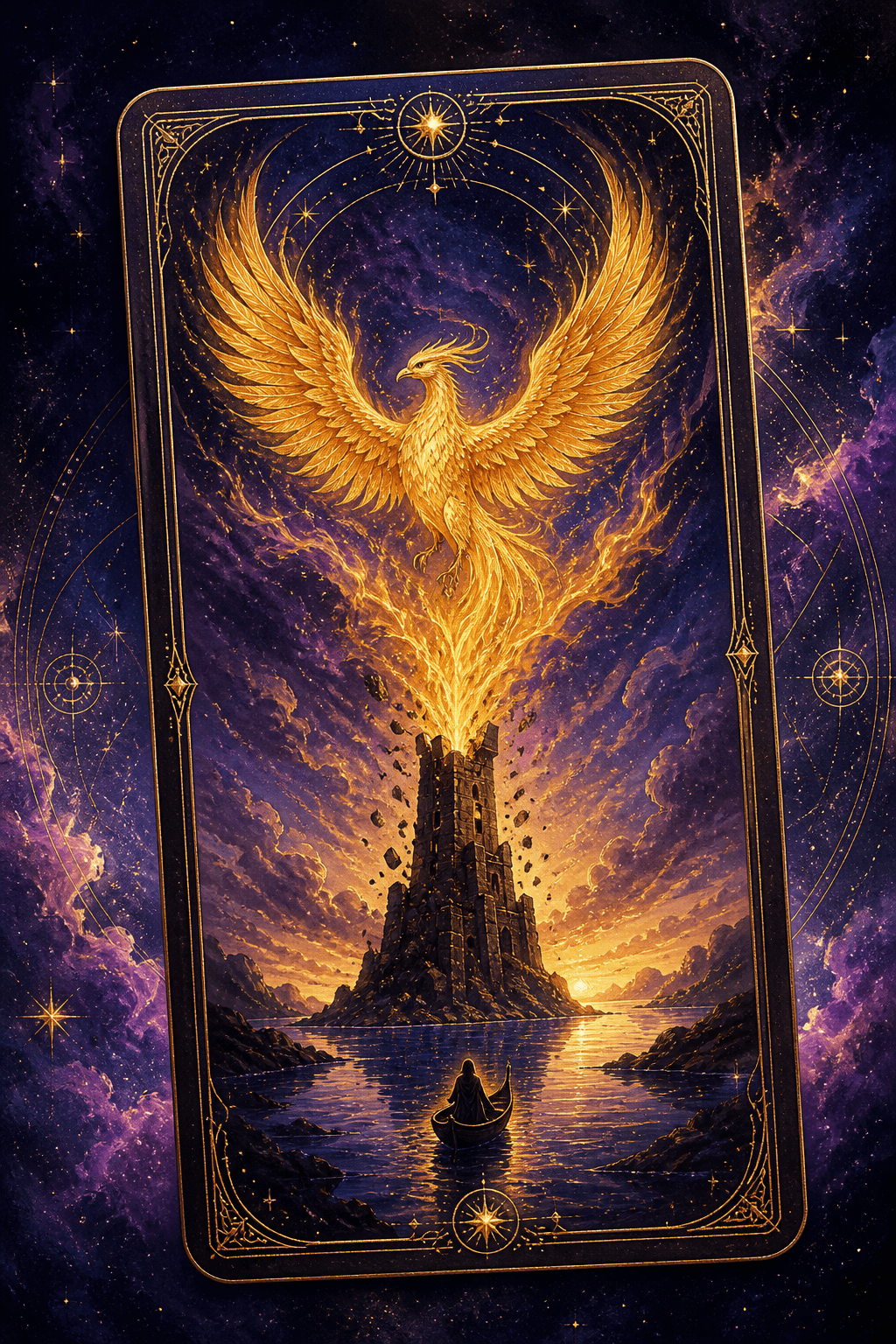
The Ultimate Guide to Tarot Cards for Change, Transition, and Rebirth
You do not turn to the tarot when your life is perfectly still. We shuffle the deck when the ground shifts. A career path abruptly ends, a decade-long relationship quietly hollows out, or a persistent, nameless restlessness settles into your chest. In these moments of upheaval, you are not looking for parlor tricks or vague reassurances. You need a map.
Welcome to the architecture of transition. This guide is built on a single, vital premise: the tarot does not view change as a mistake or a punishment. Instead, the seventy-eight cards treat transformation as the fundamental fabric of reality. When you lay a spread on the table, you are looking at a highly sophisticated, centuries-old blueprint of how human beings outgrow their old lives, survive the collapse of their certainties, and eventually rebuild on firmer ground.
If you have ever drawn the Death card or The Tower and felt your stomach drop, you are not alone. For too long, pop culture has hijacked the tarot's most potent symbols of change. Movies and television have reduced the skeletal rider and the lightning-struck fortress to cheap jump scares, convincing generations of readers that these archetypes are literal omens of doom. This guide strips away that superstitious dread. At Tarot & Balance, we treat the deck as a practical, psychological mirror. By looking closely at the genuine symbolism encoded in the Rider-Waite-Smith tradition—the white rose of purification, the falling crowns of the ego, the choppy waters of a difficult crossing—we reclaim these cards as tools for profound spiritual rebirth.
Whether you are a curious beginner or a seasoned practitioner refining your craft, this is your definitive resource for reading the cards during times of crisis. We will examine the distinct tempos of transformation, contrasting the quiet, evolutionary agency of the Six of Swords with the sudden, revolutionary shocks delivered by The Tower. You will learn how the Death card operates not as a final curtain, but as the natural law of compost and renewal. Along the way, we will explore how to externalize your struggles using these ancient archetypes, relieving the heavy, modern burden of treating every unexpected setback as a personal failure.
Finally, we will look at how these cards interact with the wider deck, synthesizing these heavy-hitters into practical alchemy so you can design your own spreads for radical transition. Change is rarely comfortable, but it does have a structure. The storm is already here. Let us learn how to read the weather.
The Architecture of Transition: How Tarot Maps Human Change
Change is rarely a single, smooth motion. It is a messy, multi-layered experience that behaves more like weather than a straight highway. Sometimes it arrives as a slow, gray drizzle that forces you to pack your bags and seek shelter elsewhere; other times, it is a sudden bolt of lightning that splits your life down the middle before you can even reach for an umbrella.
In the language of the tarot, these experiences are not treated as random disruptions to an otherwise orderly life. Instead, the cards treat change as the fundamental fabric of reality. When you sit down for a tarot reading, the seventy-eight cards do not simply tell you what will happen; they provide an anatomical map of how we grow, stall, collapse, and rebuild. By studying this map, we can begin to see our personal upheavals not as chaotic disasters, but as recognizable phases in a larger, predictable cycle of human development.
The Two Tempos of Transformation: Evolutionary vs. Revolutionary Change
To understand how tarot handles transition, we must first look at the two distinct speeds at which human lives alter: the evolutionary and the revolutionary. The cards capture this distinction with striking visual clarity.
Consider the Six of Swords. This card depicts a quiet, solemn scene: a ferryman rows a hooded figure and a small child across a body of water toward a distant shore. Six swords are thrust vertically into the boat, acting as a physical barrier between the passengers and their past. The water on one side of the boat is rippled and choppy, while the water ahead is smooth.
This is the archetype of evolutionary change. It is gradual, deliberate, and deeply organic. It represents the quiet decisions we make to walk away from situations that no longer serve us. The transition is not painless—the heavy swords in the boat suggest we carry our grief and baggage with us—but it is orderly. It is the slow process of moving from a turbulent mental state to a calmer one. It requires patience, endurance, and the willingness to endure a cold, gray middle ground while we wait for the new shore to appear.
Now, contrast this with The Tower.
Here, there is no boat, no slow rowing, and no quiet transition. Instead, a black stone tower built on a high crag is struck by a jagged bolt of lightning. The golden crown that served as its roof is blasted clean off, and two figures plunge headfirst into the dark void below. Flames pour from the windows.
This is revolutionary change. It is the sudden, catastrophic collapse of a structure—be it a relationship, a belief system, or a career—that was built on a false or fragile foundation. The Tower does not ask for your permission. It does not wait until you are packed and ready. It simply occurs, stripping away illusions in a single, violent stroke.
While the Six of Swords represents the changes we choose to make through quiet agency, The Tower represents the changes that are made for us when we refuse to move on our own. When these two cards appear together in a reading, they describe a profound shift. They suggest that a period of slow, effortful transition (Six of Swords) is either being catalyzed by, or is the direct result of, a sudden structural collapse (The Tower). The quiet rowing is often what we must do after the lightning has struck and the dust has settled.
                  TEMPOS OF CHANGE

   Evolutionary                     Revolutionary
  [Six of Swords]                    [The Tower]
        │                                 │
  • Slow, deliberate                • Sudden, disruptive
  • Conscious agency                • External catalyst
  • Carrying old grief              • Stripping away illusion
  • Smooth waters ahead             • Complete foundation rebuild
The Fool’s Journey as a Psychological Blueprint
When we first learn cards, we are introduced to the Major Arcana as a sequence of twenty-two steps known as "The Fool’s Journey." This sequence is far more than a quaint narrative; it is a highly sophisticated model of psychological development.
In this journey, change is not presented as an error or a detour from the path. It is the path itself. The sequence of the Major Arcana suggests that the human ego must go through specific, inevitable structural phases to reach wholeness.
We begin as The Fool (0), representing pure, unformed potential. We build an ego through the early cards—learning boundaries from the Emperor, social structures from the Hierophant, and love from the Lovers. But a well-functioning ego is not the end goal of life. If we remain locked in our early successes, we grow rigid.
Thus, the middle section of the Major Arcana introduces the deep, unsettling work of inner transition. We encounter Death (13), which is not a physical end but the archetype of natural pruning. Just as a forest requires fire to clear away dead undergrowth so new seeds can germinate, the psyche requires the death of old identities.
Immediately following Death comes Temperance (14), a card of slow chemistry, where we learn to balance the disparate parts of ourselves. But this balance is soon tested by The Devil (15), which reveals our shadow side—our addictions, unhealthy attachments, and the chains we forge ourselves.
It is only after we confront these deep-seated attachments that The Tower (16) appears. Psychologically, the Tower is the necessary destruction of the false self. If we did not have the Tower, we would remain forever trapped in the chains of the Devil. The collapse of our illusions is painful, but it is the only event that can clear the sky to reveal The Star (17)—the archetype of hope, raw vulnerability, and genuine spiritual healing.
When you look at this sequence, a vital truth emerges: you cannot reach the healing light of the Star without first going through the structural collapse of the Tower. The tarot positions crisis not as a sign that you have done something wrong, but as a structural necessity for the next stage of your growth.
Externalizing the Crisis: Archetypes and the Myth of Personal Failure
One of the heaviest burdens of modern life is the belief that we are entirely responsible for every setback we experience. If a business fails, if a long-term relationship dissolves, or if we find ourselves in the grip of a mid-life identity crisis, we tend to view it as a moral or personal failure. We tell ourselves that if we had been smarter, stronger, or more resilient, we could have prevented the collapse.
This is where the archetypal nature of the tarot provides profound relief.
By representing transition through ancient, universal symbols, the cards allow us to externalize our internal crises. When you draw The Tower or Death during a period of upheaval, the cards shift the perspective. They take the raw, chaotic pain of your situation and place it within a historic, human context.
The imagery on these cards is deliberately democratic. On the Rider-Waite-Smith Death card, the skeletal rider trampling over a field spares no one: a king lies dead beneath his horse’s hooves, a young woman averts her eyes, a child offers flowers, and a bishop stands in plea. The message is clear: endings are an impartial law of nature. They do not care about your status, your goodness, or your efforts.
Similarly, the falling figures on The Tower wear crowns and fine clothing. Their sudden fall is not a punishment for being bad people; it is the natural consequence of building a structure on a cliffside with poor foundations.
By seeing these cards on the table, you are reminded that ruin is not a personal defect. It is a universal human archetype. The collapse of your current situation is not a sign that you are uniquely broken; it is simply your turn to experience the Tower. This shift in perspective removes the paralyzing shame of failure, freeing up the psychological energy you need to actually navigate the transition.
Agency and Timing: Navigating the Wheel
A central tension in any spiritual practice is the relationship between personal agency (what we can control) and cosmic timing (what we cannot). Tarot maps this tension beautifully, showing us where to push and where to yield.
At the center of this dynamic is The Wheel of Fortune (10). The Wheel represents the cyclical nature of time and circumstance. The creatures clinging to the wheel are in constant motion: some are rising, some are at the top, and some are being carried down to the bottom. The Wheel reminds us that there are tides in human affairs that we did not set in motion and cannot stop.
But how do we act when these tides turn?
A classic dilemma arises when we look at difficult card combinations. For example, a spread containing the Six of Swords reversed, Death, and The Tower is often viewed by beginners on tarot forums as a sign of unmitigated doom. They see the three most disruptive cards in the deck and assume their life is over.
       [Six of Swords Reversed]  +  [Death]  +  [The Tower]
                  │                    │             │
           Refusing to move     Natural decay     Forceful collapse
In reality, this combination is a masterclass in the relationship between agency and timing.
The Six of Swords reversed indicates a resistance to moving on. It is the image of someone sitting in a leaking boat, clinging to a rotten dock, refusing to row toward the new shore because they are afraid of the deep water.
Death represents the natural, inevitable decay of that old shore. The situation is already dead; the relationship is over, the job has run its course, the belief system is dry.
When you refuse to row away from a dead situation (Six of Swords reversed) despite the natural laws of ending (Death), the universe eventually intervenes to do the work for you. That intervention is The Tower. The lightning strike of the Tower is simply the explosive release of tension built up by your own resistance to change.
This combination isn't "doom." It is a diagnostic warning. It tells you that if you do not consciously choose to row away from what is already dead, the structure will be taken down for you, and the fall will be far more painful. The cards are not predicting an unavoidable tragedy; they are showing you the exact point where your agency can prevent a crisis from becoming a catastrophe. By turning the Six of Swords upright—by accepting the heavy, quiet necessity of moving on—you can bypass the violent lightning of the Tower entirely.
Ultimately, the tarot does not promise a life free of storms. Instead, it offers a sturdy boat, a clear set of coordinates, and the quiet reassurance that every storm, no matter how fierce, eventually runs out of rain.
The Death Card: Dismantling the Myth of Mortified Ends
No card in the tarot deck carries a heavier burden of cultural anxiety than Card XIII. In cinema and television, pulling the Death card is an easy, shorthand device to signal physical doom, a curse, or an impending tragedy. The camera zooms in on the skeletal face, the dramatic music swells, and the querent trembles.
But this pop-culture dread is built on a fundamental misunderstanding of both historical tarot and human psychology. In early Italian decks, such as the Visconti-Sforza, the card was often left unnamed, represented only by a skeletal figure holding a bow or a scythe. It was a mirror of the medieval danse macabre—a reminder that death spares no one, from peasant to pope. It was not a prediction of a sudden, literal demise, but an acknowledgment of a universal law: all things that have a beginning must also have an end.
When Arthur Edward Waite and Pamela Colman Smith designed their deck in 1909, they sought to move away from mere medieval terror. They infused the card with symbols of spiritual evolution and cyclic renewal. To understand the Death card in a modern tarot reading, we must first dismantle the myth of the mortified end and look closely at what is actually happening on the canvas of Card XIII.
       [ The RWS Death Imagery ]

            Black Banner
          (White Tudor Rose)
                 |
         [Skeletal Rider] ---> (Riding a White Horse)
                 |
      +----------+----------+
      |          |          |
   [King]     [Bishop]   [Child]
  (Fallen)   (Pleading) (Accepting)
                 |
          [Twin Towers]
                 |
            [Rising Sun]
The Skeleton, the Sun, and the White Rose
If you look at the Rider-Waite-Smith (RWS) image, the first thing that strikes you is the skeletal rider. He is not a ragged grim reaper lurking in the dark; he is a knight in polished black armor, riding a slow, deliberate white horse. The armor is defensive, representing the cold, unyielding nature of change—it cannot be wounded, negotiated with, or bribed.
Yet, the horse is white, the color of purity, clarity, and new beginnings. This is not a beast of war, but a mount of state. The rider does not carry a scythe to cut down the living; instead, he holds a black banner emblazoned with a white five-petaled rose. This rose is a crucial key to the card’s deeper meaning. In western esoteric traditions, the five-petaled rose (often associated with the Tudor rose or the Rosicrucian seal) represents purification, beauty, and the light that emerges after dark times. It is a symbol of life force in its most refined state.
In the background of the card, we see a river—reminiscent of the River Styx, the boundary between the known world and the underworld. On the water floats a small boat, a quiet nod to the passage of souls and the journeys we must take when we leave one shore for another, much like the quiet crossing found in the Six of Swords.
But the most telling detail lies on the far horizon. Nestled between two distant stone towers is a rising sun. These towers are the same gates we see in The Moon and Death’s sister card, The Sun. The light between them is not the fiery glare of midday, but the soft, golden promise of dawn. The message of the landscape is clear: the darkness of the rider’s arrival is temporary. The sun is already climbing back into the sky, proving that every ending is structurally linked to a new beginning. If you wish to understand the broader architecture of these transitions, you can explore the meanings of the Major Arcana further at our guide to learning the cards.
The Law of the Soil: Death as Compost
To make peace with Card XIII, it helps to step out of human psychology for a moment and look at the natural world. If you walk into an old-growth forest, you will find the ground carpeted with fallen pine needles, rotting logs, and decaying leaves. To a child, this might look like a graveyard. To a biologist, it is a bustling laboratory of life.
Without this decay, the forest would choke on its own growth. The nutrients locked inside the dead wood would remain trapped, unavailable to the seeds waiting in the soil. The forest floor is a giant compost pile. It takes what has run its course, breaks it down, and turns it into fertile dark earth.
This is the organic law of the Death card: it represents the natural release of what has reached its natural terminus.
[ Active Life ] ---> [ Natural Terminus ] ---> [ Decay & Compost ] ---> [ New Growth ]
When Death appears, it indicates that a project, an attitude, a lifestyle, or a relationship has run out of vital energy. It has given everything it had to give. Trying to keep it alive is like trying to tape dead leaves back onto a tree branch in November. It looks unnatural, it requires immense effort, and it ultimately prevents the tree from growing new buds in the spring.
Unlike the sudden, violent collapse of the Tower—which represents structures built on false pretenses being torn down by external force—Death is quiet, systematic, and inevitable. It is the autumn of the soul. It is the slow, necessary letting go of what no longer serves the living organism.
King, Bishop, and Child: The Hierarchy of Surrender
At the feet of the white horse stand four figures, each representing a different aspect of human consciousness and how we respond to the inevitability of change.
+------------+-------------------------+----------------------------------+
| Figure     | Primary Representation  | Typical Reaction to Change       |
+------------+-------------------------+----------------------------------+
| The King   | Ego, worldly power      | Total collapse; crushed by force |
| The Bishop | Dogma, intellectualism  | Bargaining; trying to negotiate  |
| The Maiden | Emotion, sensitivity    | Grief; turning away in sorrow    |
| The Child  | Innocence, trust        | Curiosity; open-eyed acceptance   |
+------------+-------------------------+----------------------------------+
First, we see the King. He lies dead on the ground, his gold crown rolled away into the dirt. The King represents the ego, worldly power, and the illusion of absolute control. He spent his life building a kingdom, thinking his status would protect him from the laws of nature. His fall is absolute. When we resist change by relying on our titles, our wealth, or our social standing, we act like the King. We are crushed because we refuse to bend.
Next is the Bishop, clad in rich yellow vestments, his hands clasped in prayer. He stands his ground, trying to negotiate with the rider. The Bishop represents dogma, intellectualism, and spiritual bargaining. When we face a major ending and try to rationalise it, make deals with the universe, or use our moral superiority to keep things from changing, we are the Bishop. He hopes his piety will buy him an exemption, but the horse moves forward regardless.
Beside him is a young maiden, who has collapsed in grief. She turns her face away from the rider, unable to look directly at the end of her world. She represents our emotional nature, our sensitivity, and our natural grief. She cannot stop the transition, but her reaction is honest. She mourns what is lost, which is a necessary step before she can move toward the rising sun.
Finally, there is the child. Clad in simple clothing, the child does not run, fight, or weep. Instead, he looks up at the skeletal rider with a quiet, open-eyed curiosity. He offers a simple flower. The child represents innocence and the part of us that has not yet been conditioned to fear the dark. He does not have an ego to defend like the King, nor a dogma to protect like the Bishop. He understands, with the intuitive wisdom of youth, that this giant on the white horse is simply part of the game of life.
When you see Death in a reading, ask yourself: Which of these four figures am I channelings? Are you the King, fighting to keep a crown that has already fallen? Are you the Bishop, trying to argue your way out of the inevitable? Or can you find the grace of the child, who accepts that the old day must end so the new one can begin?
Reading Death in the Real World
In practical readings, the Death card is rarely a cause for alarm. Instead, it is an invitation to perform a psychological audit. It asks us to identify what is dead in our lives and to let go of the corpse. Whether you are using a simple yes-or-no layout or a complex ten-card spread, its appearance marks a clean break between the past and the future.
In Career and Finance
When Death appears in a career reading, it often signals the end of a professional era. This is not necessarily a layoff or a bankruptcy (though it can be), but rather the death of your enthusiasm for a particular path.
- The Stagnant Plateau: You may have reached the absolute limit of growth in your current role. The work feels dry, repetitive, and empty. Death tells you that trying to revive this dead job is a waste of your energy. It is time to let the role go, update your resume, and step into the unknown.
- Sunsetting Projects: If you are a business owner, Death suggests that a specific product line, partnership, or business model has run its course. It is time to wind it down cleanly rather than throwing good money after bad.
- Reversed: If the card appears reversed, it indicates a stubborn resistance to professional change. You may be staying in a toxic work environment because you fear the temporary discomfort of unemployment or transition.
In Relationships
In matters of the heart, the Death card can be intimidating, but its medicine is highly effective.
- The End of a Cycle: Sometimes, Death does mean a relationship has reached its natural terminus. The love has dried up, the lessons have been integrated, and staying together serves only to breed resentment. It calls for a clean, respectful parting of ways—allowing both partners to compost the experience and grow elsewhere.
- The Death of a Pattern: More often, the card does not signify the end of the relationship itself, but the end of a dynamic within it. For example, a couple might need to let go of an codependent pattern, an old grudge, or an outdated way of communicating. The old relationship must die so a healthier, more mature partnership can be born from the ashes.
- Reversed: A reversed Death card in a relationship reading is a classic sign of "holding on to a ghost." It represents two people who are staying together out of habit, fear of loneliness, or social pressure, long after the emotional connection has flatlined.
In Identity and Spiritual Shifts
The most profound applications of the Death card occur in readings focused on personal development and identity.
- Shedding the Persona: Throughout our lives, we build personas to navigate the world. We might be "the smart one," "the caretaker," "the rebel," or "the victim." Death arrives to tell us that we have outgrown these masks. The old self-image is cracking.
- The Liminal Space: This transition is rarely comfortable. When you shed an old identity, there is a period of time when you do not yet know who you are. You are in the dark space between the towers, waiting for the sun to rise. Death encourages you to sit in this liminal space without rushing to fill it with noise. Let the old skin fall away completely before you try to grow a new one.
When Card XIII rides into your reading, take a deep breath. Look past the armor and the bones, and focus on the white rose on the banner. The rider has not come to destroy you; he has come to clear the path. He is the quiet gardener of the soul, cutting away the dead wood so that when the spring sun rises between those distant towers, you will have the room to bloom.
The Tower: Deconstructing False Foundations and the Grace of Collapse
Few cards in the tarot deck elicit as visceral a reaction as Card 16 of the Major Arcana. In a tarot reading, when the image of a black stone fortress split by jagged lightning appears, the atmosphere in the room often shifts. There is an instinctive tightening in the chest, a quiet holding of the breath. We are creatures of habit, built to seek stability, and the Tower represents the absolute disruption of that stability.
Yet, to understand the Tower is to understand that some structures are built on foundations so compromised that preservation is a form of slow harm. This card does not represent random, malicious cruelty; it represents the sudden, uncompromising arrival of truth. It is the moment the universe refuses to let you live a lie any longer. When the Tower appears, the question is not how to save the building, but how to stand in the rubble with your eyes open, ready to rebuild on solid ground.
                  THE TOWER (XVI)
               ---------------------
              |       \  |  /       |  <- Lightning (Divine Intervention)
              |        \ | /        |
              |       ---*---       |
              |      /   |   \      |
              |     /    |    \     |
              |        [___]        |  <- Struck Crown (Ego/Pride)
              |         | |         |
              |       .-' '-.       |
              |      /       \      |
              |     |  _ _ _  |     |  <- Burning Stone Tower
              |     | |_|_|_| |     |     (False Foundations)
              |     | |_|_|_| |     |
              |  o  |         |  o  |
              | / \ |  o   o  | / \ |  <- Falling Figures
              | L_j | / \ / \ | L_j |     (Democratization of Crisis)
              |     | L_j L_j |     |
               ---------------------
The Anatomy of the Lightning Strike: Decoding the Symbolism
To comprehend the sheer kinetic energy of the Tower, we must look closely at its classical iconography, most famously rendered by Pamela Colman Smith in the Rider-Waite-Smith deck. The card presents a stark, violent scene set against a pitch-black sky. This darkness is not merely atmospheric; it represents the unconscious state, the fog of denial we inhabit before the strike occurs.
The Crown Struck by Lightning
At the apex of the stone tower sits a golden crown. In tarot symbolism, the crown represents the sovereign intellect, the ego-self, and the systems of authority we build to keep ourselves elevated above the earth. The lightning bolt does not strike the base of the tower; it strikes the crown directly, popping it clean off the battlements. This is a deliberate symbolic act. The lightning represents a flash of sudden, absolute insight—often associated with the martial, severing force of the planet Mars, which rules this card. Mars brings iron, fire, and the courage to cut away what is dead. When the lightning strikes the crown, it signifies the destruction of intellectual pride and the illusion that we can control our lives through sheer willpower or social status.
The Plummeting Figures
Two figures fall headfirst from the burning heights. One wears a crown; the other is dressed in simpler garments. This detail carries profound weight: gravity does not care about your tax bracket or your spiritual credentials. When a systemic collapse occurs, the hierarchies we spent lifetimes constructing are instantly neutralized. The figures fall headfirst, a posture of absolute vulnerability and disorientation. They are forced from their lofty heights back down to the earth, the very ground they sought to distance themselves from.
The Flames and the Yodhs
Fire pours from the windows of the three-story structure. The three windows represent the mental, emotional, and physical chambers of human experience; none are spared from the heat. Yet, suspended in the dark air around the tower are twenty-two golden sparks, shaped like the Hebrew letter Yodh. These sparks represent the twenty-two cards of the Major Arcana, the complete spectrum of human consciousness. Even in the midst of ruin, these droplets of light remind us that grace is present. The fire is not merely destructive; it is purifying. It burns away the dry rot, leaving behind only that which cannot be consumed by flame: your essential self.
The Architecture of the Self: Ego Defenses and the Tower’s Necessity
From a psychological perspective, we are all architects. From early childhood, we build internal fortresses to protect our softest, most vulnerable parts from the harsh realities of the world. Psychologists call these fortresses "ego-defense mechanisms." We use denial, rationalization, projection, and compartmentalization to keep our anxieties at bay.
We build towers out of:
- Compromised Relationships: Staying in a partnership that has long since soured because the prospect of being alone is too terrifying.
- Prestigious Careers: Pouring sixty hours a week into a job that hollows us out, because the title on our business card shields us from feelings of inadequacy.
- Outgrown Belief Systems: Holding onto rigid religious, political, or personal dogmas because admitting we were wrong feels like a death of the self.
These defense structures work—until they don't. The tragedy of human psychology is that we often mistake our prisons for our sanctuaries. We lock ourselves in the high tower, pull up the drawbridge, and call it safety.
[ The Ego-Defense Tower ]
  ├── Battlements of Denial
  ├── Walls of Rationalization
  └── Foundation of Compromised Truths
            ▲
            │ (The Lightning Strike: Truth/Reality)
            ▼
[ The Rubble of Liberation ]
  └── The Ground of Authentic Reality
The Tower represents the moment when reality breaks through these defenses. It is the sudden confrontation with an undeniable truth that makes it impossible to continue living as you did before. If you have been ignoring the signs of an unfaithful partner, the Tower is the forgotten text message left open on the counter. If you have been ignoring your physical health for years, the Tower is the sudden medical diagnosis that forces you to change your life overnight.
This disruption feels violent because the ego identifies with the structure. When the walls crumble, the ego feels like it is dying. But you are not the stone walls. You are the occupant of the tower, and the collapse of the building is often the only way you will ever walk out into the open air.
Sudden Shock vs. Quiet Shift: The Tower Among Its Neighbors
To truly understand how the Tower functions in the narrative of human transformation, we must contrast it with the cards that surround it in the Major Arcana and the wider deck. It is easy to confuse the Tower with other cards of transition, but its mechanism of change is entirely distinct.
| Card | Nature of Transition | Source of Impetus | Emotional Quality |
|---|---|---|---|
| The Death Card (XIII) | Gradual, organic decay; composting; the natural end of a cycle. | Internal/Universal law | Melancholic, quiet, accepting |
| The Tower (XVI) | Sudden, violent rupture; structural failure; immediate dismantling. | External/Sudden revelation | Shocking, chaotic, urgent |
| The Six of Swords | Deliberate, conscious departure; moving toward calmer waters. | Personal agency | Somber, weary, hopeful |
The Tower vs. Death
As we explored in our section on The Death Card, Death is an organic, seasonal process. It is the autumn leaves falling to the forest floor to become rich soil for the spring. Death is quiet, predictable, and necessary. You usually see Death coming from a mile away, even if you try to look away.
The Tower, by contrast, is a sudden explosion. It is not a leaf falling; it is the tree being split in half by a lightning strike in mid-summer. Death is about composting; the Tower is about demolition. When the Tower appears, there is no time for a long, melancholic goodbye. You must move, and you must move now.
The Tower and the Six of Swords
The contrast is even more pronounced when we look at the Six of Swords. In that card, a quiet ferryman rows a mother and child across gray waters toward a distant shore. It is a transition characterized by agency, planning, and quiet grief.
If you are trying to understand a complex layout, perhaps using techniques from our guide to learn-spreads, seeing these two cards together is highly instructive. For example, a combination like the Six of Swords reversed + Death + The Tower is often feared as a sign of absolute doom in online forums, but the reality is far more nuanced.
This combination suggests a profound resistance to a necessary transition (Six of Swords reversed), which forces the universe to escalate the situation from a quiet, natural ending (Death) to an unavoidable, sudden collapse (The Tower). It is the psychic equivalent of refusing to pack your bags until the landlord literally boards up the windows. The Tower only needs to be violent when our resistance to change is absolute.
Finding the Liberating Truth in the Rubble
When the Tower falls, the immediate aftermath is characterized by a ringing silence. The dust is still settling, the air smells of soot, and the old landmarks you used to navigate your life are gone. It is a moment of profound disorientation.
But if you look closely at the ground beneath your feet, you will find that the Tower has given you a rare and precious gift: the gift of clarity.
When a structure collapses, it reveals two things:
- What was weak: You see exactly where the mortar was dry, where the stone was cracked, and where you tried to build on sand. You learn where you compromised your integrity.
- What is indestructible: You see what remains standing. The bedrock remains. Your core resilience, your fundamental worth, and your capacity to breathe and heal are still there.
How to Work with the Tower in a Reading
If you pull the Tower in a personal reading, or when exploring a quick question through a yes-or-no query, do not panic. Use these three principles to navigate the energy:
- Stop Trying to Hold Up the Ceiling: If a relationship, a project, or an identity is collapsing, let it go. Trying to hold up falling stones will only get you hurt. Step out of the way and let the gravity of the situation do its work.
- Acknowledge the Relief: Beneath the grief of a Tower moment, there is almost always a quiet, whispering sense of relief. You no longer have to carry the heavy weight of maintaining a lie. You no longer have to pretend.
- Salvage the Good Stones: Not every stone in the old tower was bad. Some were beautiful, strong, and honest. As you sift through the rubble, save the lessons, the genuine moments of love, and the skills you acquired. You will need them to build your next home—one that is closer to the ground, with wider windows and doors that open to the world.
The Tower is not the end of the journey. In the sequence of the Major Arcana, it is immediately followed by Card 17, the Star. The Star represents hope, quiet healing, and the soft light of a new dawn. But you cannot see the Star if you are locked inside a dark stone fortress. The Tower must fall so that the starlight can finally reach your face.
The Six of Swords: Quietly Crossing to the Far Shore
If the Death card is the clearing of the field and the Tower is the sudden, violent shattering of the house, the Six of Swords is the quiet morning that follows. It is the card of the packing of bags, the damp wool of a coat in the early mist, and the long, silent row toward a shore you cannot yet see.
In the geography of human transition, we often crave the clean, dramatic breaks. We want the lightning bolt of clarity or the absolute finality of a door shutting. But most human change does not happen in the flash of a moment; it happens in the long, gray interval between leaving and arriving. This is the liminal space of the Six of Swords. It represents the quiet, sometimes agonizing work of survival—the realization that while the worst is behind you, the destination is still miles away across cold water.
To understand this card is to understand that healing is rarely a triumphant march. More often, it is a slow, methodical rowing through the shallows, carrying exactly what you have left, even when what you have left feels incredibly heavy.
The Anatomy of the Gray River: Pamela Colman Smith’s Silent Voyage
To fully grasp the psychological landscape of the Six of Swords, we must look closely at the imagery created by artist Pamela Colman Smith in the Rider-Waite-Smith deck. Every element of this illustration speaks to the physical and emotional weight of a transition in progress.
                  [ The Distant Shore: Calm, Flat Water ]
                                    ^
                                    |
                         [ The Six Swords ]
                  (Planted upright, forming a screen)
                                    ^
                                    |
  [ Shrouded Woman & Child ] <==============> [ The Ferryman ]
   (Passive, seated, looking down)            (Active labor, poling forward)
                                    ^
                                    |
                 [ The Near Shore: Choppy, Ripped Water ]
The composition is dominated by a small, shallow-draft boat moving from the right side of the card toward the left. In the boat sit three figures: a ferryman seen from behind, a cloaked woman whose head is bowed in a posture of grief or exhaustion, and a small child huddled beside her.
The first detail that demands our attention is the water itself. Beneath the stern of the boat, on the right, the water is drawn with jagged, concentric lines—rippled, turbulent, and unsettled. This is the water of the past. It represents the conflict, the noise, and the emotional storms of the Five of Swords that the travelers are leaving behind. But look ahead to the bow of the boat on the left. The water there is depicted as perfectly flat, a smooth sheet of silver.
This contrast is not accidental. The card does not promise immediate joy or abundance; it promises calm. It tells us that the immediate threat of shipwreck has passed. The air is no longer screaming. The water is no longer fighting the hull.
Then, there are the swords. Six of them stand upright, planted directly into the wood of the boat's floor. They form a physical barrier between the passengers and the far shore. This is a strange, counterintuitive way to carry weapons. If the boat were to hit a rough patch, these upright blades could easily fall or injure the passengers.
Yet, there they stand, acting as a screen. Notice that the passengers cannot see what lies ahead of them; their view of the future is literally blocked by the swords of their past. They must trust the ferryman to guide them, because their own vision is obscured by the very things they are carrying.
Finally, consider the ferryman. Unlike the passengers, who are passive and wrapped in their thoughts, the ferryman is engaged in active, physical labor. He holds a long pole, pushing against the muddy bottom of the river or lake. This is not a sailing vessel that relies on the wind of inspiration or luck.
This is a boat that moves through human effort alone. Poling a boat is slow, back-breaking work. It requires leverage, repetition, and patience. The presence of the ferryman reminds us that getting through a transition is a craft. It requires us to show up for the dull, repetitive logistics of moving forward, day after day, even when the spirit is weary.
The Slough of Despond: Carrying the Swords of the Past
There is a distinct literary echo in the Six of Swords that connects to John Bunyan’s 1678 allegory, The Pilgrim’s Progress. Early in his journey, the protagonist, Christian, falls into the "Slough of Despond"—a deep, boggy swamp where all the doubts, fears, and heavy thoughts of his past life accumulate. He sinks because of the heavy burden on his back.
In the Six of Swords, we see a visual representation of this same psychological weight. The six swords are not being left behind on the shore of the conflict; they are in the boat with us.
In tarot, the suit of Swords represents the intellect, communication, belief systems, and the mental constructs we build to understand our world. When we experience a betrayal, a loss, or a major life upheaval, we do not simply walk away clean. We carry the mental consequences. These swords represent:
- The lingering beliefs we hold about why things went wrong.
- The protective skepticism we adopt to prevent ourselves from being hurt again.
- The silent grief of what we had to abandon.
- The hard-won lessons that we are not yet ready to celebrate, but cannot afford to forget.
It is tempting to look at this card and wish the passengers would simply throw the swords overboard. Wouldn't the boat be lighter? Wouldn't the journey be faster?
But the card suggests a deeper, more compassionate truth about human psychology: we cannot always drop our burdens immediately. Sometimes, those swords are the very things keeping us structurally sound. They are the frameworks of our survival. If we pull them out of the hull too quickly, we might open up holes in the floorboards and sink the boat.
When you are in a period of transition, you do not have to be fully healed to move forward. You do not have to have "let go" of everything to reach the other side. The Six of Swords is a profound validation of the passenger who travels with their grief packed tightly beside them. It says: Bring your heavy thoughts. Bring your scars. Bring your protective armor. Just keep moving toward the calm water.
Flight versus Pilgrimage: The Crucial Turn Toward Healing
There is a vital distinction in tarot practice between running away from something and moving toward something else. When people seek a tarot reading during times of crisis, they are often desperate to escape their current circumstances. They want a quick exit.
In the minor arcana, we see different types of departure. The Eight of Cups, for example, is a card of walking away into the mountains at night—an emotional, instinctual abandonment of what no longer feeds the soul. The Three of Swords is the sharp shock of heartbreak.
The Six of Swords, however, is a conscious relocation. It is the transition from flight to pilgrimage.
| Aspect | Flight (Running Away) | Pilgrimage (Six of Swords) |
|---|---|---|
| Primary Driver | Panic, avoidance, and fear of the present. | Acceptance of necessity and commitment to the future. |
| Speed | Fast, chaotic, and unplotted. | Slow, deliberate, and paced. |
| Mental State | Reacting to the threat behind you. | Focusing on the quiet shore ahead. |
| Baggage | Denied, ignored, or dropped in haste. | Carried consciously, understood as part of the price of admission. |
When we are in flight, we are still tethered to our tormentors because our entire focus is on running from them. We are reactive.
But when we enter the energy of the Six of Swords, we make a quiet pact with ourselves. We acknowledge that the old life is over, the battle is done, and the only constructive thing left to do is to build a new one on the far shore. We stop looking back at the smoking ruins. We turn our faces toward the gray horizon.
This is often the card that appears when someone finally decides to leave a toxic relationship, close a failing business, or relocate to a new city after a period of intense grief. It is rarely accompanied by cheering crowds. Often, it is a very lonely card. Friends might wonder why you aren't happier now that the crisis is over.
But you know the truth: you are still on the water. You are still doing the quiet work of processing. To explore how this card operates in more binary situations of decision-making, practitioners often look to a yes or no tarot framework, where the Six of Swords typically suggests a gentle "yes, but only through patience, planning, and a willingness to leave things behind."
The Silent Labor of the Middle Passage
The most difficult part of any transition is the middle.
We love beginnings because they are full of hope and potential. We love endings because they offer closure and resolution. But the middle is formless. It is the long stretch of highway where the old radio station has faded out and the new one hasn't yet started playing.
The Six of Swords is the patron archetype of this middle passage. It represents the mental labor of waiting. It is the realization that you cannot force the boat to move any faster than the pole can push it.
To work with this card in your own life—or to understand its placement when you learn cards in a spread—is to practice the art of surrender to the pace of recovery. You cannot rush the integration of grief. You cannot force yourself to trust people again before your nervous system has settled.
The ferryman does not thrash the water; he uses his weight, leans into the pole, and trusts the physics of the craft.
[ Active Crisis ] =======> [ The Liminal Space ] =======> [ The New Shore ]
  (Tower/Death)             (Six of Swords)              (New Foundations)
  *High energy*             *Low energy*                 *Stabilizing energy*
  *Shattering*              *Processing*                 *Rebuilding*
During this middle passage, the mental labor is quiet. It looks like sleep. It looks like long walks where nothing in particular happens. It looks like staring out the window of a train. To the outside world, you might look unproductive or stagnant. But internally, your mind is doing the heavy lifting of rewiring itself. It is adjusting to the absence of the old noise. It is learning what it feels like to live in calm water.
If you are currently in this space, the Six of Swords asks you to respect the quiet. You do not need to have a grand plan for when you land on the far shore. You do not need to know what you will build with the six swords you are carrying. For now, your only job is to stay in the boat, trust the slow glide of the hull, and let the distance grow between you and the storm.
The Anatomy of Resistance: When We Fight the Current
Transition is rarely a clean glide from one state of being to another. More often, it is a high-friction process of letting go, characterized by hesitancy, fear, and the quiet weight of things left unsaid. While the upright cards of the tarot outline the natural mechanics of change—the necessary endings of Death, the sudden clearings of the Tower, the quiet departures of the Six of Swords—the reversed cards and challenging combinations map our resistance to those very processes.
Resistance is not a moral failure or a lack of courage. It is a deeply human preservation instinct. We cling to what is broken because the broken thing is familiar, and the familiar offers an illusion of safety. When we look closely at how resistance manifests in a layout, we find a precise diagnostic map of where we are holding our breath, where we are refusing to look, and why we are standing in the wreckage of an old life trying to pretend the roof is still intact.
The Weight in the Boat: The Six of Swords Reversed
In its upright position, the Six of Swords represents a quiet, somatic shift. A boatman rows a huddled figure and a child across gray, still waters toward a distant shore. Six swords are thrust vertically into the hull of the boat. They do not puncture it; instead, they act as a protective barrier, keeping the passengers from looking back at the shoreline they have left behind. It is a card of silent acceptance, of packing up what remains and moving toward a quieter space.
       [ Upright ]                          [ Reversed ]
  Quiet movement forward              Paralysis and stagnation
  Leaving the troubled shore          Returning to the storm
  Swords as silent cargo              Swords as leaking wounds
When the Six of Swords is reversed, the physics of the card turn against the traveler. The quiet momentum of the journey stalls. Visually, if we imagine the card turned upside down, the swords no longer stand as a protective shield; they seem to hang precariously over the passengers, or worse, they threaten to slip and puncture the very floor of the vessel. The water, once calm and manageable, begins to slosh over the gunwales.
In a reading, the Six of Swords reversed points to a state of mental or situational paralysis. You are trying to move to a new phase of life, but you have brought the old atmosphere with you. It is the person who leaves a toxic workplace only to recreate the same frantic, self-sacrificing dynamics in their new job. It is the partner who ends a relationship but spends three hours a day monitoring their ex’s digital footprint.
The reversal indicates that while your body may be in the boat, your eyes are fixed firmly on the shore you just left. You are carrying unresolved emotional baggage that makes the boat too heavy to row. The drag is immense. You may find yourself returning to troubled waters, picking old arguments, or entertaining situations you know are detrimental to your peace, simply because the anxiety of the open water is more terrifying than the familiar misery of the storm.
The Sanctuary of Sorrow: The Eight of Cups Reversed and Six of Swords Reversed
When certain cards pair together in a reading, they create a psychological compound—a specific emotional state that is greater than the sum of its parts. One of the most profound descriptions of transition-resistance occurs when the Six of Swords reversed appears alongside the Eight of Cups reversed.
To understand this combination, we must look at the classic imagery of the Eight of Cups. In the upright position, a figure turns their back on eight carefully stacked cups. They walk away in the dead of night, clutching a staff, heading into barren, mountainous terrain. The cups are structurally sound, yet the figure leaves them because they realize that emotional fulfillment lies elsewhere. It is a conscious, active choice to abandon what is comfortable but ultimately dry.
+---------------------------+---------------------------+
|   Eight of Cups Reversed  |  Six of Swords Reversed   |
+---------------------------+---------------------------+
|  Refusing to walk away    |  Inability to move boat   |
|  Clinging to empty cups   |  Carrying old baggage     |
|  Fearing the dark path    |  Stuck in the gray water  |
+---------------------------+---------------------------+
When both of these cards appear reversed, they describe a profound reluctance to leave familiar grief.
There is a strange, quiet comfort in sorrow. When we have lived with disappointment, heartbreak, or frustration for long enough, those feelings become predictable. We know their dimensions. We know exactly how we will feel when we wake up, how we will react to criticism, and who we are in relation to our suffering. Our pain becomes our identity.
When the Eight of Cups reversed (the refusal to walk away from the empty cups) joins the Six of Swords reversed (the inability to row the boat to the far shore), the reader is caught in a self-made purgatory. You are standing before a life that no longer works, looking at the empty vessels of old expectations, and choosing to stay because the thought of stepping into the dark, moonlit mountains of the self is too intimidating.
This combination suggests that you are treating your grief not as a passage to be moved through, but as a dwelling to live in. It is a warning that you are choosing the safety of a slow, predictable decay over the terrifying vulnerability of starting over.
Clinging to the Rubble: Resisting Death and the Compromised Tower
There is an enormous, exhausting expenditure of energy required to keep a dead thing standing.
In the upright positions, both Death and The Tower represent forces of nature that are larger than the human ego. Death is the slow, seasonal sweep of the scythe, clearing the field of dry stalks so that new life has room to take root. The Tower is the sudden, violent intervention of reality—a lightning bolt that shatters a structure built on compromise, pride, or falsehoods. These cards do not ask for permission; they simply occur.
But when we fight these cards, we enter an artificial state of stasis that is incredibly draining.
Imagine a house that has been struck by lightning. The roof has caved in, the load-bearing walls are cracked, and the foundation is split. Instead of walking away to build anew, you stand in the center of the living room, holding up a collapsing ceiling beam with your bare hands. Your muscles are shaking, your breath is shallow, and your entire life has been reduced to the singular, agonizing task of preventing the inevitable from falling on your head.
This is what it looks like to resist the Tower. We do this when we stay in marriages that have long since lost their truth, or when we cling to careers that actively damage our health, convincing ourselves that if we just work harder, care more, or tolerate more pain, we can keep the ruined structure standing. It is a monument to stubbornness, built at the expense of our vitality.
       [ The Tower Upright ]               [ Resisting The Tower ]
  Sudden, necessary collapse            Holding up crumbling walls
  Clear, albeit painful, truth          Exhausting, artificial stasis
  Space created for rebuilding          Trapped in a half-ruined life
Similarly, trying to freeze-frame the Death card is like attempting to halt the autumn. We try to paint the dying leaves green; we pretend the cold air isn't coming. We refuse to mourn, we refuse to let go of old versions of ourselves, and we paste a smile over our exhaustion.
The energy required to maintain this denial is astronomical. It leaves us chronically tired, irritable, and disconnected from our actual lives. The tarot reminds us of a fundamental truth: the pain of the collapse is sharp, but it is finite. The pain of resisting the collapse is dull, chronic, and endless. By refusing to let the old structure fall, we deny ourselves the space to build anything new on the ground it occupies.
Redefining the Upside-Down: A Tactical Guide to Reversals
When you are learning how to read tarot cards or conducting a personal tarot reading, seeing a card fall upside down can feel like a setback. It is a common misconception that reversals are inherently negative—that they represent "bad luck," a reversal of fortune, or a double dose of doom. If the Tower upright is difficult, the logic goes, surely the Tower reversed must be catastrophic.
This is a flat, unhelpful way to approach the cards. Reversals are not threats; they are shifts in direction. They indicate that the energy of the card is behaving differently, often moving inward rather than outward, or experiencing a temporary block.
To read reversals with nuance and accuracy, you can apply three practical interpretive lenses:
1. Internalized Energy
An upright card usually describes external events, visible behaviors, or circumstances in your environment. A reversed card often indicates that this same energy is playing out entirely within your own psyche.
- Example: The upright Six of Swords is a physical move or a change in your external circumstances. The Six of Swords reversed is an internal transition. You may have already changed jobs or left the relationship externally, but internally, your mind is still doing the quiet, difficult work of moving across the water. The resistance is happening in your thoughts, not your life.
2. The Blocked or Diverted Flow
Think of an upright card as a clear channel where water flows freely. A reversal is a boulder dropped into that channel. The water is still there, and it still wants to move, but it is being forced to find a workaround or is pooling behind the obstruction.
- Example: If you receive the Eight of Cups reversed, the desire to leave what is unfulfilling is still present. The reversal is simply pointing to the dam. It invites you to ask: What is the specific fear that is blocking me from walking away? Is it financial anxiety? Is it a fear of loneliness? The card isn't telling you that you can't leave; it is showing you what you must address before you can.
3. Excess or Deficit
Sometimes, a reversal indicates that the energy of the card is being expressed in an unhealthy volume—either far too much or not nearly enough.
- Example: The Death card upright is a natural transition. Reversed, it can represent an unhealthy obsession with endings (cutting things off too quickly before they have a chance to mature) or a total deficit of ending energy (clinging to dead situations long past their expiration date).
By treating reversals as diagnostic tools rather than bad omens, you take the anxiety out of your practice. When you do a simple yes or no tarot query or study more complex layouts on learn spreads, a reversed card becomes a helpful mirror. It does not say, "You cannot change." It says, "Look here. This is where you are holding your breath. This is where you are still fighting the current."
The Catalyst Pairings: Synthesizing Death, the Tower, and the Six of Swords
When a single card of transition appears in a reading, it acts as a signpost. It tells you that the weather is changing. But when these cards cluster together—when Death, the Tower, and the Six of Swords crowd into the same layout—the reading stops being a simple forecast. It becomes a map of a major life shift.
In isolation, we can compartmentalize these archetypes. We can treat Death as a metaphor for autumn, the Tower as a brief shock to the system, and the Six of Swords as a quiet weekend getaway. But when they interface, they reveal the mechanics of human transformation. They show us exactly how we fall apart, how we cling to the wreckage, and how we eventually find our way to the far shore.
To understand these dynamics, we have to look at how these cards speak to one another. Like chemical agents, their properties change when mixed.
Death and The Tower: The Slow Burn Meets the Lightning Strike
To understand the pairing of Death (Major Arcana XIII) and the Tower (Major Arcana XVI), we must first look at their differing speeds and scales.
   [ DEATH ]                   [ THE TOWER ]
Organic, Internal           Constructed, External
The Slow Compost             The Sudden Rupture
"This is dying."            "This is falling now."
Death is an organic process. In the Rider-Waite-Smith tradition, the card depicts a skeletal knight riding slowly through a landscape where kings and children alike fall before him. In the background, a sun sets—or rises—between two distant pillars. This is the card of Scorpio, associated with deep water, rot, compost, and the quiet, inevitable decay of things that have run their course. Death rarely surprises us; if we are honest with ourselves, we usually smell the dry rot long before the floorboards give way. It is the slow cooling of a marriage, the gradual obsolescence of an industry, or the steady erosion of a belief system.
The Tower is the opposite. Ruled by Mars, it is dry, explosive, and loud. It depicts a stone fortress built on a jagged peak, struck by lightning, its crown sent tumbling into the abyss as two figures plummet toward the rocks below. The Tower does not wait for things to decompose. It is the sudden corporate restructuring, the unexpected phone call at 2:00 AM, or the sudden realization that a partner has been living a double life.
When Death and the Tower appear together in a spread, they describe a situation where a slow, natural decline meets a sudden, violent catalyst.
The Anatomy of the Collision
Consider a career that has been dying for years. You have felt the slow pull of Death: your daily tasks have lost their meaning, your motivation has evaporated, and you are staying only out of habit. You are in the compost phase, but you refuse to leave. You try to preserve the dead structure.
Then comes the Tower. The company goes under, or you are abruptly laid off. The structure you tried to sustain is forcibly demolished.
In this pairing, Death represents the underlying reality—the truth that the situation was already dead—while the Tower represents the event that forces you to acknowledge it. The Tower acts as the executioner of what Death had already marked for ending.
When reading this pair, look at the order in which they appear:
- Death followed by the Tower: This indicates a period of quiet, internal fading that culminates in an undeniable external collapse. You knew it was over, but you didn't act, so the universe acted for you.
- The Tower followed by Death: This is often the more painful sequence. It suggests a sudden, shocking disruption (the Tower) that requires a long, slow, and sober process of mourning and letting go (Death). The crisis happens in an instant, but the internal adaptation takes years.
This combination teaches us that we cannot negotiate with endings. If we try to preserve what is naturally dying, the universe tends to deploy a lightning bolt to finish the job. It is not done out of malice, but out of a cosmic necessity for space. New growth cannot occur on a site clogged with dead timber.
The Six of Swords and The Tower: Navigating the Aftermath of Collapse
If the Tower is the explosion, the Six of Swords is the quiet morning after.
In the Six of Swords, we see a ferryman rowing a hunched figure and a child across a grey, flat body of water. Six swords are thrust vertically into the bow of the boat. The water on the right is choppy, representing the turbulent past they are leaving behind; the water ahead is smooth, representing a calmer future. It is a card of silent departure. No one is talking. There is no joy here, only the heavy, physical labor of moving from a place of pain to a place of safety.
       [ THE TOWER ]                      [ SIX OF SWORDS ]
The sky is split by fire.            The water is flat and grey.
The crown is cast down.  =========>  The oarsman rows in silence.
Noise, heat, and ruin.               Silence, cold, and distance.
When you pair the Six of Swords with the Tower, you are looking at the classic profile of recovery from trauma. The Tower has done its work. The old life has collapsed. The dust is still hanging in the air, and the ground is still warm.
The Six of Swords in this position is your survival strategy. It says: Do not try to rebuild the tower today. Just get in the boat.
The Mechanics of the Recovery Journey
In a tarot reading, this pair often shows up when someone has survived a major life crisis—a sudden divorce, a financial ruin, or a mental health breakdown—and is wondering what to do next. The temptation after a Tower event is to immediately start scrambling through the ruins, trying to salvage old bricks or quickly erect a temporary shelter.
The Six of Swords advises against this. It suggests that your only job right now is transition. You must put distance between yourself and the site of the collapse. This is not a time for bold action or triumphant returns; it is a time for low-energy preservation.
Note the presence of the swords in the boat. They are not packed away in a chest; they are standing upright, directly in front of the passengers, partially blocking their view. In tarot symbolism, swords represent thoughts, beliefs, and mental burdens. Carrying them in the boat suggests that you are not leaving your troubles behind in a clean break. You are carrying your grief, your memories, and your wounds with you.
The combination of the Tower and the Six of Swords tells us that healing is not immediate. The transition away from crisis is often somber, quiet, and deeply tired. You do not need to be happy to move forward; you only need to keep rowing. The smooth water is ahead, but the journey to get there will be grey.
Deconstructing the "Doom" Triad: Six of Swords Reversed, Death, and The Tower
There are few spreads that cause as much immediate, visceral panic as seeing the Six of Swords reversed alongside Death and the Tower. Online forums and historical guides often treat this trio as a harbinger of absolute catastrophe—a "doom triad" that suggests complete, inescapable ruin.
But a grounded reading of these cards reveals something far more human, common, and ultimately liberating. This is not a sequence of external doom; it is the ultimate psychological portrait of resisted transition.
Let us dissect the mechanics of this triad:
[ SIX OF SWORDS REVERSED ]  +  [ DEATH ]  +  [ THE TOWER ]
Refusal to leave the old       The slow, natural      The sudden, violent
shore; clinging to a ruin.     end of that state.     clearing of the stage.
1. Six of Swords Reversed: The Refusal to Move
Upright, the Six of Swords is the willingness to leave the troubled shore. Reversed, the boat is stuck. The oarsman cannot row, or the passengers are refusing to board. You are clinging to a situation that is toxic, dry, or finished because the grey water of the unknown looks more terrifying than the familiar pain of the shore you know.
It is the classic state of stagnation: staying in a job that makes you physically ill, or remaining in a dead relationship because you are terrified of being alone.
2. Death: The Natural Law of Decay
While you are refusing to move (Six of Swords reversed), Death is quietly at work. The relationship is still dying; the job is still losing its viability. You cannot freeze time just because you refuse to get in the boat. The natural cycle of life, decay, and rebirth continues to turn. Your resistance does not stop Death; it only makes the decay smell stronger.
3. The Tower: The Forced Liberation
Because you have anchored yourself to a dying structure (Six of Swords reversed + Death), the universe must eventually deploy the Tower. If you will not get into the boat willingly, the shore itself will be set on fire.
The Tower arrives to break the logjam. It blows up the dock. It forces the transition that you were too paralyzed to make on your own.
The Narrative of the Triad
When these three cards appear together, they do not mean you are cursed. They mean you are in a loop of extreme resistance. The spread is a mirror showing you the high cost of your stubbornness.
It tells you: What you are clinging to is already dead (Death). Your refusal to let go (Six of Swords reversed) is not saving you; it is only ensuring that when the end comes, it will feel like an explosion (The Tower).
If you see this triad in a reading, the actionable advice is always to return to the Six of Swords. You must flip that card upright. You must look at the grey water, accept the sorrow of leaving, and willingly step into the boat. If you do, you bypass the worst of the Tower's violence. The Tower only needs to blow up what we refuse to release.
Reading the Storm: How to Interpret Consecutive Transition Cards Without Panic
As a reader, encountering consecutive heavy cards requires a steady hand and a calm voice. It is easy for a client—or yourself, if you are reading for yourself—to slide into a state of panic when these symbols appear in a row. The dramatic imagery of skeletons, falling towers, and weeping passengers can trigger a fight-or-flight response.
Your job is to translate this raw, mythic power into actionable life strategy. Here is how to handle high-intensity spreads without losing your footing:
1. Lower the Dramatic Scale
The cards use extreme medieval and biblical imagery to describe everyday psychological realities. A "Tower" is rarely a physical disaster; it is usually an assumption that turns out to be wrong. A "Death" is not a physical demise; it is the natural closing of a chapter.
When these cards appear, translate the imagery into plain language:
- Instead of saying: "A sudden lightning strike is going to destroy your life."
- Say: "An old way of thinking or an unstable structure in your life is about to be cleared away to make room for something more honest."
2. Look for the Agency
Even in the most intense readings, there is always a point of agency.
- In Death, the agency lies in acceptance. Will you fight the winter, or will you let the leaves fall?
- In The Tower, the agency lies in where you build next. The lightning has cleared the ground; what will you build on a foundation of truth?
- In the Six of Swords, the agency lies in the rowing. It is the small, daily choices to move away from trouble and toward peace.
If you are doing a layout, try using spreads that focus specifically on this agency, such as those found on our /learn-spreads page. Instead of asking "What will happen to me?", ask "How do I work with this energy?"
3. Recognize the Order of the Cards
The sequence of the cards tells the story of the transition. Consider these three-card lines:
| Sequence | Narrative Meaning | Strategic Advice |
|---|---|---|
| Death → Tower → 6 of Swords | A slow decay ends in a sudden break, followed by a quiet period of recovery. | Let the old thing go; accept the sudden shock; give yourself time to heal in quiet isolation. |
| 6 of Swords → Death → Tower | You try to leave a situation quietly, but the departure triggers a deeper collapse of your old identity. | Do not be surprised if leaving a bad situation makes you feel worse before you feel better. The real work of dismantling has just begun. |
| Tower → 6 of Swords → Death | A sudden crisis forces you to flee, and during the journey, you finally accept the permanent ending of your old life. | Focus on survival first (the boat), and process the deeper meaning of the loss (Death) only when you are safe. |
4. Ground the Reading in the Present
When high-intensity cards appear, the mind tends to leap into a catastrophic future. Bring the focus back to the present moment. If the Tower is coming, what can you declutter today? If Death is in play, what can you grieve and release right now?
If you need a quick, clear answer to a specific dilemma during a stormy period, a focused query using our /tarot/yes-or-no tool can sometimes help cut through the mental noise and provide a simple starting point.
Ultimately, these cards are not warnings of doom; they are initiations. They tell us that the period of comfort is over and the period of growth has begun. They remind us that while transition is rarely comfortable, it is the only way we avoid stagnation. The storm is not there to destroy you; it is there to clear the road.
The Supporting Cast of Change: Other Essential Keys of Transition
We often treat change as a singular, thunderous event—a lightning strike on a tower, or a sudden, necessary departure across a gray lake. But lived experience teaches us that transition is rarely a clean, single break. It is a sequence of moves, some loud and others so quiet they occur entirely in the dark.
While the Major Arcana of Death and the Tower represent the seismic shifts that reshape our landscapes, and the Six of Swords shows us the somber middle passage of recovery, there exists a supporting cast of cards that map the finer gears of human transition. These cards help us understand what happens when we must choose to walk away on our own terms, how to navigate changes we did not ask for, how to plan our next steps, and what it looks like when we finally wake up to a new life.
The Eight of Cups: The Active Walk Away
To understand the Eight of Cups, we must contrast it with the Six of Swords. In the Six of Swords, the figures are passengers. They sit huddled in a boat while a silent oarsman steers them away from choppy waters toward a distant shore. It is an escape born of necessity, sometimes survival. They are leaving because staying is no longer an option.
The Eight of Cups presents an entirely different kind of departure.
In the classic Pamela Colman Smith imagery, a figure in a red cloak and boots walks away from eight carefully stacked golden chalices. The cups are not broken. No storm has knocked them down. This is not the ruin of the Tower. In fact, these cups represent something the traveler spent years building, gathering, and polishing. They represent a life that is, by all outward measures, complete.
Yet, if you look closely at the arrangement, there is a gap in the top row—a missing piece that no amount of rearranging can fill.
This card represents the conscious, voluntary decision to leave behind what is no longer spiritually or emotionally viable. It is the hardest kind of departure because it lacks the dramatic justification of an external crisis. No one is forcing you out. The job is stable, the relationship is pleasant enough, and the life you built looks enviable from the outside. But inside, you have outgrown it.
Walking away in the Eight of Cups is an active gesture of self-respect. The terrain ahead is steep, dark, and uneven, symbolized by the jagged mountains and the crescent moon overhead. It requires you to exchange comfort for truth. Where the Six of Swords is about crossing to the far shore to heal, the Eight of Cups is a deliberate pilgrimage into the unknown to find what is missing. It reminds us that sometimes, the ultimate act of courage is not staying to fix what is broken, but leaving what is merely "good enough." You can explore these subtle emotional distinctions further through our resource on tarot card meanings.
The Wheel of Fortune: Navigating the Uncontrollable
If the Eight of Cups is about personal agency, the Wheel of Fortune (Key 10) is about its absolute limits.
This card introduces us to systemic change—the cycles, patterns, and macro-forces that operate entirely outside our control. The imagery of the Wheel is dense with cosmic symbolism. In the corners of the card, we see the four fixed signs of the zodiac—the angel (Aquarius), the eagle (Scorpio), the lion (Leo), and the bull (Taurus)—each reading from an open book. At the center is the great wheel itself, flanked by Anubis rising on the right, Typhon descending on the left, and a sphinx sitting atop the wheel holding a sword.
The lesson of the Wheel is simple but challenging: you are not always the author of your circumstances. Markets crash, industries shift, organizations restructure, and luck behaves with frustrating randomness. The Wheel of Fortune represents those moments when the ground rotates beneath your feet without your permission.
When this card appears in a reading about transition—which you can explore deeper in a personal tarot reading—it asks you to identify where you are on the wheel. Are you on the rise, riding a wave of momentum? Or are you being crushed at the bottom?
The wisdom of the Wheel lies in understanding that neither state is permanent. When you are at the top, enjoy it, but do not become arrogant. When you are at the bottom, take comfort in the knowledge that the only direction left to turn is up. The Wheel demands that we stop fighting the weather and start learning how to sail within it. It calls for adaptability, a recognition of patterns, and the grace to surrender our illusion of absolute control.
The Judgement Card: The Awakening and the Reckoning
Once the Tower has collapsed and Death has cleared the field, a strange silence settles. The debris is gone, the old identity is dead, but what comes next?
This is the domain of the Judgement card (Key 20).
In traditional decks, we see an angel blowing a trumpet from the clouds, draped with a banner bearing a red cross. Below, figures rise from open coffins floating on a gray sea, their arms outstretched in awe and receptivity.
Do not mistake this for a card of doom or punishment. In the context of transition, Judgement is the card of spiritual rebirth and deep integration. It is the moment when the fog clears and you finally understand why you had to go through the fire of the previous chapters.
Judgement is a calling. It represents a reckoning—not in the sense of a courtroom trial, but a deep, honest self-assessment. It is the point in your transition where you look back at your past mistakes, your pain, and your victories, and you synthesize them into a coherent story. You stop running from your past; instead, you reclaim it as the raw material for your future.
When you hear the call of the Judgement card, you cannot go back to sleep. It demands that you step out of the coffin of your old, small life and step into a larger, more authentic version of yourself. It is the final spiritual awakening that validates all the difficult, muddy work of change.
The Wands of Foresight: Strategy, Choice, and Action
While the Major Arcana provides the spiritual philosophy of change, we still have to live in the physical world. We still have to make plans, sign leases, send emails, and take calculated risks. This is where the Two and Three of Wands come in. They represent the practical, strategic phase of transition that occurs after you have made the decision to change, but before the new reality has fully materialized.
The Two of Wands: The Weight of Choice
In the Two of Wands, a man stands on the stone battlements of a castle, looking out over a vast harbor and distant hills. In his right hand, he holds a small globe; in his left, he holds a staff fixed to the stone wall, while another staff stands free beside him.
This is the card of anticipation and potential. You have achieved success in your current domain (represented by the castle), but your gaze is fixed on the horizon. The globe in the man's hand represents the world of possibilities available to you, but it also represents the burden of choice.
The Two of Wands is that quiet, intense moment before you take the leap. You have the resources, the power, and the vision. But to go out into that world, you must leave the safety of the castle walls. It is a card of strategic planning, weighing options, and preparing your mind for the journey ahead.
The Three of Wands: Watching the Ships Return
When we move to the Three of Wands, the perspective shifts. The man has now stepped outside the castle walls. He stands on a high cliff, looking out over a golden sea where three ships are sailing. He leans on one of three staves planted firmly in the ground, his back turned to us.
In the Two of Wands, we were planning; in the Three of Wands, the wheels are in motion. You have made your move. You have sent out your ships—your resumes, your applications, your creative projects, your emotional investments—and now you are watching them navigate the open water.
This card represents active waiting and expansion. It is an optimistic card of transition, indicating that your plans have taken root and your efforts are beginning to bear fruit. But it also requires patience. You cannot control the wind or the waves that carry your ships; you can only stand on your high ground, keep your vision clear, and prepare to receive what returns to you. It is the practical bridge between the inner decision to change and the outer manifestation of success.
Practical Alchemy: Designing Tarot Spreads for Radical Change
When the earth shifts beneath your feet, random card pulls can sometimes feel like throwing loose stones into a rushing river. You might catch a glimpse of a reflection, but you will not build a bridge. To move through profound personal transitions—whether chosen or forced upon you—you need structure.
In tarot practice, a spread is not a passive receptacle for fate. It is an architectural blueprint. It organizes the chaotic, competing voices of the subconscious into a coherent dialogue. When we design spreads specifically for change, we are doing the work of practical alchemy: taking the raw, often painful matter of our lives and rearranging it to find the gold.
If you are new to laying out cards, you may want to review our foundational guide on how to design and read layouts. But if you are ready to work with the heavy timber of transition, the following four spreads are designed to meet you at different stages of the crucible.
1. The Tower Reconstruction Spread
For managing sudden upheaval, unexpected endings, and rebuilding from the rubble.
When the lightning bolt of the Tower strikes, the initial response is often panic. The air is thick with dust, the old structure is ruined, and you are left standing in the cold. This five-card spread is not designed to prevent the collapse—the collapse has already happened. Instead, it acts as a damage assessment and a rebuilding plan.
      [ 5 ]
   [ 2 ] [ 4 ]
   [ 1 ] [ 3 ]
- Position 1: The Lightning Strike (The Catalyst). What was actually broken? This card identifies the precise illusion or outmoded structure that the collapse targeted. Often, it reveals that what fell was already unstable.
- Position 2: The Rubble (What to Leave in the Dirt). What is truly ruined beyond repair? This represents beliefs, habits, or relationships that you must not try to salvage. Trying to glue these broken pieces back together will only compromise your next building.
- Position 3: The Cornerstone (What Survived). What remains standing when the dust clears? This is your unshakeable core—your values, skills, or truths that no crisis can dismantle.
- Position 4: The Scaffold (Temporary Support). What do you need right now to keep yourself upright while you rebuild? This is not a permanent solution, but a practical, immediate coping mechanism, boundary, or resource.
- Position 5: The New Horizon (The Clear View). What does this newly cleared space make room for? This card points to the long-term potential that was previously blocked by the old tower.
Reading Tip
Pay close attention to the element of the card in the Cornerstone (Position 3). If it is a Pentacle, your survival lies in physical reality, routine, and material patience. If it is a Sword, your survival lies in intellectual clarity and speaking the cold truth. If a Major Arcana card lands in The Scaffold (Position 4), the support you need is spiritual or systemic; if it is a Minor Arcana, look to small, daily actions.
2. Crossing the River Spread
Inspired by the Six of Swords: identifying the baggage you carry, the forces guiding your transition, and the quiet shore ahead.
In the traditional Rider-Waite imagery of the Six of Swords, a silent ferryman poles a small boat across grey, flat water toward a distant shore. In the boat, a cloaked figure sits beside six upright swords planted in the hull. This spread mimics that solemn journey. It is for those times when you are leaving something behind, not with a bang, but with a quiet, necessary departure.
  [ 1 ] -------> [ 2 ] -------> [ 4 ]
           |
         [ 3 ]
- Position 1: The Swords in the Hull (The Baggage). What painful memories, habits, or unresolved arguments are you carrying into your new life? These swords are heavy, but they also form a protective barrier in the boat. This card shows what you cannot leave behind just yet, but must carry safely without letting it sink you.
- Position 2: The Ferryman (The Vehicle of Transition). What force is moving you forward? This could be a professional mentor, a rigid daily routine, a creative project, or simply the steady passage of time. It is the mechanism that keeps you from stagnating in the middle of the river.
- Position 3: The Wake (The Water Left Behind). What is the emotional climate of the place you are leaving? This card offers closure by naming the precise quality of the past era—allowing you to honor it without turning back.
- Position 4: The Far Shore (The Landing Place). What does peace look like on the other side? This is not a card of wild triumph; it is a card of stabilization. It shows what life looks like when the immediate transition is over and you finally step onto solid ground.
Reading Tip
If you find heavy, emotional cards (like the Five of Cups or Three of Swords) in The Swords in the Hull (Position 1), do not despair. It is a reminder that transition does not require you to be perfectly healed before you start moving. You are allowed to travel while still carrying your grief. To understand the specific meanings of individual cards in these positions, you can explore our index of individual card meanings.
3. The Compost and Seed Spread
Inspired by the Death card: mapping the organic cycle of rot, dormancy, and eventual bloom.
The Death card is rarely about physical mortality; it is about the chemistry of the forest floor. For new growth to occur, old matter must rot, lose its shape, and return to the soil as nutrients. This three-card vertical layout is designed to help you cooperate with your own pruning cycles rather than fighting them.
   [ 3 ] - The Bloom
     |
   [ 2 ] - The Seed
     |
   [ 1 ] - The Compost
- Position 1: The Compost (What Must Rot). What part of your identity, career, or lifestyle is currently dying? This card shows what you must stop trying to keep alive. Let it decay; it is meant to become fertilizer for your future.
- Position 2: The Wintering Seed (What is Dormant). What is currently resting in the dark, invisible to the eye? This represents a talent, desire, or path that is currently inactive but alive. It does not need to be forced into the light yet; it needs quiet protection.
- Position 3: The Bloom (What is Sprouting). What is ready to grow right now? This card indicates where your active energy should go. It represents the immediate, fresh potential that is being fed by the decay of Position 1.
Reading Tip
Sometimes, we find traditionally "positive" cards (like the Ten of Cups or the Three of Wastes) in The Compost (Position 1). This can be jarring. It suggests that even a beautiful, successful chapter of your life has run its natural course and must be allowed to end so that something else can begin. Keeping a dead flower in a vase will not bring it back to life; let it go to the soil.
4. The Crossroads of Transition
A comprehensive, seven-card layout designed to clarify your options when facing complex, branching paths.
When we are in the middle of a major life transition, we are rarely presented with a single clear road. More often, we stand at a confusing intersection. We are pulled by duty in one direction, desire in another, and fear in a third.
This spread is designed to lay two competing paths side by side, allowing you to weigh their demands and fruits objectively. It is particularly useful when you are tempted to look for a simple yes-or-no answer but know, deep down, that the situation requires a more nuanced map.
      [ Path A ]           [ Path B ]
     [ 2 ] [ 3 ]          [ 4 ] [ 5 ]
           \                 /
            \--- [ 1 ] -----/
                 [ 6 ]
                 [ 7 ]
- Position 1: The Intersection (Your Present State). This card represents your current position of suspension. It reveals the core tension that is keeping you from making a choice.
- Position 2: Path A - The Steep Climb (The Demands). If you choose the first option, what will it demand of you? This is the work, the sacrifice, or the specific discipline required to walk this path.
- Position 3: Path A - The Harvest (The Yield). What is the genuine reward of Path A? If you put in the work, what will you actually build or receive?
- Position 4: Path B - The Steep Climb (The Demands). If you choose the second option, what will it demand of you?
- Position 5: Path B - The Harvest (The Yield). What is the genuine reward of Path B?
- Position 6: The Blind Spot (What You Are Ignoring). What factor are you leaving out of your calculations? This card often reveals a hidden motive, a family expectation, or a fear of failure that is quietly driving your decision-making.
- Position 7: The True North (The Core Value). This card represents the ultimate guidepost for this transition. It does not tell you which path to take; instead, it reveals the primary value (such as freedom, security, creation, or service) that should dictate your final choice.
Reading Tip
Compare Position 3 (Path A Harvest) and Position 5 (Path B Harvest). Look not just at which card seems "better," but which one aligns more closely with Position 7 (The True North). If your True North is the Hermit (inner wisdom and solitude) and the harvest of Path A is the Ten of Pentacles (material wealth and family legacy) while Path B is the High Priestess (intuitive depth), the cards are suggesting that Path B, though perhaps less lucrative, is the one that feeds your current evolutionary need.
To dive deeper into how these cards interact in a live reading environment, you can explore our resources on structuring a professional tarot reading. When you sit down with these layouts, take your time. Light a candle, clear your desk, and let the cards help you rebuild, row, compost, and choose.
The cards on the table do not make your choices for you. They cannot stop the rain, and they will not rebuild the stone walls once the lightning has struck. What the tarot does offer is clarity in the dark. It gives you a vocabulary for your most difficult transitions, reminding you that your personal upheavals are part of a massive, shared human cycle.
When we look at the heavy-hitters of the deck—the quiet crossing of the Six of Swords, the natural pruning of Death, and the sudden, structural demolition of The Tower—we stop seeing ourselves as victims of circumstance. You learn to recognize the tempo of your own life. You begin to understand when it is time to row the boat, when it is time to let the autumn leaves fall, and when it is time to simply stand in the rubble and trust that the ground beneath you is finally solid. The crises that once felt like personal failures reveal themselves as necessary, structural corrections on your way back to authenticity.
Your next step is not to memorize every keyword associated with these archetypes, but to integrate them into your actual life. Tonight, pull your deck out of its box. Separate the Six of Swords, Death, and The Tower, and lay them side by side on the table. Look honestly at your current circumstances and ask yourself: Where am I refusing to row away from a dead shore? What outdated identity am I trying to keep on life support? Where are the cracks in my foundation starting to show? Write down your answers. The simple act of naming your resistance is often the first step toward genuine spiritual rebirth.
Transition is messy, and you do not have to map it entirely on your own. If you are standing in the middle of a major life shift and want a grounded, compassionate second opinion, we are here to help. Head over to our main platform at Tarot & Balance to book a personalized reading. Together, we can lay the cards on the table, locate exactly where you are in the cycle of change, and chart a clear, steady course toward your new shore.
Continue Your Journey
Ready to go deeper? You can: