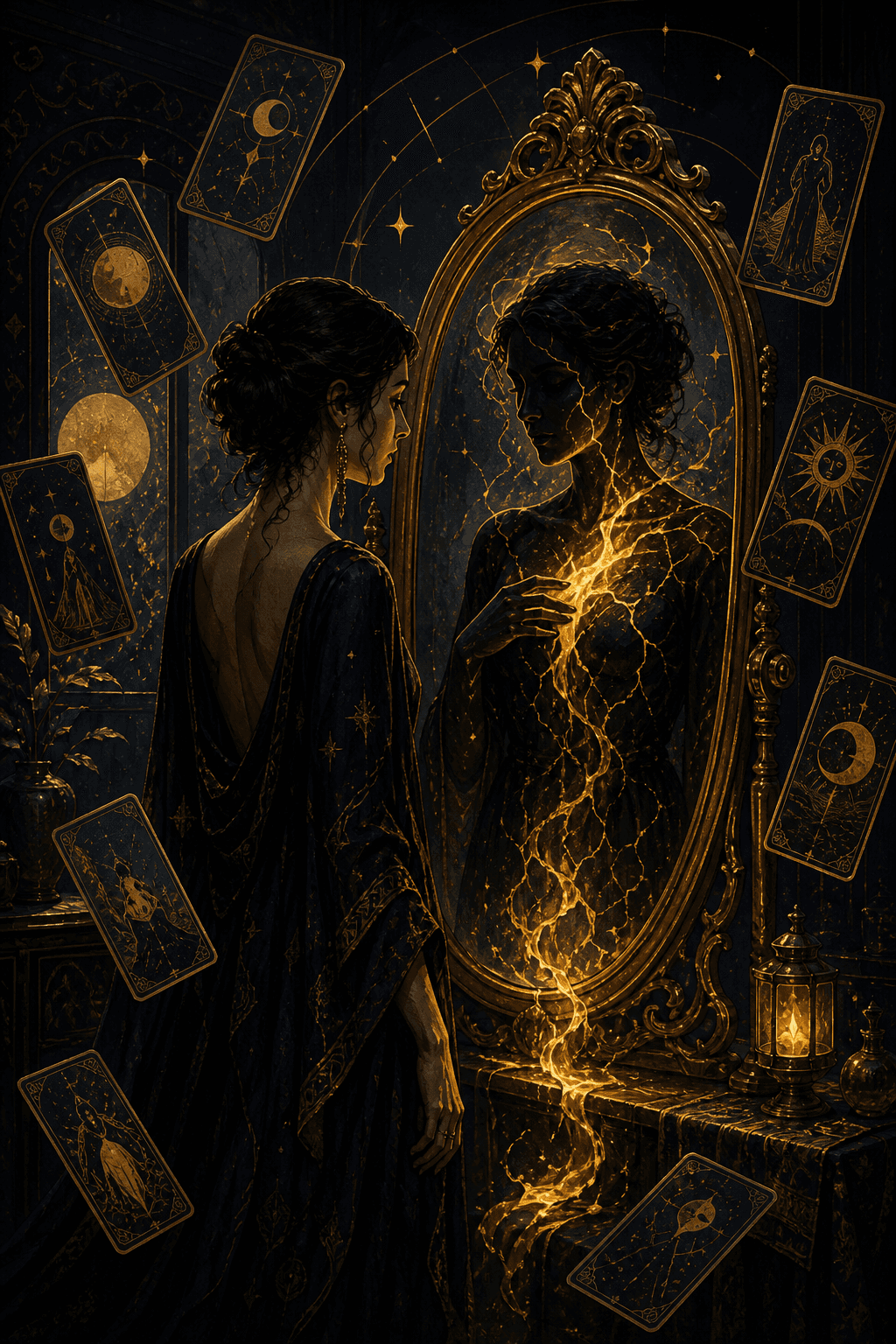
Tarot Shadow Work: Techniques, Spreads, and Integration
Most of us come to the tarot hoping for good news, or at least a clean explanation for why our lives feel stuck. Then we turn over a card like The Devil, The Tower, or the Nine of Swords, and our stomach drops. The instinctive move is to reshuffle, pull three 'clarifiers' until the Sun appears, or tell ourselves the deck is just in a foul mood.
Yet that sudden flare of discomfort—the urge to look away—is precisely where the real work begins.
At its best, tarot is not a parlor trick for dodging bad luck. It is a secular mirror for the psyche. When approached through the framework of analytical psychology, the seventy-eight cards form an externalized landscape of human nature: our conscious ambitions, the polished masks we wear to survive polite society, and the disowned desires, wounds, and unlived potentials we have locked in the basement. In the lexicon of Carl Jung, that hidden basement is the shadow.
Most writing on tarot shadow work falls into one of two traps. Either it treats the practice as spooky occult melodrama, or it flattens profound psychological confrontation into toothless self-care prompts. This guide was written to bridge the gap between authentic clinical history and practical cartomancy. Drawing on the Zurich school of analytical psychology, Sallie Nichols’s pioneering work with the Major Arcana, and modern projective techniques, we have assembled a comprehensive manual for using your deck to uncover—and integrate—the parts of yourself you have been taught to ignore.
Because genuine shadow work asks you to dismantle your own defenses, we have structured this resource as a progressive journey from theory to grounded daily practice:
- Foundations and Archetypes: We begin with Jung’s structural map of the psyche—distinguishing the Ego and Persona from the personal and collective shadows—and examine how the Major Arcana mirrors the lifelong arc of individuation.
- The Mechanics of Projection: You will learn why painted cardstock acts like a psychological Rorschach test, bypassing your rational defenses to surface repressed anger, grief, and fear.
- Reclaiming the Golden Shadow: Not everything hidden in the dark is painful. We will look at how to excavate your exiled ambition, creative vitality, and personal authority.
- Spreads, Dialogue, and Difficult Cards: You will find original diagnostic spreads, a step-by-step protocol for Jungian active imagination, and a method for dismantling your bias against the deck’s darkest cards—plus the shadow sides of radiant cards like The Star and The Emperor.
- Safety, Embodiment, and Long-Term Practice: Because excavating the unconscious requires firm footing, we establish clear ethical and psychological guardrails, somatic integration techniques, and a sustainable architecture for shadow journaling.
You do not need to believe in fate, psychic abilities, or mystical intervention to do this work. You only need a deck of cards, a notebook, and the willingness to catch yourself in the act of self-deception. Pull up a chair, clear the table, and let us look at what is waiting in the dark.
The Psychology of the Shadow: Jungian Foundations for Tarot Readers
In the winter of 1913, Carl Gustav Jung deliberately stepped off the ledge of his conscious intellect. Having severed ties with Sigmund Freud, his mentor and the father of psychoanalysis, Jung found himself adrift in an unsettling interior terrain. Instead of looking away, he picked up a pen and began documenting the visions, monsters, and mythical figures that drifted through his mind. The resulting journal, later bound in red leather and known simply as The Red Book, was not an exercise in occultism. It was an empirical confrontation with the unconscious.
"Until you make the unconscious conscious," Jung famously observed, "it will direct your life and you will call it fate."
When you set a deck of cards on a table, you step into that exact current. Tarot shadow work is neither demonic conjuring nor an idle parlor game. Approached through a Jungian lens, a spread of cards becomes an instrument of psychological self-inquiry—an externalized, secular apparatus designed to expose what the waking mind spends enormous amounts of energy concealing.
The Topography of the Psyche: Ego, Persona, and the Unseen
To understand how cards reflect the hidden mind, we have to grasp Jung's structural sketch of the psyche. He did not view the human mind as a uniform entity, but rather as an ecosystem composed of distinct layers, each with its own motives and boundaries.
       CONSCIOUS AWARENESS
      ┌───────────────────┐
      │      Persona      │  (The social mask presented to the world)
      ├───────────────────┤
      │        Ego        │  (The conscious seat of "I")
──────┴───────────────────┴────── THRESHOLD OF CONSCIOUSNESS
      │      Shadow       │  (Repressed, split-off personal material)
      ├───────────────────┤
      │    Collective     │  (Universal archetypes, instincts, and
      │    Unconscious    │   mythic motifs shared across humanity)
      └───────────────────┘
      UNCONSCIOUS TERRAIN
At the surface sits the Ego. This is your conscious sense of identity—the familiar voice that says, I am a patient partner, I value hard work, I am rational. The Ego operates as the gatekeeper of everyday waking reality, keeping your psychological house in enough order to hold a job, cross a street, and hold a conversation.
Closely wrapped around the Ego is the Persona, named after the clay and linen masks worn by Roman stage actors. The Persona is your social interface. It is how you package yourself to survive family expectations, corporate standards, and cultural mores. An adaptable Persona is useful: you do not speak to your manager the same way you speak to an old friend in a dive bar.
Trouble begins when the Ego mistakes the mask for the entire face.
Everything that does not match the clean contours of your Persona must go somewhere. If your childhood home punished anger, you learned to swallow your fury. If your culture derided vulnerability, you buried your tears. If ambition was framed as selfishness, you choked down your hunger for power.
This brings us to the Shadow. The Shadow is the basement where those disowned fragments gather dust. It is the repository of every impulse, wound, longing, and instinct your conscious mind judged unacceptable and banished.
Beneath that personal basement lies a deeper foundation: the Collective Unconscious. This layer is not built from your individual life history. It is the inherited psychological architecture shared by all human beings, populated by Archetypes—instinctual blueprints and motifs that emerge across fairy tales, religions, dreams, and art throughout recorded history. When you consult a deck, you tap into a symbolic inventory drawn directly from this bedrock.
The Moral Fallacy: Why the Shadow Is Not Evil
The most persistent misunderstanding in popular psychology is the assumption that the shadow is inherently wicked. Popular culture treats the shadow as a synonym for malice, cruelty, or psychopathology.
Jung explicitly rejected this. To him, the shadow is not evil; it is merely unadapted. It is whatever is unacknowledged, unintegrated, or split off from the light of conscious awareness.
                   ┌───────────────────────────────────┐
                   │         THE SPLIT PSYCHE          │
                   └─────────────────┬─────────────────┘
                                     │
           ┌─────────────────────────┴─────────────────────────┐
           ▼                                                   ▼
┌─────────────────────┐                             ┌─────────────────────┐
│     THE PERSONA     │                             │     THE SHADOW      │
│  "What I show you"  │                             │  "What I bury away" │
├─────────────────────┤                             ├─────────────────────┤
│ • Social compliance │                             │ • Raw aggression    │
│ • Politeness        │                             │ • Unbound eros      │
│ • Predictability    │                             │ • Wild grief        │
│ • Self-effacement   │                             │ • Golden Shadow:    │
│                     │                             │   (unlived genius,  │
│                     │                             │    vital ambition,  │
│                     │                             │    erotic power)    │
└─────────────────────┘                             └─────────────────────┘
Consider what happens to a person raised in an environment that values quiet compliance above all else. To remain safe and loved, that person represses healthy anger. Yet anger is not just a destructive impulse; it is the physiological fuel required to say "no," to maintain a boundary, and to defend yourself against exploitation. When repressed, that vital life force does not disappear. It turns inward, transforming into chronic self-sabotage, passive-aggressive barbs, or somatic exhaustion.
Furthermore, the shadow holds what analytical psychologists call the "golden shadow." This is unlived positive potential: your raw creative fire, your fierce instinct for truth, your erotic vitality, your capacity to lead. If claiming those gifts once risked drawing the envy or wrath of your caretakers, you may have locked them in the cellar alongside your resentments.
In the tarot tradition, no card embodies this moral misunderstanding more completely than The Devil.
In traditional fortune-telling, card fifteen was often read as temptation, addiction, or sheer misfortune. But examine the card through a Jungian lens. The horned figure—half-beast, half-human—is the wild instinctual body that polite society attempts to starve. The two smaller figures chained to its pedestal wear loose iron collars. Their hands are free; their bonds can be slipped off at any moment.
They remain bound not because the creature possesses supernatural power over them, but because facing their own raw desires, bodily shame, and instinctual appetites demands more responsibility than remaining comfortable captives. The Devil card does not ask you to exorcise darkness; it asks you to look honestly at where you have traded autonomy for comfortable denial.
From Fortune-Telling to the Secular Mirror
For centuries, cartomancy leaned on a predictive promise: What will happen to me next month? Does this person love me? Will my harvest hold?
While predictive traditions carry their own rich folk histories, the modern revival of tarot underwent a quiet revolution in the latter half of the twentieth century. Inspired by the Zurich school of psychology and thinkers like Sallie Nichols—who studied directly at the C.G. Jung Institute—practitioners began to recognize the seventy-eight cards not as crystal balls, but as a pictorial Mutus Liber (a "wordless book") of human development.
When you sit down for a psychological /tarot-reading, the cards act as a structured projective test, much like a Rorschach inkblot or a Thematic Apperception Test, but with a richer narrative vocabulary.
The mechanism relies on psychological projection. The human mind hates ambiguity; when confronted with an abstract, emotionally loaded image, it instinctively projects its internal conflicts onto the scene.
- If you draw The Moon and your first thought is betrayal, you are not receiving a telepathic warning about an unfaithful friend. You are catching your conscious mind in the act of externalizing its own latent paranoia, unresolved grief, or fear of emotional disorientation.
- The image catches your defenses off guard. It acts as a mirror that reflects the observer's unconscious contents back to their waking eyes.
This shifts the fundamental question of the practice. Instead of asking the deck, "What will the future do to me?" the psychological practitioner asks, "What part of my current reality am I refusing to acknowledge?"
Archetypes at the Crossroads: Triggers in Times of Impasse
We rarely seek out deep psychological inquiry when life is running smoothly. We reach for symbolic tools during emotional dead-ends: the dissolution of a partnership, the slow rot of career burnout, a midlife collapse of meaning, or the sudden loss of an identity we spent twenty years constructing.
In these moments, the Ego's familiar toolset breaks down. Intellectualizing the problem fails. Making pros-and-cons lists yields nothing. The rational mind runs in frantic circles, exhausting itself because the problem cannot be solved using the same conscious strategies that created it.
This is precisely where archetypes function as catalysts.
Archetypes are not intellectual theories; they are lived emotional experiences. They lie dormant in the unconscious until an external crisis shakes the Ego enough to let them surface. When you pull The Tower during a personal crisis, the card bypasses your conscious defenses. The bolt of lightning shattering the crown, the figures tumbling into the abyss, the burning stonework—these images evoke an immediate visceral recognition.
┌────────────────────────────────────────────────────────┐
│                   THE ARCHETYPAL LEAP                  │
├──────────────────────────┬─────────────────────────────┤
│ Intellectualizing (Ego)  │ "I have suffered an         │
│                          │ unexpected structural       │
│                          │ setback in my life plan."   │
├──────────────────────────┼─────────────────────────────┤
│ Archetypal Symbol        │ [The Tower]                 │
│                          │ Lightning shatters the      │
│                          │ crown of false pride; what  │
│                          │ was built on a lie collapses│
│                          │ to make room for truth.     │
└──────────────────────────┴─────────────────────────────┘
The symbol does something rational thought cannot: it links your isolated, private agony to an ancient, universal pattern. It reframes your personal ruin not as a meaningless accident, but as a necessary, archetypal clearing of psychic land.
By engaging with the archetype directly, the Ego stops fighting the collapse and begins cooperating with the psychological restructuring already underway.
The Two Strata: Personal Scars Versus Collective Shadows
When working with tarot as a diagnostic tool, you must learn to distinguish between two distinct layers of the shadow. Misidentifying them leads to muddy interpretations and ineffective integration.
┌─────────────────────────────────────────────────────────────────────────┐
│                      TWO LEVELS OF THE SHADOW                           │
├───────────────────────────────────┬─────────────────────────────────────┤
│ PERSONAL SHADOW                   │ COLLECTIVE SHADOW                   │
├───────────────────────────────────┼─────────────────────────────────────┤
│ • Rooted in biographical memory   │ • Rooted in universal human drives  │
│ • Family systems, personal trauma │ • Archetypal myths, taboos, drives  │
│ • Private shame and adaptations   │ • Primordial dread and majesty      │
│ • Mirrored mainly in Minor Arcana │ • Mirrored mainly in Major Arcana   │
│   and Court Cards                 │                                     │
└───────────────────────────────────┴─────────────────────────────────────┘
The Personal Shadow (Biographical Wounds)
The personal shadow belongs to you alone. It is assembled from your direct sensory memories, childhood experiences, family rules, and specific cultural adaptations.
- It is the voice of the schoolteacher who laughed when you read aloud, convincing you that your intellect was defective.
- It is the habit of withdrawing emotionally whenever someone gets close, learned from an erratic caregiver.
In the cards, the personal shadow frequently speaks through the Minor Arcana and the Court Cards.
When you encounter the Five of Swords or the Nine of Swords, you are generally dealing with the mechanics of your personal biographical wounds: your learned habits of self-recrimination, your familiar relational battlegrounds, and the specific sleepless anxieties of your daily life.
These cards mirror your biographical baggage back to you with pinpoint accuracy.
The Collective Shadow (The Transpersonal Murk)
The collective shadow is far older and vastly deeper. It contains the dark, archaic impulses of our entire species: the urge to scapegoat the outsider, the bloodlust of the mob, primordial panic, and the tyrannical drive to dominate others. It is the repository of every taboo that civilization has had to repress in order to prevent collective self-destruction.
When this stratum stirs, it speaks almost exclusively through the Major Arcana.
Cards like The Devil, The Tower, and The Moon carry an emotional resonance that feels larger than your private biography. If you draw The Moon and find yourself seized by an ancient, watery, disorienting dread, you are not merely remembering an awkward moment from high school. You are brushing against the collective human fear of the dark: the primordial threshold where forms dissolve, instinct replaces reason, and the boundary of the individual self threatens to disappear entirely.
Recognizing which layer you are confronting changes how you handle your practice.
You integrate a personal shadow card through biographical reflection, somatic awareness, and behavioral changes in your daily routines. But you do not "fix" a collective shadow card. You do not domesticate an archetype like The Moon or The Devil. Instead, you learn to recognize its presence, respect its sheer gravity, and consciously withdraw your projections before its immense current sweeps you along.
To explore how these psychological principles map across the entire deck, review the symbolic architecture in our guide to card meanings, or explore structured layouts in our directory of tarot spreads.
The Major Arcana as Archetypal Mirror: From Nichols to Modern Practice
For centuries, the twenty-two cards of the Major Arcana were treated primarily as allegorical triumphs or engines of predictive divination. That changed quietly in the mid-twentieth century when Sallie Nichols, a student at the C.G. Jung Institute in Zurich, laid the cards side by side with the clinical literature of analytical psychology. Nichols did not view the trumps as fortune-telling apparatus. She viewed them as a mutus liber—a wordless book of the collective unconscious, recording the soul’s jagged movement toward psychological wholeness.
When you draw a card from the Major Arcana during an introspective tarot reading, you are not receiving a prediction about tomorrow's weather or an impending encounter with a stranger. You are looking into an archetypal mirror. The images catch light in the blind spots of your conscious ego. Where your daylight mind insists on coherence, control, and moral cleanliness, the trumps reflect the messy, disowned, and vital undercurrents that Jung categorized as the shadow. Understanding how the Major Arcana functions as an individuation map allows you to move past superficial interpretations and confront the living material of your own psyche.
Nichols and the Map of Individuation
Nichols’s foundational work, Jung and Tarot: An Archetypal Journey, grounded the sequence of the trumps in the process of individuation: the lifelong psychological task of integrating conscious awareness with unconscious content. In her analysis, the sequence is neither a straight line nor an arbitrary game. It traces the ego's birth, its inevitable calcification into social roles, its catastrophic collapse, and its eventual reconciliation with the wider Self.
The sequence begins with The Fool—unconscious potential stepping heedlessly toward the cliff edge of human experience. From there, the early cards trace the construction of the persona and the social ego. We learn will from The Magician, social order from The Emperor, and cultural doctrine from The Hierophant.
For Nichols, the critical turn comes halfway through the sequence. A life lived purely in the daylight of the first ten cards eventually produces neurosis. The ego becomes rigid, over-identified with its accomplishments, and brittle. To grow, the seeker must experience what mythology calls the nekyia—the descent into the underworld.
[Daylight Ego: I–X]  --->  [Descent & Crisis: XI–XVI]  --->  [Integration & Wholeness: XVII–XXI]
Social adaptation           Confronting the Shadow            Reconciliation with the Self
The second half of the Major Arcana abandons the clean drawing rooms of civil society. It forces an encounter with the beast, the swamp, the lightning strike, and the tomb. In Nichols’s reading, these disturbing cards are not punishments. They are necessary compensatory movements of the unconscious, engineered to smash open the ego’s self-deceptions so that a larger, more authentic self can emerge.
The Overt Gates: The Devil and The Moon
Two cards in the Major Arcana serve as direct portals into the underworld of the psyche: The Devil and The Moon. While both expose disowned material, they map onto distinct strata of the unconscious mind.
+-------------------------------------------------------------------------+
|                              THE CONSCIOUS EGO                          |
+-------------------------------------------------------------------------+
                                    |
                                    v
+-------------------------------------------------------------------------+
|  THE DEVIL (Key XV)              |  THE MOON (Key XVIII)                |
|  The Personal Unconscious        |  The Instinctual & Collective Realm  |
|  - Repressed drives, taboos      |  - Archaic mammalian terror          |
|  - Scapegoating and projection   |  - Pre-verbal, non-linear dreaming   |
|  - Shame, appetite, obsession    |  - The devouring maternal matrix     |
|  - "The shadow we choose"        |  - "The wilderness that chose us"    |
+-------------------------------------------------------------------------+
The Devil represents the personal shadow—the repository of everything you were taught to loathe, hide, or disown to remain acceptable to your family and tribe. In the Rider-Waite-Smith depiction, the horned figure perches on an altar while a man and a woman stand chained below him. Look closely at the chains draped over their necks: the loops are wide enough to slip off over their heads at any moment.
This detail reveals the psychological mechanism of Key XV. The Devil represents the pacts we make with our own disempowerment. When you disown your ambition, your rage, or your primal appetites, you do not destroy them. You project them outward onto partners, rivals, or political enemies, whom you then perceive as uniquely sinister. Key XV demands an uncomfortable self-inventory: Where am I claiming to be trapped by circumstances that I am quietly choosing to tolerate because victimhood spares me the burden of agency?
If The Devil is the personal shadow of morality and appetite, The Moon plunges into something far older: the instinctual, pre-verbal unconscious. Key XVIII is the landscape of mammalian panic, somatic dread, and non-linear cognition.
Here, there are no human figures to bargain with. A dog and a wolf—the domesticated animal and its wild ancestor—howl at a luminary that sheds only deceptive, reflected light. From the brackish pool at the bottom of the card, an archaic crustacean claws its way onto the path. The crayfish is the oldest part of the nervous system: the unreasoning, survival-driven limbic brain crawling out of the muck. When The Moon surfaces in shadow work, it signals that the conscious intellect is out of its depth. The task here is not to analyze, label, or fix, but to endure the terror of disorientation without retreating into defensive rationalization.
The Shadow Expressions of "High-Vibration" Cards
A persistent trap in contemporary tarot culture is the division of the deck into "positive" and "negative" cards. Light-worker clichés suggest that cards like The Star or The Sun represent unalloyed blessings, while keys like The Devil belong exclusively to the dark.
Jung warned repeatedly that the brightest lights cast the longest, blackest shadows. In shadow work, the most deceptive psychological material often hides behind the Major Arcana’s most virtuous masks.
Consider The Emperor. In its integrated state, the card represents healthy authority, generative structure, and emotional containment. But its shadow is tyrannical and deadening:
- Calcification: When an individual fears inner chaos, they over-compensate with obsessive routines, emotional coldness, and rigid moralism.
- The Tyrant-Father: The Emperor's shadow demands that life conform to an intellectual grid. It crushes spontaneity in the name of efficiency, replacing warmth with bureaucracy and control.
- Contempt for Vulnerability: The unintegrated Emperor despises the messy, tender aspects of human nature, banishing grief and uncertainty as signs of fatal weakness.
Integrated Expression                     Shadow Expression
----------------------                    -----------------
Clear boundaries & structure    ====>     Rigid emotional armor
Generative stewardship          ====>     Authoritarian control
Protective strength             ====>     Contempt for vulnerability
Conversely, consider The Star, a card usually celebrated as a beacon of hope, healing, and divine grace. When dragged into the shadow, Key XVII becomes the signature of spiritual bypass.
The naked woman pours water onto the earth and into the pool, fixing her gaze on the celestial bodies above. The shadow of this archetype is passive quietism—an addiction to transcendent optimism that excuses real-world inaction. Hope can become a narcotic. Faced with an abusive relationship, a deadening job, or deep grief, the Star’s shadow whispers that the universe will provide, that everything happens for a reason, and that concrete boundaries are unnecessary if one’s vibrations remain sufficiently pure. The shadow of The Star is the refusal to get your hands dirty in the friction of human reality, hiding behind aesthetic serenity while life passes by unlived.
Exploring these inversions deepens any study of the full library of cards. Every archetype contains its own negation, and every virtue carries its specific neurosis.
Marseille Versus Rider-Waite-Smith: Semiotics of the Repressed
Your choice of deck dramatically shapes how shadow material surfaces in your readings. The two visual linchpins of Western tarot—the historical Tarot de Marseille (TdM) and the modern Rider-Waite-Smith (RWS)—employ fundamentally different visual semiotics to engage the unconscious mind.
+-------------------------------------------------------------------------+
|                  MARSEILLE vs. RIDER-WAITE-SMITH                        |
+-------------------------------------------------------------------------+
| TAROT DE MARSEILLE (Historical)     | RIDER-WAITE-SMITH (Modern)        |
| - Stark, woodcut flat perspective   | - Theatrical, scenic narrative    |
| - Mask-like, inscrutable faces      | - Expressive, relatable characters|
| - Alien, archaic geometry           | - Rich, occult-Christian allegory |
| - Resists easy narrative projection | - Invites immediate empathy       |
| - Shocks the intellect by strangeness- Evokes recognizable drama        |
+-------------------------------------------------------------------------+
Sallie Nichols worked exclusively with the Tarot de Marseille, and for good reason. Its fifteenth- and sixteenth-century woodcuts are flat, strange, and emotionally inscrutable. The figures do not meet your gaze with modern psychological warmth; they stare past you with wide, hieratic eyes.
Because the Marseille cards lack the cozy, illustrated realism of twentieth-century art, they resist being folded into easy, sentimental narratives. Their very oddity bypasses the conscious ego's defense mechanisms. Confronting the grotesque, androgynous devil of the Marseille—with eyes on its knees and breasts on its torso—acts like a Rorschach blot. The intellect stumbles, leaving the unconscious free to project its raw, unedited contents directly onto the woodcut's archaic geometry.
The Rider-Waite-Smith deck, illustrated by Pamela Colman Smith under the direction of occultist Arthur Edward Waite, works through a different mechanism: psychological identification and theatrical narrative. Smith was a theatre designer, and her cards are staged like moments in a drawing-room drama or a mythic play.
The figures in the RWS deck possess readable facial expressions, body language, and detailed environmental settings. The chained captives on Key XV look sheepish and seduced; the figure fleeing The Tower falls with tragic kineticism. This illustrative richness makes the RWS an extraordinarily sensitive instrument for personal shadow work. It evokes your family dramas, your childhood injuries, and your social embarrassments with cinematic immediacy.
Where the Marseille confronts you with the alien collective archetype, the Rider-Waite-Smith invites you to see your personal history enacted on a miniature stage. Both approaches are valid, but switching between them can often dislodge material that one system has allowed you to intellectualize.
The Cataclysmic Descent: The Tower as Psychic Breakthrough
No card in the Major Arcana is greeted with more dread—or misunderstood more thoroughly—than The Tower. In standard fortunetelling, it is feared as an omen of external ruin: bankruptcies, sudden divorces, or shocking scandals. In the laboratory of psychological shadow work, however, Key XVI is the ultimate instrument of liberation.
The Tower represents the psychic superstructure that the ego painstakingly builds to defend itself against reality. It is the fortress of who you think you should be:
- The pristine reputation built on the denial of your messy human needs.
- The dogmatic intellectual system that pretends to explain away grief and tragedy.
- The carefully curated persona that secures approval at the cost of your vitality.
Notice the construction of the building itself. In traditional decks, it is a stone crown perched atop an isolated, barren peak. It has no doors at ground level, only tiny, unyielding windows near the parapet. It is an image of profound isolation—the ego fortified against life, walled up inside its own certainties.
     /\      [Crown: The Inflated Ego]
    /  \     <--- Shattered by lightning (compensatory unconscious force)
   |====|
   | || |    [The Tower: Rigid character armor / neurosis]
   |    |
  /      \   [Falling Figures: Reluctant descent back to reality]
The lightning strike that decapitates the structure does not originate from an enemy outside. In Jungian psychology, it represents the compensatory force of the unconscious. When the conscious ego becomes too inflated, too one-sided, or too cut off from the animal roots of life, the psyche corrects the imbalance. The unconscious strikes the tower not to destroy the individual, but to breach the character armor that has trapped them in living petrification.
The two figures tumbling from the heights are not dying; they are being returned to the earth. To fall from the tower is to experience the humiliating, agonizing, and entirely necessary collapse of a false persona.
When you draw The Tower during shadow integration, your work is not to prevent the collapse. You cannot negotiate with a lightning strike. The work is to notice what you are frantically trying to salvage from the rubble. Are you clinging to an expired belief system? Are you attempting to repair an identity that suffocated your true nature for twenty years?
The Tower teaches that catastrophe is often the shadow’s violent mercy. When the stone walls split open, daylight enters the prison cell for the very first time.
The Mechanics of Projection: How Illustrated Cards Surface Repressed Material
When Carl Jung remarked that psychological projection is an unconscious, automatic mechanism, he pointed to a stubborn human habit: whatever is rejected from conscious awareness does not evaporate. It simply looks for an external surface on which to land. We disown our envy, our cruelty, our unbearable grief, or our unexpressed ambition, and then we spot those exact traits across the dinner table in a spouse, down the hall in a colleague, or across the political aisle in a public figure. The ego stays tidy; the world outside takes the blame.
A deck of tarot cards functions as an engineered screen for this exact transaction. Much like the inkblots of a Rorschach plate or the narrative prompts of Henry Murray’s Thematic Apperception Test (TAT), the cards offer ambiguous, emotionally charged imagery. Yet unlike clinical inkblots, tarot carries seven centuries of layered human archetypes, scenic interactions, and cultural folklore. When you sit down for a /tarot-reading, you are not gazing at an objective forecast of tomorrow’s weather. You are looking at a gallery of mirrors, every card waiting to receive the disowned cargo you have spent decades trying not to see.
The Card as Screen: The Architecture of Projection
Projection requires a receptive hook. You cannot easily project avarice onto a blank sheet of paper, because the mind needs a scaffold on which to hang its story. Tarot cards provide precisely the right balance of structure and indeterminacy: recognizable human forms, evocative landscapes, and symbolic gestures, combined with just enough narrative silence that the observer must fill the gaps.
When you look at an image, your optic nerves deliver raw data, but your psyche delivers meaning. If consciousness is functioning smoothly, you register the card’s traditional iconography. But when a card brushes against repressed material—an instinctual drive you deem shameful, a memory you buried to survive childhood, or an impulse that threatens your social persona—the unconscious jumps the queue. It interprets the figure’s posture, gaze, and motives through the lens of your own unfinished business.
The image does not generate the shadow; it merely hosts it. The card becomes what psychodynamic theorists call an "externalized object." Because looking directly at your own repressed traits would trigger intense guilt or anxiety, the mind permits you to perceive those traits out on the card table, printed on 350-gsm cardstock. You are suddenly observing your disowned self from a safe distance, wrapped in robes and holding swords, unaware that you are narrating an autobiography.
Somatic Whistleblowers: Visceral Revulsion as a Diagnostic Flag
In shadow work, your mind is an unreliable witness, but your nervous system rarely lies. The conscious ego is an expert editor; it knows how to sanitize interpretations and keep you comfortable. The body, however, acts as a somatic whistleblower.
When you encounter a card that reflects an integrated part of yourself, your reaction is generally measured—perhaps curious, appreciative, or neutrally attentive. Even cards that depict sorrow or transition can be received with gentle recognition. But when an image connects directly with an unacknowledged shadow complex, the response is visceral, immediate, and somatic.
Watch for these physical indicators during a reading:
- A sharp, involuntary contraction in the solar plexus or gut
- A sudden tightening of the throat or jaw
- A quick flare of hot irritation or quiet disgust
- The immediate impulse to shuffle the card back into the deck, look away, or draw a "replacement"
Visceral revulsion is shadow gold. Indifference means a symbol carries no current psychic charge for you. True aversion, however, proves that you are in intimate contact with something you have outlawed in yourself.
Consider /learn-cards/15-TheDevil. If your immediate reaction is disgust at the bestial figures chained to the altar, ask what the revulsion is defending. Is it an instinctual horror of entrapment, or is it a ferocious defense against your own hunger for control, illicit pleasure, or raw dependency? The card you want to scrub out of your deck is invariably the card holding the key to your baseline defense mechanisms.
The Narrative Ambush: How Minor Arcana Catch the Ego Off-Guard
Readers frequently assume shadow work belongs exclusively to the harrowing Major Arcana—the lightning of /learn-cards/16-TheTower or the primordial swamp of /learn-cards/18-TheMoon. Yet the Major Arcana carry such monumental archetypal weight that the ego immediately raises its guard; we brace for impact when we see catastrophe depicted on a cosmic scale.
The Minor Arcana work through stealth. They depict everyday human dilemmas: awkward negotiations, quiet domestic disappointments, and petty compromises. Because they seem mundane, the ego treats them casually, allowing its defenses to drop. It is here, in the small corners of the numbered cards, that narrative projection lays its most effective ambushes.
Take /learn-cards/07-SevenOfSwords. The Pamela Colman Smith illustration shows a man slipping away from an encampment, cradling five stolen blades while glancing back over his shoulder at two upright swords left behind.
                                 [07-SevenOfSwords]
                                         │
                 ┌───────────────────────┴───────────────────────┐
                 ▼                                               ▼
         PROJECTION "A":                                 PROJECTION "B":
   "He is a treacherous thief."                    "He is clever and resourceful."
                 │                                               │
                 ▼                                               ▼
     Shadow: Repressed deceit,                       Shadow: Fear of confrontation,
   envy of others' boundaries,                     sanctimonious isolation,
     or rigid moral perfectionism.                   guilt over taking what is needed.
When someone describes this figure as a despicable imposter, they are frequently protecting an image of themselves as unimpeachably honest, disowning the strategic deceit or quiet corners they themselves cut. Another person looks at the same illustration and sees a resourceful underdog outsmarting an oppressive majority; here, the projection often covers an unwillingness to engage in direct, courageous confrontation. The story you supply to explain why he is running reveals your personal relationship to stealth, boundaries, and survival.
Similarly, examine /learn-cards/05-FiveOfCups. A dark-cloaked figure bows its head before three spilled vessels while two stand upright behind them. When readers feel deep annoyance toward this card—dismissing the figure as a self-indulgent wallower who simply needs to "turn around and see what’s left"—they are rarely assessing the artwork objectively. They are projecting their own intolerance for unresolved grief. The annoyance is an ego defense against messy, inconvenient sadness, born of a personal mandate to stay productive, resilient, and cheerful at all costs.
Overcoming Ego Defenses in the Reading
When a card successfully brings repressed material to the surface, the conscious personality does not surrender easily. It deploys three classic diversionary tactics to maintain its equilibrium:
- Intellectualization: The reader retreats from the emotional impact of the image into arcane technicalities. Instead of feeling the sting of /learn-cards/05-FiveOfCups, they recite its astrological attribution (Mars in Scorpio), debate the historical origins of the chalice, or dissect the color symbolism of the black cloak. Analysis becomes an armored bunker that keeps felt experience at bay.
- Denial and Over-Drawing: When a layout delivers an unsettling diagnosis, the ego insists the deck is malfunctioning or that the reader's focus was blurred. The common reaction is to draw three "clarifiers," reshape the query into a hasty /tarot/yes-or-no formula to secure reassurance, or shuffle repeatedly until a more flattering archetype appears.
- Spiritual Bypassing: This is the tendency to coat challenging imagery in toxic positivity. The destructive clearing of /learn-cards/16-TheTower is immediately reframed as "a wonderful breakthrough of light," before the reader has spent thirty seconds acknowledging what was broken, who was hurt, or what false security just collapsed.
To dismantle these defenses, you must practice sitting with the raw image before reaching for reference books or silver linings.
When a card makes you wince, pause. Place both feet on the floor. Describe the figure on the card aloud using only first-person statements: "I am turning my back on these cups because looking at what is ruined makes me feel irredeemable." Or: "I am taking these swords because I believe nobody will ever give me what I need unless I take it in secret."
When you allow the projected voice to speak without immediate correction or spiritual polishing, the card ceases to be an external picture. The projection dissolves, the boundary softens, and the disowned trait returns home to conscious awareness, where it can finally be integrated. Exploring focused /learn-spreads designed around this dialogue is where genuine transformation begins.
The Golden Shadow: Uncovering Exiled Talents, Joy, and Personal Power
When people speak of the shadow, they almost always speak in the vocabulary of basements, baseness, and decay: envy, wrath, petty grievances, and forbidden desires. Yet Carl Jung was unambiguous on this point: the unconscious does not contain only what is pathological. It holds everything that consciousness could not house without upsetting the fragile architecture of the ego.
Alongside your cruelty and cowardice, you buried your unrefined genius, your capacity for fierce joy, and your appetite for sovereign authority.
Jungian analyst Robert A. Johnson coined the term the golden shadow to describe these exiled treasures. In practice, reclaiming the golden shadow is often considerably harder than integrating our darker impulses. Admitting to pettiness or resentment costs us only our pride; admitting to latent brilliance costs us our excuses.
                    THE ARCHITECTURE OF EXILE

     ┌─────────────────────────────────────────────────────┐
     │                     THE EGO                         │
     │      "I am modest, agreeable, and manageable."     │
     └──────────────────────────┬──────────────────────────┘
                                │ Represses
                                ▼
     ┌─────────────────────────────────────────────────────┐
     │                 THE SHADOW CELLAR                   │
     │                                                     │
     │   Dark Shadow                 Golden Shadow         │
     │   ┌────────────────────┐      ┌─────────────────┐   │
     │   │ Resentment, Rage,  │      │ Raw Brilliance, │   │
     │   │ Petty Jealousy     │      │ Sovereign Power,│   │
     │   └────────────────────┘      │ Unmasked Joy    │   │
     │                               └────────┬────────┘   │
     └────────────────────────────────────────┼────────────┘
                                              │ Projects outward
                                              ▼
                                 ┌────────────────────────┐
                                 │ THE PEDESTAL           │
                                 │ "They are luminous;    │
                                 │  I am just an observer"│
                                 └────────────────────────┘
The Mechanism of Golden Projection
Because the conscious mind refuses to own these high-voltage qualities directly, it projects them onto the external world. You see the golden shadow at work whenever you place someone on a pedestal.
Notice who dazzles you. Pay attention to the mentor whose presence makes you feel smaller, the artist whose fierce originality provokes an ache in your chest, or the charismatic colleague whose effortless confidence seems completely alien to your nature.
That sudden, breathless veneration is rarely about them. It is an unconscious sleight of hand. By idolizing someone else’s radiance, you absolve yourself of the terrifying responsibility of inhabiting your own. It is far safer to be the loyal devotee of another person’s creative force than to sit down at the desk, step up to the lectern, and build something that might fail.
Tarot gives us an honest instrument for breaking these projections. When you draw cards during a tarot reading focused on self-inquiry, you strip away the mythologies you build around other people and see the archetypes staring directly back at you.
The Fear of Visibility: Why We Hide Our Light
Why would anyone lock their best attributes in a dungeon?
The answer lies in conditioning and survival. In many families and schoolrooms, an assertive child is branded disruptive; an exceptionally bright child learns that excellence invites social isolation; a joyful child is told to quiet down and stop making a scene. Cultural traditions reinforce this self-erasure through mechanisms like "tall poppy syndrome"—the unwritten social law that any plant growing taller than the rest of the field must be lopped off at the stem.
To survive childhood, many of us struck an implicit bargain: I will stay small, manageable, and self-deprecating so that you do not abandon or punish me.
                 THE COST OF THE BARGAIN

     Early Conditioning         Adult Strategy
    ┌──────────────────┐       ┌────────────────────────┐
    │ "Don't show off" │ ────> │ Chronic self-effacement│
    │ "Don't be loud"  │ ────> │ Chronic throat-clearing│
    │ "Stay safe"      │ ────> │ Abdicated ambition     │
    └──────────────────┘       └────────────────────────┘
Carried into adulthood, this bargain curdles into chronic self-effacement. You apologize before stating a valid opinion. You preface creative work with elaborate disclaimers. You deflect praise as though it were an insult.
Stepping into authority requires enduring the discomfort of being seen. Visibility invites criticism, envy, and demands from the community. If you acknowledge that you possess executive will or rare artistic ability, you can no longer plead helplessness. The golden shadow terrifies us because it demands that we grow up.
Four Mirrors of Disowned Brilliance
When conducting shadow work through the cards, certain figures act as severe tests of our willingness to accept our own light. If these cards provoke irritation, discomfort, or an urge to explain them away as "unrealistic," you are likely looking directly at your disowned gold.
       FOUR ARCHETYPES OF THE GOLDEN SHADOW

   [ The Sun ] ────────────── Radically Visible Joy
   [ The Magician ] ───────── Unapologetic Agency
   [ Strength ] ───────────── Instinctual Soft Power
   [ Queen of Wands ] ─────── Unmasked Charisma
1. The Sun: Unabashed Visibility and Radical Joy
In the Rider-Waite-Smith system, The Sun presents an image that many modern, cynical adults find almost embarrassing: a naked child crowned with flowers, astride a white horse, arms flung wide beneath an immense golden face.
There is no armor, no irony, and no defensive self-consciousness.
The Sun represents joy that refuses to apologize for its own warmth. When this card appears in a shadow spread, it often exposes a deep-seated suspicion of happiness. Many people carry a superstitious dread that joy invites disaster—that if they celebrate too openly, life will punish them.
The Sun demands that you drop the protective shell of world-weariness. It asks: Where are you choosing sophisticated misery over vulnerable delight?
2. The Magician: Conscious Agency and Creative Will
Standing with one hand pointed toward the heavens and the other toward the earth, The Magician sits at the nexus of ideation and execution. On his table rest the symbols of all four suits—will, emotion, intellect, and physical substance. He lacks nothing he needs to act.
When The Magician falls into a shadow position, he confronts our habit of manufactured powerlessness.
We often pretend we do not know what to do next. We buy another book, take another course, or consult another deck because researching feels like working while asking nothing risky of us.
The Magician exposes this stalling tactic. He reveals that you already possess the tools, the vocabulary, and the baseline competence to change your circumstances. He shows where you are playing the victim to avoid the burden of becoming the architect.
3. Strength: The Mastery of Soft Power
In Sallie Nichols’s classic Jungian analysis of the Tarot, the figure in Strength does not conquer the lion through violence, chains, or brute force. She closes its jaws with a gentle touch, adorned in garlands of flowers, an infinity symbol hovering over her brow. She has befriended the beast.
The shadow side of Strength is rarely weakness; it is the clumsy overreliance on control, force, and hyper-vigilance.
Many people disown their capacity for graceful endurance and emotional authority, mistaking gentleness for submission. They believe that unless they are exhausting themselves, fighting, or dominating their environment, they are unsafe.
Strength reflects the golden power of composure: the ability to sit with intense passion, terror, or conflict without striking out or running away.
4. The Queen of Wands: Unmasked Charisma and Social Sovereignty
Few court cards disturb the self-effacing reader quite like the Queen of Wands. She sits with her knees wide, holding a flowering branch and a black cat at her feet, basking like a sunflower turned to noon. She does not wonder if she is taking up too much room; she assumes the space was made for her.
This Queen is the patron archetype of untamed creative vitality and social ease.
If this card makes you roll your eyes or dismiss her as vain, you have likely exiled your own hunger for attention and influence. She reminds us that there is a vast difference between cheap narcissism and healthy, radiant self-regard.
She challenges you to stop shrinking into the corner of your own life and claim your seat at the center of the room.
Inquiries for Reclaiming Exiled Power
To bring your golden shadow out of hiding, you must construct a deliberate dialogue with the unconscious. In your next self-reflective session, lay out your deck and pull cards against these targeted inquiries:
- The Pedestal Query: What quality do I relentlessly admire in my rivals or idols that I refuse to develop in myself?
- The Sanctuary of Helplessness: What specific creative or professional agency am I abdicating by pretending to be confused?
- The Cost of Safety: What part of my vitality did I shut down in childhood to maintain peace, and which card represents its resurrection?
- The Fear of Excess: How would my life change if I stopped worrying about being "too loud," "too ambitious," or "too much"?
If you are designing your own layout around these themes, look to the structured models in our guide to card layouts and spreads.
Approach the resulting cards not as moral ideals to achieve, but as long-lost family members returning from a forced exile. They do not belong to the deck, and they do not belong to the people you put on pedestals. The cards only show the shapes; the gold belongs entirely to you. Explore our broader library of card meanings to understand how each archetype carries its own hidden reservoir of creative power.
Diagnostic to Integration: Core Spreads for Excavating the Hidden Self
A spread is not an arbitrary arrangement of cardboard; it is a psychic scaffold. When you lay cards on a table in deliberate spatial relationships, you construct an externalized map of your own cognitive architecture. For shadow work, this architecture must do something ordinary readings rarely attempt: it must pit different strata of your mind against one another so that defensive rationalizations crumble under direct observation.
Predictive spreads ask, What will happen to me? Shadow spreads ask, What am I actively orchestrating while pretending to be an innocent bystander?
To cross the threshold from passive awareness to active psychological integration, you need layouts scaled to the complexity of the inquiry. The three spreads detailed below move from acute triage to an exhaustive cross-section of your interior terrain, backed by rigorous synthesis mechanics that prevent the ego from hijacking the results.
The 3-Card Blindspot Spread: A Triadic Friction Point
When time is limited or an emotional reaction is too fresh for an elaborate ten-card spread, you need a lean, uncompromising diagnostic. The 3-Card Blindspot Spread cuts straight past behavioral symptoms to expose the tension between what you show, what you bury, and the deliberate psychological effort required to reconcile them.
       [ 3. The Bridge ]
              ^
              |
[ 1. The Persona ] <---> [ 2. The Exiled Instinct ]
Card 1: The Persona (What the Ego Claims)
This card represents the narrative you tell yourself and the world about your motivations. It reflects your conscious self-image: the martyr, the rational mediator, the tireless worker, the enlightened seeker. It is not necessarily a lie, but it is an edited draft. If you pull The Hierophant here, your ego may cling to correctness, tradition, or intellectual orthodoxy as a shield against messy instinct.
Card 2: The Exiled Instinct (What the Shadow Demands)
Placed opposite the Persona, this card reveals the specific drive, feeling, or capacity you have disowned because it threatened your social belonging or moral self-conception. It is the unvarnished counterweight. If The Devil appears across from your Hierophant, the exiled instinct is not "evil"; it is raw, unmediated hunger—for pleasure, autonomy, rage, or material power—that your structured Persona finds intolerable.
Card 3: The Bridge of Conscious Recognition (The Integrative Vector)
Suspended above or between the first two, the Bridge shows the precise attitude or behavioral shift that allows the exiled instinct to rejoin conscious life without detonating your relationships. It translates the friction between Cards 1 and 2 into an actionable discipline.
If Temperance sits on the Bridge between the Hierophant and the Devil, the assignment is not to bounce erratically between pious restraint and secretive binges. It calls for psychic alchemy: consciously blending instinctual appetite into your daily boundaries so that neither card starves the other.
The 5-Card Subconscious Mirror: Tracking the Neurotic Loop
When a specific, repetitive interpersonal crisis recurs—a fight that plays out with different partners, or a sudden bout of self-sabotage whenever a creative project nears completion—you are caught in a closed emotional circuit. The 5-Card Subconscious Mirror unpacks the anatomy of that loop, paying close attention to the unconscious payoff keeping the wound open.
         [ 5. The Integration Path ]
                      ^
                      |
[ 1. The Mask ] -> [ 2. The Trigger ] -> [ 3. The Root Wound ]
                      |
                      v
            [ 4. The Secondary Gain ]
Position 1: The Mask (Conscious Compensation)
The overt defensive posture adopted to avoid emotional exposure. Where the Persona in the 3-card spread is a broad identity, the Mask is a tactical stance: cool detachment, forced cheerfulness, preemptive aggression, or learned helplessness.
Position 2: The Trigger (The Environmental Flashpoint)
The external stimulus that breaches the Mask. This card identifies what specific dynamic threatens your psychic equilibrium: being ignored, being constrained, being praised, or facing unpredictability. A card like the Three of Swords here suggests that even minor boundary-setting by an ally is registered internally as catastrophic betrayal.
Position 3: The Root Wound (The Primal Rupture)
The original developmental injury or unmet developmental need that gave birth to the defense. This is historical material—often reaching back into childhood or formative early ruptures. A card like the Five of Pentacles points to ingrained, somatic terror of material abandonment, poverty of affection, or being cast into the cold.
Position 4: The Secondary Gain (The Hidden Payoff)
This is the most critical card in the spread and the one readers resist most fiercely. Secondary gain is the neurotic profit your ego extracts from remaining stuck. It answers the uncomfortable question: What does staying broken protect you from doing, facing, or risking?
If you pull the Four of Cups here, your chronic dissatisfaction keeps you safely disengaged; you never have to risk failure because you never fully invest in life. If you pull The Hermit, your self-pitying isolation protects you from the terrifying vulnerability of intimacy.
Position 5: The Integration Path (Reclaiming the Exiled Energy)
The functional behavior that satisfies the root need without running the destructive loop. It reallocates the energy previously consumed by maintenance of the Mask and pursuit of the Secondary Gain. It provides the antidote, not by eliminating the wound, but by offering it a mature channel of expression.
The Deep Archetypal Cross: The Celtic Cross as an Intra-Psychic Instrument
The classic ten-card Celtic Cross is frequently misused as a loose predictive net for daily life. In truth, its geometric structure—an inner tension cross surrounded by foundational strata and flanked by a vertical ascent of conscious realities—makes it arguably the finest intra-psychic diagnostic instrument in Western cartomancy.
When adapted for shadow integration, the positions discard external events and turn inward toward the geography of the psyche:
                [ 5. Persona Ideal ]
                         |
[ 4. Fading Defense ] [ 1 / 2 ] [ 6. Emerging Shadow ]
                         |
                [ 3. Root Complex ]

         [ 10. Integrated Synthesis ]
                      |
         [  9. Ego Resistance     ]
                      |
         [  8. The Mirror/Other   ]
                      |
         [  7. Somatic Base       ]
1. Core Ego Identification (The Current Conscious Center)
Who you currently think you are in this crisis. The baseline conscious perspective holding court.
2. The Shadow Antagonist (The Active Repression)
Crossing the first card directly, this represents the psychic material actively colliding with your conscious self-image. It is not an external obstacle; it is the counter-will of your own psyche pushing back against the ego’s agenda. If Card 1 is Strength and Card 2 is the Nine of Swords, your forced posture of calm patience is being actively sabotaged by panic and sleepless, unacknowledged despair.
3. The Unconscious Substratum (The Root Complex)
The basement of the spread. This card unmasks the archaic archetype or primal instinct driving the drama from beneath conscious recall. It represents the psychological foundation upon which the current neurosis was built.
4. The Fading Defense (Retiring Coping Mechanisms)
A strategy of self-protection that once served you—perhaps during adolescence or a past trauma—but is now losing its efficacy and calcifying into a liability. It is the obsolete armor you are reluctant to put down.
5. The Persona Ideal (The Super-Ego Dictate)
The idealized, often punishing standard against which your ego judges itself. This is not your true potential; it is the internal critic's vision of who you ought to be to remain safe and irreproachable.
6. The Emerging Shadow (What Demands Integration Next)
The psychic material knocking at the door of consciousness. Unlike Card 2 (which is oppositional), Card 6 is forward-facing: it shows what must be accepted, metabolized, and integrated over the coming developmental cycle.
7. The Somatic Base (The Body’s Reality)
How this psychological conflict is lived out in the physical organism. Shadow material is visceral before it is mental. A card like the Ten of Wands here identifies muscular armoring, chronic exhaustion, and spinal stress as the holding pens for unexpressed boundary-setting.
8. The Mirror of the Other (The Interpersonal Projection Screen)
The exact qualities, both hostile and golden, that you disown in yourself and project onto friends, partners, or colleagues. When you look at people in your orbit and feel irrational disgust or starstruck idealization, Card 8 reveals the mirror you are looking into.
9. Ego Resistance (Hopes and Terrors of Dissolution)
The ego’s panic response to the prospect of real change. Integration feels like a mini-death to an established self-image. This position names your fear of what will happen if you drop your defensive identity, alongside the paradoxical longing to be free of it.
10. Integrated Synthesis (Psychic Equilibrium)
The state of balance that becomes possible when the shadow antagonist (Card 2) is incorporated rather than banished. It is not a permanent "happily ever after," but the next stable plateau of psychological wholeness.
Positional Architecture Guidelines: Designing Custom Diagnostic Layouts
Premade spreads cannot anticipate the exact nuances of every behavioral knot. When designing your own diagnostic layouts via our spread learning modules, you must move beyond generic questions like "What does my inner child want?" and design positions based on dynamic conflict.
1. Anchor Positions in Psychological Tension Lines
A diagnostic spread requires polarity. If you have a position titled "My Strength," you must counterbalance it with "The Cruelty of My Strength" or "The Cost of My Competence." Without structural opposition, the ego naturally reads every card in the most flattering light possible.
- Defensive Stance versus Unconscious Longing
- What I Demand of Others versus What I Refuse to Give Myself
- The Conscious Sacrifice versus The Hidden Resentment
2. Replace Narrative Inquiries with Structural Inquiries
Avoid questions that invite victim narratives (Why do they always hurt me?). Instead, formulate prompts that force radical self-implication:
- Ineffective: "Why is my work unappreciated?"
- Diagnostic: "How does playing the overlooked worker protect me from the terror of visibility?"
- Ineffective: "How can I find peace?"
- Diagnostic: "What secret excitement or identity do I derive from remaining in crisis?"
3. Map the Somatic-Behavioral Reality
Every shadow dynamic has three checkpoints: the belief, the bodily sensation, and the resulting action. Strong spreads include distinct positions for each:
- The Cognitive Myth: The rationalized belief ("I must handle everything alone").
- The Somatic Grip: The physical sensation driving the belief (throat constriction, knot in the solar plexus).
- The Compulsive Action: The behavioral discharge (isolating, overspending, attacking).
Card Synthesis Mechanics: Transcending the Binary in Complex Geometries
The single greatest failure point in shadow work with tarot is the persistent habit of reading cards as fundamentally "good" or "bad." In the architecture of the human mind, there are no benevolent or malevolent symbols—there are only psychic energies functioning either consciously or pathologically.
+-----------------------------------------------------------------+
|                    THE DUAL-LENS SYNTHESIS                      |
+-----------------------------------------------------------------+
| LIGHT CARDS IN SHADOW POSITIONS   | DARK CARDS IN SHADOW POSITIONS|
| (Manic defense, spiritual bypass) | (Boundaries, vitality, grief) |
| Example: The Sun                  | Example: The Devil            |
| -> Egocentric blind spots         | -> Instinctual self-ownership |
| -> Denial of complexity           | -> Raw energetic boundary     |
| -> Compulsive optimism            | -> Severing enmeshment        |
+-----------------------------------------------------------------+
Light Cards in Shadow Positions
When traditionally radiant cards land in positions of defense, blockage, or the exiled self, they frequently signify spiritual bypassing, manic defense, or narcissistic inflation:
- The Sun: Can operate as compulsory positivity, intellectual shallowness, a refusal to endure the dark night of the soul, or an arrogant insistence that one's conscious will is the only reality that counts.
- The Star: Often masks a refusal to engage with muddy earthly realities, choosing instead a passive, disembodied hope that avoids concrete action while waiting for cosmic rescue.
- The Empress: Can reveal smothering codependency, emotional enmeshment masquerading as maternal devotion, or consumption without creative output.
Dark Cards in Integrative Positions
Conversely, cards traditionally associated with suffering, terror, or ruin often carry the exact medicine needed to dissolve a neurotic loop:
- The Tower: As an integrative bridge, it demands the intentional, courageous demolition of an outgrown life structure. It represents the relief of having a false pretense shattered so the real person can breathe.
- The Devil: In an outcome or integration position, it frequently represents the reclamation of somatic instinct, unapologetic sexual appetite, financial pragmatism, and the vital ability to say "No" without apology.
- Death: Represents the non-negotiable psychic hygiene of mourning and closing a chapter, ending a cycle of emotional resuscitation on an attachment that is already dead.
Reading Elemental Crosstalk Across Spread Geometries
Shadow dynamics rarely exist in isolation on a single card; they live in the friction between cards. When synthesizing your spread, analyze the elemental balance across the layout:
- Suit Dominance: A spread dominated by Swords while examining an emotional rupture reveals that the reader is intellectualizing their feelings—analyzing grief with surgical detachment to avoid actually weeping.
- Elemental Starvation: If a reading exploring creative stagnation contains zero Wands but three Pentacles, the shadow issue is not a lack of inspiration, but an obsessive focus on material security and risk mitigation that suffocates the pilot light of creative daring.
By approaching the cards through this nuanced, intra-psychic lens, you transform your deck from a fortune-telling novelty into an objective psychological mirror. To ground these mechanics in real-time practice, explore our interactive tarot reading engine or study the archetypal roots of individual cards in our card index.
The shadow is not an adversary to be conquered, conquered, or excised. It is vital psychic energy trapped in primitive forms, waiting for an ego courageous and literate enough to pull back the curtain and welcome it home.
Active Imagination and Card Dialoguing: A Step-by-Step Method
Spreads give you a snapshot of the unconscious, but snapshots are static. You can lay out cards, map their structural relationships, and identify where a repressed impulse lives, yet still leave the table entirely unchanged. Analysis informs the intellect; it rarely moves the gut.
To dismantle an active defense mechanism, you have to talk to it.
In his Black Books and later seminars, Carl Jung formalized what he termed active imagination: a method of intentionally dropping the threshold of consciousness to let unconscious complexes express themselves as autonomous figures, dramatic scenes, or dialogues. Unlike passive daydreaming—where the ego drifts helplessly along a stream of unexamined fantasy—active imagination demands an alert, critical waking ego that participates as an equal interlocutor.
Tarot offers this protocol a distinct advantage. Pure active imagination can be daunting; staring into an empty mind often produces either intellectual chatter or blank anxiety. An illustrated card acts as an externalized visual anchor—a Mutus Liber, or wordless book, as Sallie Nichols observed of the tradition. When you place a card before you, the archetype is already held in color, posture, and symbol. Your task is not to invent an image out of nothing, but to animate the one already looking back at you.
+-------------------------------------------------------------+
|                  ACTIVE IMAGINATION vs. FANTASY              |
+-------------------------------------------------------------+
| PASSIVE DAYDREAMING           ACTIVE IMAGINATION            |
| • Ego is asleep or helpless   • Ego is alert and critical   |
| • Unconscious runs unchecked  • Equal, ethical negotiation  |
| • Dissociative drift          • Grounded somatic presence   |
| • No lasting integration      • Conscious boundary setting  |
+-------------------------------------------------------------+
Grounding the Container: Psychic Receptivity Without Dissociation
Shadow work fails most reliably when the practitioner slips into trance without an anchor. If you dissolve into the imagery, you are not doing shadow work; you are dissociating. Conversely, if you sit with arms crossed, critiquing every symbol like an art historian, nothing unconscious will emerge. You are aiming for a state of relaxed vigilance.
Prepare your physical space deliberately:
- Clear the visual field. Clear your desk of clutter, phones, and peripheral cards. A single image requires your entire visual field.
- Choose raw writing tools. Use a notebook and a pen rather than a keyboard. The tactile friction of ink on paper slows the cognitive motor down to the speed of somatic feeling, whereas typing encourages rapid, disembodied intellectualizing.
- Anchor the body. Sit with both feet flat on the floor, your spine self-supporting. Take five slow breaths into the lower abdomen, lengthening the exhalation. Feel the weight of your pelvis in the chair and the temperature of the room on your forearms.
- Define the threshold. Speak a brief, spoken sentence to mark the beginning of the work: "I am opening a dialogue with what this card holds, while remaining grounded in my present self." This sets an explicit psychological boundary. You are inviting an autonomous complex into the parlor; you are not handing it the keys to the house.
If you ever feel dizzy, depersonalized, or flooded by traumatic memory during this process, stop immediately. Open your eyes, name five physical objects in your room aloud, drink a glass of cold water, and walk around. Active imagination is an advanced technique; it is not an endurance test.
Selecting the Antagonist: The Difficult Mirror
Do not begin this practice with a card you adore. Affection is often a cover for the persona's aesthetic preferences. Instead, choose a card that provokes visceral irritation, dread, or an impulse to look away.
You might select a card that has dogged your recent inquiries at /tarot-reading, an archetype that emerged as an obstacle in one of your diagnostic layouts (such as those detailed in /learn-spreads), or a card you historically dislike. The figures of /learn-cards/15-TheDevil, /learn-cards/18-TheMoon, or /learn-cards/12-TheHangedMan are classic candidates.
For this guide, we will use the Nine of Swords (/learn-cards/58-NineOfSwords).
In Pamela Colman Smith's rendering, a figure sits upright in bed, face buried in hands, waking into midnight gloom. Above them hang nine heavy iron blades, pointing rightward like a wall of unyielding thoughts. The bedstead features a carving of one figure striking another down; the coverlet is patterned with astrological roses and geometric glyphs. This image carries the archetypal weight of midnight rumination, catastrophic shame, and the psychic agony of the inner persecutor.
               [ Nine of Swords ]
                       |
        +--------------+--------------+
        |                             |
  Visual Anchor                 Somatic Hook
  (Blades, black wall,         (Tight throat,
   carved bedstead)             hollow chest)
        |                             |
        +--------------+--------------+
                       |
              Active Imagination
          (The figure drops its hands)
Staging the Written Dialogue: A Four-Phase Process
Prop the card up at eye level. Sit back, hold your pen, and work through these four sequential phases.
Phase 1: Somatic Entry and Gaze
Gaze softly at the card for three to five minutes without trying to interpret it. Resist cataloging its keywords. Instead, let your eyes drift across the concrete particulars: the black void of the wall, the hard horizontal lines of the swords, the weight of the quilt across the figure's knees.
Notice where your body responds. Does your breathing turn shallow? Does your jaw clench? Do you feel a hollow sensation behind your sternum? Shadow complexes enter through the autonomic nervous system long before they translate into thoughts. Once you feel that physical resonance, you have found your bridge.
Phase 2: Entering the Frame
Close your eyes or hold a relaxed, de-focused gaze on the card. In your mind's eye, step across the border of the illustration into the room.
Feel the temperature of the floorboards underfoot. Notice the silence of that black room—is it muffled, suffocating, freezing? Approach the bed. Observe the figure sitting there. Wait. Do not make them move or force them to deliver a dramatic monologue. Wait until the figure shifts of its own accord—a breath, a drop of the hands, a sideways glance.
When the figure acknowledges your presence, address it on the page. Write down your spoken words as Me: and wait for its unbidden reply under the label Figure: (or whatever name it gives itself).
Phase 3: The Interrogation (Uncovering the Core Need)
The shadow card will often greet you with its habitual defense: hostility, weeping, silence, or scathing accusation. Your job as the conscious ego is neither to cower nor to preach. You are an investigative journalist of the psyche, calm and resolute.
Write down whatever answers emerge, even if they surprise or disturb you. If your inner critic interrupts with "I'm just making this up," note the thought and return immediately to the card. Even your "made-up" dialogue reveals the underlying architecture of your complexes.
To move past defensive behaviors and reach the core emotional wound, use precise questions:
- To pierce the behavioral defense: "What are you protecting by staying awake in this dark?"
- To identify the underlying terror: "What do you believe will happen to us if you drop your hands?"
- To expose the primary unmet need: "What are you starving for right now?"
- To clarify the dynamic with the ego: "Where did I abandon you, that you feel you must sit here alone?"
Here is an authentic excerpt of what this dialogue looks like on the page when working with the Nine of Swords:
Me: Why do you wake up every night at three in the morning?
Figure: Because if I go to sleep, you will drop your guard. Someone has to keep inventory of everything we ruined.
Me: The inventory is killing us. It leaves us exhausted all day.
Figure: Exhaustion is safer than humiliation. If I remind you of your failures first, no one else's judgment can surprise you.
Me: So the swords aren't weapons to hurt me?
Figure: They are a fence. As long as you are looking at these blades, you won't step outside where you might be seen.
Notice the psychological shift: the persecutory complex (the tormentor keeping you awake with anxiety) reveals its true nature as an archaic, hyper-vigilant protector. It is executing an outdated survival strategy designed to shield an earlier, fragile version of you from public shame.
+-------------------------------------------------------------+
|              THE ARC OF SHADOW INTERROGATION                |
+-------------------------------------------------------------+
| SURFACE DEFENSE  -->  "I hate you / I must keep inventory"  |
| UNDERLYING FEAR  -->  "If you sleep, you'll be humiliated"  |
| CORE NEED        -->  "I need safety from exposure"         |
| EGO NEGOTIATION  -->  "I will protect us; you can rest"     |
+-------------------------------------------------------------+
Phase 4: Confrontation and Relational Bargaining
A dialogue is not a surrender. Jung insisted that the ego must not capitulate to the demands of the unconscious. If the figure demands that you withdraw from your career, sever your relationships, or indulge in self-flagellation, the waking ego must push back.
Speak from adult sovereignty: "I see that you are trying to keep us safe from exposure. But your method is obsolete. Paralyzing me with dread no longer protects me; it suffocates me. I am the adult here. I will take responsibility for our failures, but you are not allowed to use these blades on our bed anymore."
Ask the archetype what conditions it requires to step down from its post: "What do you need from me in waking life so you don't have to keep watch all night?"
Listen carefully. Often, the figure will request something disarmingly simple: quiet time in the evening, an honest apology to someone you hurt, or permission to stop pretending you have everything under control.
Closing the Encounter: Boundaries and Ego Restoration
Never walk away from active imagination with the scene left open. Leaving an activated complex hanging in the imaginal space is an open invitation for lingering moodiness, brain fog, and emotional contamination throughout your day.
Follow these closing steps:
- Agree on next steps. State clearly what you will enact in the waking world, and what you refuse to do. The archetype must know you heard it, but also that you retain executive authority.
- Step out of the frame. In your imagination, take three steps back from the bed. Bow, nod, or speak a simple parting sentence: "We are finished for today. Return to your place." Watch the figure step back into the stillness of the card.
- Sever the imaginal line. Close your notebook firmly. Cap your pen. Place the card face down, return it to its silk wrap or box, and slide it back onto the shelf. This physical action signals to your nervous system that the symbolic portal is shut.
- Discharge the psychic energy. Stand up immediately. Wash your hands with cold water, paying attention to the sensation on your palms. Eat something solid, stretch your legs, or step outside to look at the horizon.
You have stepped back across the threshold into the daylight of the ordinary ego. You are not meant to live in the underworld of the cards; you are simply meant to visit it, negotiate terms with its exiled denizens, and carry their reclaimed gold back to the surface. You can consult the cards across /learn-cards to understand how other archetypes carry different facets of this psychic material.
Reading the 'Challenging' Cards: Dismantling Bias in the Dark Minor and Major Arcana
When an ominous card surfaces during a tarot reading, the physical reaction is immediate: a tightening in the gut, a shallow breath, an instinct to draw a clarifying card or shuffle the deck back into neutrality. Predictive folklore has conditioned us to read the so-called "dark" cards as omens of external disaster—a sudden breakup, a ruined project, a malicious rival.
Shadow work demands that you unlearn this reflex. In an archetypal framework, cards do not forecast bad weather; they map the psychic weather you are already trying to outrun. The images that provoke an immediate cringe are almost never warnings about tomorrow's outer events. They are flashlights trained on disowned coping mechanisms, internal persecutors, and emotional contracts you signed without reading the fine print. When you peel away superstitious dread, these demanding cards reveal themselves as some of the most exact diagnostic tools in the deck.
The Suit of Swords: A Field Guide to Internalized Harshness
In traditional cartomancy, the Suit of Swords carries a grim reputation, crowded with images of weeping figures, pierced hearts, and bloodless battlefields. Yet the suit's elemental correspondence is Air—the realm of intellect, communication, perception, and belief. A sword cuts, but so does an unexamined thought.
Seen through a psychological lens, the darker Swords serve as a clinical field guide to cognitive distortions. The human intellect possesses an extraordinary ability to mistake its own models for objective reality. When stress mounts, the mind isolates itself from somatic feedback and begins manufacturing narratives: hypervigilance, catastrophizing, polarized thinking, and black-and-white absolutism.
The blades in these cards rarely belong to an external enemy. They are the cutting edges of your own internalized critic—the sharp, punitive voice borrowed from parents, teachers, or cultural mandates to keep you "safe" through preemptive self-attack. Shadow work with the Swords asks a disarming question: What belief am I treating as absolute truth simply because it hurts?
Three, Five, and Seven of Swords: Betrayal, Warfare, and Strategic Self-Deception
Within the Minor Arcana, these three numbered Swords trace the trajectory of how the ego protects itself through conflict and distortion.
       [ Three of Swords ]
        Heartbreak & Ruptured Illusion
                 │
                 ▼
       [ Five of Swords ]
        Pyrrhic Victory & Boundary Warfare
                 │
                 ▼
       [ Seven of Swords ]
        Evasion & Strategic Self-Deception
The Three of Swords is frequently reduced to third-party heartbreak or external betrayal. The Pamela Colman Smith illustration offers something far more intimate: a suspended heart pierced cleanly by three steel blades beneath gray, weeping clouds. Notice that no human tormentor is depicted. The injury exists in the open sky of consciousness. In shadow practice, this card marks the precise moment a cherished fantasy shatters against reality.
The pain of the Three of Swords is rarely caused by the bare facts alone; it is caused by the rupture of an illusion we needed to believe. You may be mourning an idealized partner, an unearned sense of security, or a life timeline that failed to materialize. The shadow impulse is to harden the chest, construct an armor of cynicism, and declare that vulnerability is foolish. Integration requires staying with the somatic ache without immediately converting it into a bitter philosophy.
In the Five of Swords, that protective cynicism turns combative. A smirking figure collects three blades from the ground while two defeated adversaries walk away toward an agitated sea. Traditional interpretations point to humiliation or defeat, but the shadow inquiry focuses on the victor. The Five of Swords represents boundary warfare and the pyrrhic victory of needing to be right.
This is the shadow of righteous indignance:
- Demolishing an intimacy just to win an argument.
- Setting boundaries with cruel, performative finality rather than calm clarity.
- Choosing ideological superiority over emotional connection.
When this card appears, ask yourself what you have actually gained by winning. If your triumph leaves the room empty and the field littered with severed ties, the victory is a disguised defense mechanism.
With the Seven of Swords, open conflict slips into evasion. A figure tiptoes away from a military camp clutching five stolen blades, looking back over his shoulder with a sly, uneasy glance. It is easy to project this card outward onto thieves, con artists, and deceitful partners. In personal shadow integration, however, the card exposes strategic self-deception and avoidant behavior.
The Seven of Swords represents the ways you sneak around your own values:
- Giving a polite, evasive "yes" when your body screams "no."
- Hoarding energy, ideas, or affection out of fear that full transparency will leave you unprotected.
- Convincing yourself you are being "tactful" when you are simply terrified of direct confrontation.
The shadow here is the conviction that survival requires stealth. By bringing the card to light, you can examine whether your secrecy is an active necessity or an outdated childhood strategy for avoiding punishment.
Ten of Swords and Ten of Wands: The Addictions to Martyrdom and Exhaustion
When we reach the final numbered cards of a suit, the elemental energy reaches its absolute peak—and frequently collapses under its own weight.
┌────────────────────────────────────────────────────────┐
│  TEN OF SWORDS               TEN OF WANDS              │
│  The Theater of Ruin         The Muscle of Overwork    │
│  ─────────────────────────   ────────────────────────  │
│  Victim identity             Martyrdom by competence   │
│  "There is nothing left      "If I don't carry this,   │
│   I can do."                  everything falls apart." │
│  Exhaustion through drama    Exhaustion through labor  │
└────────────────────────────────────────────────────────┘
The Ten of Swords is visual melodrama. A figure lies facedown on the shore, pinned under ten separate blades, an absurdly fatal overkill. A pool of blood seeps near the head, yet across the water, the horizon glows with pale yellow light. The theater of this card is the point.
In shadow work, the Ten of Swords represents the seductive shelter of victimhood. Believing that you are utterly, irreversibly destroyed offers a perverse relief: if you are completely broken, no one can ask anything of you. You are excused from agency, from accountability, and from the terrifying work of trying again. Catastrophizing becomes an emotional narcotic. The shadow work here is recognizing that the crisis has already peaked. The ten swords have already fallen, your nervous system survived, and the yellow light on the horizon insists that the melodrama is over.
If the Ten of Swords dramatizes mental ruin, the Ten of Wands shows physical martyrdom. A lone figure bends double under the weight of ten heavy wooden staves, plodding toward a distant town with his vision completely blocked by his own burden.
This card maps an addiction to exhaustion—a staple shadow trait of the hyper-independent. In a culture that conflates suffering with moral value, chronic overfunctioning is an effective shield against vulnerability. The unconscious logic is simple: If I carry everything for everyone, nobody can abandon me, and I will never have to look at my own emptiness.
When working through your deck's card profiles, notice how the figure in the Ten of Wands has gathered every stick himself. No taskmaster stands behind him with a whip. The shadow integration of this card involves setting down the sticks that do not belong to you, tolerating the discomfort of disappointing others, and breaking the habit of treating self-neglect as a badge of honor.
Liberating the Heavy Majors: Death and The Devil
No cards trigger more existential tension than Trump XIII and Trump XV. Yet within Jungian practice, they are not adversaries; they are emancipators.
       [ XIII. DEATH ]                    [ XV. THE DEVIL ]
              │                                    │
   The Scythe of Renewal                The Forge of Vitality
              │                                    │
    Ego-dissolution & Composting         Confronting Compulsion
    Surrendering dead identities         Reclaiming disowned instinct
              │                                    │
              ▼                                    ▼
       PSYCHIC CLEANUP                      EMBODIED AUTONOMY
Death (XIII) arrives not to end biological life, but to strip away the calcified identities that have outlived their purpose. In the Smith-Waite system, a skeletal rider carries a black banner emblazoned with the white rose of purification. Before him kneel a king, a bishop, a maiden, and a child; status, piety, and innocence offer no exemption from psychological transition.
The ego experiences any fundamental shift as literal death. When a long-standing role, marriage, career title, or trauma narrative begins to wither, the conscious self panics and scrambles to sustain the corpse. The shadow work of Death is learning psychic composting:
- Identifying where you are keeping dead structures on life support out of habit.
- Distinguishing between the grief of loss and the panic of identity-collapse.
- Allowing an outworn version of yourself to decay so its nutrients can feed your next era.
Where Death demands surrender, The Devil (XV) demands conscious confrontation. A winged satyr perches on an altar, holding a downturned torch. Chained to the pedestal stand a man and a woman, sprouted with small horns and tails. The crucial detail—the key that unlocks the card's therapeutic power—lies in the chains around their necks: they are absurdly loose. Both figures could lift those loops over their heads at any second.
The Devil represents willing bondage to compulsion, addiction, codependency, and disowned animal instinct. Whatever we repress—our rage, sexuality, ambition, or appetite—does not disappear. It retreats into the shadow, putrefies, and returns as a tyrannical master. We project our power onto substances, systems, or people, and then complain that we are trapped.
When The Devil appears in a self-diagnostic spread, rather than viewing it through a rigid yes or no polarity of good versus evil, look for where you have traded your autonomy for comfortable numbness. The card does not ask you to exorcise your desires. It asks you to step out of the loose chain, claim your base instincts, and integrate that primal vitality back into conscious life.
Ethical Guardrails and Safety: Knowing When to Put the Deck Away
Shadow work has earned a reputation for being inherently intense, almost heroic. Books on depth psychology and esoteric practice frequently describe descending into the underworld of the psyche as a trial by fire. When working with illustrated archetypes, that descent can happen fast. An image like The Devil or The Moon can bypass your intellectual defenses and strike directly at unintegrated grief, childhood shame, or buried rage.
Because tarot uses evocative visual symbols, it is an exceptionally efficient catalyst for projection. That efficiency is its greatest strength, but it is also its primary hazard.
Looking into an archetypal mirror requires an ego strong enough to tolerate what it sees without fracturing, dissociating, or spiraling into self-recrimination. Practicing shadow work ethically does not mean being fearless; it means possessing the discernment to know when the cards are serving your integration and when they are actively harming your mental health.
The Mirror Is Not a Therapist: Scope and Limitations
A deck of tarot cards is an arrangement of ink on cardstock. It has no clinical training, no capacity for empathy, and no ability to monitor your autonomic nervous system.
Tarot functions brilliantly as an adjunct to self-reflection. It can help you formulate better questions, identify recurring behavioral patterns, and unearth blind spots to bring to your journal or your therapist’s office. It can serve as a creative prompt for active imagination or a quiet conversational partner when you are feeling stuck.
It is never, under any circumstance, a substitute for licensed psychotherapeutic care.
Clinical conditions—such as major depressive episodes, generalized anxiety disorder, active obsessive-compulsive loops, complex trauma (C-PTSD), and psychosis—are neurobiological and relational events. They cannot be resolved through archetypal interpretation alone. In fact, attempting to treat acute psychological distress with a tarot reading often exacerbates the problem. It tends to intellectualize pain that needs relational co-regulation, or worse, it encourages magical thinking around symptoms that require evidence-based clinical treatment.
If your inquiry brushes against memories of abuse, severe neglect, chronic dissociation, or thoughts of self-harm, step away from the table. The responsible use of tarot means recognizing where self-guided inquiry ends and professional care must begin.
Recognizing Red Flags: Discomfort vs. Destabilization
Growth requires discomfort. When a card strips away a flattering self-deception, you will likely feel a prickle of embarrassment, resistance, or sorrow. That is normal friction. It signals that an ego-defense has been momentarily parted.
Destabilization is fundamentally different. It does not feel like productive friction; it feels like threat, flooding, or sudden emotional collapse.
In trauma-informed psychology, practitioners often reference the window of tolerance—the optimal zone of arousal where a person can process experiences, tolerate emotional signals, and reflect without losing their footing. Constructive shadow work presses against the edges of that window. Unsafe shadow work blows through them, pushing you into hyperarousal (fight-or-flight) or hypoarousal (freeze and collapse).
Watch for these somatic and behavioral warning signs during a session:
- Physiological panic: A sudden spike in heart rate, shallow breathing, nausea, cold sweats, or a clenching in your gut that does not ease after a few deep breaths.
- Dissociation or depersonalization: Feeling as though you are floating above your body, that the room is no longer real, or that your hands do not belong to you.
- The rumination spiral: Obsessively fixating on a challenging card—like the Nine of Swords—and interpreting it not as an invitation to examine your nocturnal fears, but as an omen of inevitable ruin.
- Moral collapse: Concluding that because you pulled a card associated with deceit or aggression, you are inherently corrupt, broken, or unlovable.
- Hypervigilance: Leaving the reading feeling unsafe in your environment, scanning your relationships for immediate betrayal, or anticipating catastrophe because The Tower appeared in an outcome position.
If you observe these reactions, your nervous system has flagged the material as an active threat rather than a symbolic metaphor. Continuing to stare at the cards in this state will not produce insight; it will simply reinforce a trauma loop.
Breaking the Compulsive Loop: Rules of Engagement
One of the most common shadow expressions among tarot practitioners is the desperate shuffle. You pull a card that unnerves you, reject its premise, and immediately draw three "clarifiers." When those clarifiers fail to soften the blow, you sweep the cards together, reshuffle with clammy hands, and cast another spread from our spread library, searching for an image that will soothe your anxiety.
This is not shadow work. It is an obsessive-compulsive loop fueled by avoidance.
Using tarot to continually demand reassurance or attempting to reduce complex intra-psychic tensions down to a frantic /tarot/yes-or-no verdict strips the practice of all therapeutic utility. It turns the cards into an external validation machine designed to protect your ego from the very truths you claimed you wanted to confront.
To prevent this dynamic, establish strict procedural boundaries before you take the cards out of their box:
- Set a card limit: Commit to a specific spread structure before you begin. If you decide on a three-card layout, you pull three cards. No emergency clarifiers.
- Enforce the "One and Done" rule: If a reading disturbs you or refuses to make sense, you are not permitted to redraw for the same issue on the same day. Photograph the layout, put the deck away, and return to it forty-eight hours later with a rested nervous system.
- Prohibit late-night readings: Do not engage in shadow work when you are exhausted, intoxicated, or already emotionally raw. Shadow exploration demands cognitive clarity; doing it at 1:00 AM when your defenses are depleted invites paranoia and rumination.
Grounding Protocols: Returning to the Room
When you conclude a challenging shadow session, you must intentionally close the container. Archetypal images linger in the imagination; leaving a spread open on your desk all afternoon can keep your subconscious quietly churning in the background.
Once you have finished logging your observations, physically gather the cards, tap them squarely against the table, and place them back in their box or cloth. This tactile action signals to your mind that the reflective space is closed.
If a reading leaves you unsettled or unmoored, do not attempt to think your way back to stability. The intellect is what got caught in the loop; you must rely on your body to pull you back out.
- Deploy sensory shocks: Splash cold water on your face or hold an ice cube in the palm of your hand. Temperature shifts instantly stimulate the vagus nerve and down-regulate panic responses.
- Plant your feet: Sit upright in a hard chair. Press both feet firmly into the floor until you feel the tension in your calves and thighs. Name aloud five physical objects you can see in the room, four textures you can touch, three sounds you can hear, two scents you can smell, and one taste in your mouth.
- Change your physical environment: Leave the room where you conducted the reading. Step outside, drink a full glass of cool water, or perform light physical work—wash the dishes, sweep the floor, or take a ten-minute walk around the block.
Shadow integration does not happen while staring at a spread. It happens when you stand up, step away from the table, and re-engage with the tangible, ordinary demands of your everyday life.
Embodiment and Real-World Integration: Translating Archetypes into Action
Insight is seductive. It feels like resolution. When you draw a card like [/learn-cards/15-TheDevil] during an excavation of your boundary patterns and sudden clarity hits—I hand over my autonomy because I confuse obedience with safety—your nervous system rewards you with a brief rush of catharsis. You write three passionate pages in your journal. You close the notebook. You feel lighter.
Then, forty-eight hours later, your employer asks you to work through a holiday weekend, and you hear your own voice say, "Of course, happy to help."
Tarot shadow work fails most often not at the level of diagnosis, but at the threshold of the physical world. A deck of cards operates in the clean, evocative realm of sign, myth, and aesthetic contemplation. Life operates in muscle tension, bank accounts, conversational pacing, and defensive reflexes. If the revelations you harvest from your [/tarot-reading] practice stay inside your head—or remain confined to your altar—they do not dissolve the shadow. In fact, they make it harder to dislodge.
The Integration Paradox: When Insight Becomes Resistance
In analytic psychology, recognizing a complex is not the same as dismantling it. Carl Jung cautioned that intellectual awareness can itself become a defensive fortress. When you can describe your neuroses with clinical fluency or articulate your archetypal hang-ups using esoteric vocabulary, the ego convinces itself that the problem has been dealt with.
This is the integration paradox: conscious realization without behavioral modification actually reinforces the shadow.
┌──────────────────────────────────────────────┐
│          The Intellectualizing Loop           │
│                                              │
│  Symbolic Insight ──> Emotional Catharsis    │
│          ▲                    │              │
│          │                    ▼              │
│  Reinforced Shadow <── Inaction / Bypass     │
└──────────────────────────────────────────────┘
When you name an exiled impulse—your competitiveness, your need for control, your hidden appetite for praise—without altering how you act, your psyche learns a cynical lesson. It learns that your shadow can be observed as a decorative curiosity while remaining completely in charge of your schedule, your tone of voice, and your compromises. You become a tourist in your own unconscious.
Integration requires friction. It demands that the symbolic language of the deck be translated into physical, measurable changes in how you occupy space and respond to conflict.
Translating Symbolic Insight into Daily Micro-Actions
The cards in the Major Arcana represent macro-forces: cosmic order, existential death, radical authenticity, institutional doctrine. To use them in shadow work, you must shrink them down. You have to locate where these titanic themes collide with the mundane logistics of a Tuesday afternoon.
A dependable method is the Symbol-to-Friction Bridge. Take the card surfaced in your diagnostic spread (explore structured options in our [/learn-spreads] directory) and break it down through four distinct filters:
- Card Motif: The core symbolic tension (e.g., [/learn-cards/11-Justice] and its balanced scales).
- Shadow Pattern: The specific evasion you observed (e.g., letting a friend consistently underpay their share of shared expenses to avoid a moment of conversational awkwardness).
- The Friction Point: The precise physical moment the evasion takes place (e.g., reaching for your phone when the bill arrives).
- The Micro-Action: A discrete, low-stakes physical behavior that breaks the script (e.g., waiting six seconds before offering to cover the difference, then asking for the split calculation plainly).
Consider how this works across different cards in the deck:
-
[/learn-cards/4-TheEmperor] (Shadow: Abdication of Authority)
Vague resolution: "I need to own my personal authority."
Micro-action: Draft an email setting project deadlines without softening the message with three exclamation points or opening with "Just checking in to see if..." Send it without apologizing for asking people to do their jobs. -
[/learn-cards/9-TheHermit] (Shadow: Social Over-Assimilation)
Vague resolution: "I must honor my introversion and deep interior life."
Micro-action: Decline an invitation to dinner on Thursday evening using a direct sentence—"I have plans with myself tonight"—instead of inventing a fake schedule conflict or a headache. -
[/learn-cards/7-TheChariot] (Shadow: Passive-Aggressive Drift)
Vague resolution: "I will steer my life with clear intent."
Micro-action: The next time someone asks where you want to eat or what film you want to watch, voice a specific preference within four seconds rather than answering, "I don't care, whatever you want."
These behaviors appear small, even trivial. That is precisely why they work. The shadow does not live in cinematic transformations; it lives in your daily default settings. Change three defaults, and the structure of the personality shifts.
Somatic Anchors: Card Postures, Breath, and Voice
The body registers repressed material long before the prefrontal cortex can formulate a sentence about it. Sallie Nichols observed in her study of the Tarot trumps that these figures are not disembodied ideas; they sit, stand, grasp weapons, avert their eyes, and brace against forces. Their postures offer a physical blueprint for emotional states we have disowned.
When an archetype terrifies or irritates you, your body is already reacting to it. Somatic integration uses intentional physical adjustments to counter those unconscious defense postures.
Card Archetype            Defensive Posture                Somatic Anchor
─────────────────────────────────────────────────────────────────────────────
8 of Trumps (Strength)    Clenched jaw, shallow breathing   Drop shoulders, soft belly,
                                                           gentle unhurried exhalations

11 of Trumps (Justice)    Hunched spine, lowered chin,      Level gaze, weight balanced
                          apologetic upward inflection      evenly across both sit-bones

5 of Trumps (Hierophant)  Tight throat, rushed pacing,     Drop pitch, pause two beats
                          vocal fry                        before speaking
Grounding with [/learn-cards/8-Strength]
The figure in Strength closes the lion’s jaws not with brute force, but with open hands and an unclenched torso. When you catch yourself reacting to fear with hostility—tightening your fists, bracing your stomach, shouting over an interruption—call on this visual. Drop your tongue from the roof of your mouth. Let your lower belly soften on the in-breath. Hold your ground while intentionally de-escalating the physical tension in your neck. You are teaching your nervous system that you can remain sovereign without becoming rigid.
Vocalizing with [/learn-cards/5-TheHierophant]
The shadow of the Hierophant often manifests as an inability to speak from an inner seat of lineage or conviction—or conversely, talking in a shrill, dogmatic clip to mask self-doubt. If your shadow work reveals a habit of minimizing your knowledge, check your voice. Before entering an interview or difficult meeting, place your hand over your breastbone. Hum at a low pitch until you feel the chest cavity vibrate. Practice delivering your core point while maintaining that lower resonance. Speak at half your customary speed. Let silence hang in the room after you finish your sentence rather than scrambling to fill it.
Designing a Twenty-Eight-Day Archetypal Immersion
Deep integration cannot be rushed through an afternoon spread. If you want an archetype to penetrate the bone, commit to working with a single card over the course of a complete lunar cycle.
Choose a card that provoked intense resistance during earlier shadow diagnostics. Place the physical card in a visible spot in your living space. If you prefer a digital workflow, keep its page open on [/learn-cards] or save the image as your lock screen.
┌─────────────────────────────────────────────────────────┐
│               The 28-Day Immersion Arc                  │
│                                                         │
│  Week 1: Pure Tracking (New Moon)                       │
│  Week 2: Micro-Exposure (Waxing)                        │
│  Week 3: Somatic Confrontation (Full Moon)              │
│  Week 4: Composting & Release (Waning)                  │
└─────────────────────────────────────────────────────────┘
Week 1: Tracking Without Intervention (Days 1–7)
Do not try to fix yourself. For the first seven days, treat the card as an environmental scanner. If you are working with [/learn-cards/16-TheTower], look exclusively for moments when you suppress a necessary disruption to keep an illusory peace.
Every evening, jot down three instances where that archetype's shadow flickered in your interactions. Note the physical sensation that accompanied it: Did your throat close? Did your ribs tighten? Did your skin flush? Write the data down without commentary or self-rebuke.
Week 2: Controlled Micro-Exposure (Days 8–14)
Introduce intentional, microscopic doses of the card’s energy into situations with low stakes. If working with [/learn-cards/1-TheMagician], a card whose shadow frequently involves hiding one's competence out of imposter anxiety, your assignment is to share an unpolished opinion in a group chat, or speak first in an informal meeting.
Feel the spike of adrenaline that accompanies breaking your established defense. Notice that the world does not end. Your nervous system needs empirical proof that survival is possible outside your familiar emotional bunker.
Week 3: Somatic Confrontation (Days 15–21)
During the peak of the cycle, bring the archetype into your primary relationships or your creative work. This is the time for clear boundary adjustments.
If your companion card is [/learn-cards/2-TheHighPriestess] and your shadow is compulsive over-explaining, institute a rule: answer questions with one clear sentence, then stop. Do not justify, contextualize, or manage the listener's comfort. Hold your posture steady. If an uncomfortable silence follows, stay in it. Let the other person carry their half of the conversational weight.
Week 4: Composting and Release (Days 22–28)
As the cycle draws to its close, the work shifts from outward action to psychological digestion. Look back over your notes from the past three weeks. What defensive identities cracked? Which behaviors felt surprisingly natural once you pushed past the initial spike of dread?
Take the physical card from your altar. Sit with it for twenty minutes in silence, holding it between your palms. Thank the protective mechanism it represents—remembering that every shadow pattern was once a brilliant survival strategy developed by a younger version of you.
When you return the card to the deck, shuffle thoroughly. The archetype is no longer an alien force rattling the basement door; it has been invited into the house, assigned a seat, and given work to do.
Designing a Long-Term Tarot Shadow Work Journaling Practice
Insight without a container evaporates. You can pull cards during a moment of acute personal friction, feel the sting of recognition, and still find yourself repeating the exact same defensive behavior forty-eight hours later. In Jungian terms, shadow work requires a vas hermeticum—an alchemical vessel sturdy enough to hold heat, pressure, and volatile emotional material without cracking.
In your everyday life, that vessel is a dedicated workbook.
A standard tarot log often reads like a weather report: card drawn, traditional meaning noted, brief hope for a smooth day attached. A shadow work journal functions more like field notes from an archaeological dig. It documents what you flinched at, where your body contracted, and what you desperately tried to rationalize away before the ink even dried. Maintaining this practice over months and years transforms erratic self-interrogation into a sustained psychodynamic audit.
Structuring the Workbook: The Two-Phase Entry
The primary danger in tarot shadow work is premature intellectualization. The conscious ego is exceptionally clever; the moment an uncomfortable symbol appears, the mind rushes to neutralize it by consulting external authorities, citing guidebook keywords, or reframing a stark warning into an anodyne affirmation.
To bypass this defense, format every entry across two distinct phases—ideally across facing pages in a physical, bound notebook.
+------------------------------------+------------------------------------+
| LEFT PAGE: PHASE 1 (RAW CAPTURE)   | RIGHT PAGE: PHASE 2 (INTEGRATION)  |
|                                    |                                    |
| • Timestamp & Somatic Baseline     | • Archetypal & Symbolic Mapping    |
| • Unfiltered Aesthetic Reaction    | • Contextual Inversion             |
| • Visceral Identification/Disgust  | • Micro-Action / Containment Rule  |
|                                    |                                    |
+------------------------------------+------------------------------------+
Left Page: The Raw Capture (Zero Literature)
Set an absolute rule: No books, no apps, and no external reference materials allowed on the left page.
Place your card—whether drawn during a morning pull or a deeper session via /tarot-reading—on the desk. Write down:
- The Somatic Entry Marker: Note where your body registers the image before your thoughts find words. Does your throat constrict? Do your shoulders drop? Does your jaw tighten?
- The Gut Reaction: Record your immediate emotional response without editing for maturity or spiritual grace. If looking at /learn-cards/05-TheHierophant makes you feel suffocated, write down that resentment. If /learn-cards/07-TheChariot evokes a smug sense of superiority, document the arrogance plainly.
- The Scapegoat/Projection Check: Ask yourself: Who does this card look like? Name the coworker, parent, or partner who instantly flashes into your mind, along with the precise grievance you hold against them.
Right Page: The Archetypal Analysis and Bridge
Only once your unfiltered thoughts are on paper should you consult references, consider card architecture, or study broader patterns. Use the right-hand page to deconstruct the projection you captured on the left:
- The Inversion: If you assigned the cruelty of the /learn-cards/11-Justice card to your boss on the left page, how are you currently enacting an unforgiving, cold standard upon yourself or your subordinates?
- Symbolic Resonance: Examine specific details in the illustration. Notice which background figures, discarded weapons, or obscured landscapes you overlooked during your first scan. (You can study card structures across our /learn-cards library to deepen this anatomical eye).
- The Containment Statement: Finish with a concrete behavioral commitment for the next 24 hours to address the tension you unearthed.
Tracking Archetypal Frequency: Reading Seasonal Complexes
A single card pull reveals a fleeting mood; forty card pulls over twelve weeks reveal a complex. A complex is a collection of emotionally charged memories, impulses, and defenses clustered around an archetypal core. When an archetype has you in its grip, certain suits and court figures will stalk your journal with uncanny persistence.
Dedicate the back five pages of your workbook to an Archetype Frequency Ledger. Every time you pull a card for shadow exploration, mark its suit and rank. At the end of every month, audit where the clusters lie.
MONTHLY FREQUENCY AUDIT
═══════════════════════════════════════════════════════════
SUIT         TALLY                  SEASONAL COMPLEX
───────────────────────────────────────────────────────────
Swords       ||||| ||||| ||||       Intellectual bypass; chronic vigilance
Cups         |||                    Emotional drought or flooded boundaries
Wands        ||||||||               Frustrated libido; performative busyness
Pentacles    ||                     Scarcity panic; bodily neglect
───────────────────────────────────────────────────────────
COURT RANK   RECURRING FIGURE       SHADOW FUNCTION
───────────────────────────────────────────────────────────
Knights      Knight of Swords       Reactive self-righteousness as armor
What Persistent Suits Signal
- Swords Domination: You are likely stuck in analysis paralysis or using intellectual clarity as an emotional shield. You would rather dissect an emotion with surgical precision than endure the discomfort of feeling it.
- Cups Domination: You may be marinating in unexpressed grief, codependent vigilance, or quiet martyrdom. Look for covert contracts—expecting others to meet your unspoken needs because you suffer so visibly for theirs.
- Wands Domination: Unchanneled instinctual energy, burnout, or irritability. When Wands cluster in shadow work, anger is usually being suppressed to maintain an image of being easygoing, or creative drive is being frittered away in trivial arguments.
- Pentacles Domination: Material dread, hoarding of emotional or financial resources, somatization (turning repressed feelings into bodily illness), or using relentless practical chores to avoid psychological stillness.
Court Cards as Living Subpersonalities
When court cards recur in your shadow ledger, treat them as autonomous inner figures demanding acknowledgment. A run of Kings often indicates an overbearing inner critic or an ongoing struggle against external authority figures.
A sudden cluster of Queens—particularly if you draw /learn-cards/18-TheMoon alongside them—frequently flags unprocessed relational dynamics or disowned maternal material. Pages point toward your exiled vulnerability: the parts of you that feel clumsy, childlike, and terrified of public failure.
Prompts to Pierce Intellectual Armor
The most dangerous pitfall for literate readers is writing essays about the shadow instead of feeling its weight. If your journal reads like a polished literary critique, your ego has hijacked the exercise.
When you sense yourself intellectualizing a card, put your pen down, take three slow breaths, and answer one of these disruptive prompts:
- On Envy and the Golden Shadow: "If I am totally honest with myself, what permission does the figure in this card have that I refuse to give myself?" (Particularly effective when drawing cards that irritate you, like /learn-cards/00-TheFool or /learn-cards/09-TheNineOfCups).
- On Covert Superiority: "How does identifying as the victim in this scenario make me feel morally superior to everyone else in the room?" (Test this against /learn-cards/12-TheHangedMan or /learn-cards/10-TheTenOfSwords).
- On Bodily Contraband: "What secret impulse is my body preparing to act on right now—screaming, running away, collapsing, attacking—that my mind is currently dressing up as a reasonable strategy?"
- On Relational Debts: "What does this card reveal about the unspoken tax I force the people who love me to pay just to keep me calm?" (A sobering diagnostic when working through /learn-cards/04-TheEmperor or /learn-cards/15-TheDevil).
Write answers to these prompts rapidly, without punctuation if necessary. If a sentence causes an immediate wave of embarrassment, underline it. That line is your shadow speaking without its public relations team.
The Retrospective Quarterly Review
Shadow work is not a continuous downward descent; it is a cycle of excavation, containment, and behavioral integration. Every ninety days, set an afternoon aside to read your workbook from the beginning of the quarter to the end. Do not pull fresh cards until you have audited the record.
Look for measurable changes in your inner and outer life rather than vague feelings of enlightenment. Track your progress across these four pragmatic benchmarks:
THE 90-DAY SHADOW AUDIT METRICS
┌───────────────────────┬─────────────────────────────────────────────────┐
│ Metric                │ Evidentiary Question                            │
├───────────────────────┼─────────────────────────────────────────────────┤
│ Reactivity Latency    │ How much time passes between an external trigger│
│                       │ and my conscious response?                      │
├───────────────────────┼─────────────────────────────────────────────────┤
│ Recovery Velocity     │ How long do I stay dysregulated after a         │
│                       │ confrontation before returning to baseline?     │
├───────────────────────┼─────────────────────────────────────────────────┤
│ Projection Withdrawal │ Can I spot my disowned traits in others within  │
│                       │ minutes, rather than days or weeks?             │
├───────────────────────┼─────────────────────────────────────────────────┤
│ Relational Honesty    │ Have I spoken a clean, direct "no" where I      │
│                       │ previously used passive aggression?             │
└───────────────────────┴─────────────────────────────────────────────────┘
Conducting the Review Spread
Conclude your quarterly review by laying your previous three months' most recurring cards face-up on your workspace. Draw three new cards to interrogate the trajectory of your growth:
- The Dissolved Defense: What specific mask or coping mechanism have I genuinely surrendered over the past ninety days?
- The Blind Spot Migrating Outward: What repressed material have I dislodged from my subconscious that is now ready for conscious integration?
- The Necessary Friction: Where must I apply intentional emotional boundary-work in the coming season to prevent backsliding?
If you prefer structured architectures for these retrospective pulls, our guides to foundational layouts provide deliberate templates designed to measure psychodynamic change over time.
When your quarterly audit confirms that an interpersonal dynamic which once derailed you for three days now merely registers as a brief ripple of awareness, you know the practice is working. The cards are simply paper and ink; the transformation lives in the ink you put back on the page.
Shadow work carries an intimidating reputation, as though sitting down with your deck requires bracing for a weekly personal apocalypse. In practice, psychological integration rarely looks like a lightning strike from The Tower. More often, it looks like a quiet moment of recognition at the kitchen table. It is noticing the sudden tightness in your jaw when the Five of Swords turns over, and finally admitting that you would rather win an argument than be understood. It is looking at the loose chains on The Devil and realizing that nobody is forcing you to stay in a dynamic you outgrew three years ago.
When we bring the Jungian lens to the tarot, we stop treating the cards as judges delivering a verdict on our future. The seventy-eight keys carry no morality of their own. There are no cursed cards in the box, just as there are no fundamentally unlovable parts of your own psyche—only instincts, wounds, and unlived gifts that have been exiled from the light of conscious awareness.
As you fold these techniques into your personal practice, keep a few core principles close:
- Notice the flinch: Your strongest emotional resistance to a card is almost always your projection talking. Treat aversion as a compass pointing directly toward unexamined material.
- Look for the gold alongside the grief: Remember that you repress your fiercest talents, boundaries, and joys just as readily as your anger or shame.
- Respect your nervous system: Insight without containment is merely flooding. Know when to close the journal, put the deck back in its box, and step outside into the physical world.
- Require real-world action: An archetype is never integrated on paper alone. Let every deep reading end with a small, concrete shift in how you speak, set boundaries, or spend your energy.
You do not need a three-hour ritual or a ten-card layout to begin. Tonight, take your deck, skip the shuffle, and flip through the cards face-up. Pull the single image that provokes the strongest wave of irritation, confusion, or distaste. Set it in front of you, open a blank page, and ask a single question: What part of my own life is this figure living out on my behalf?
If you find yourself struggling to stay objective—because the ego is extraordinarily clever at hiding its own blind spots when you read for yourself—you do not have to work in isolation. When you are ready to test these methods with an impartial mirror, step into an AI-assisted tarot reading here on Tarot & Balance, explore our complete library of card meanings, or experiment with a new layout from our spreads directory. The cards are already on the table. All you have to do is look.
Sources
- Interpreting the signs of the times: beyond Jung
- Jung and Tarot by Sallie Nichols | The Ardent Star
- Jung, Archetypes and Tarot
- Tarot and the Archetypal Journey Book by Sallie Nichols, Mary K. Greer | Red Wheel/Weiser
- Jung and Tarot by Sallie Nichols — An Archetypal Journey Through the Major Arcana | Seba
- The Psychology of Tarot — Jung, Projection, Narrative, CBT
- Tarot and the Archetypal Journey
- Jung and Tarot : an archetypal journey : Nichols, Sallie : Free Download, Borrow, and Streaming : Internet Archive
- Jungian Archetypes and the Major Arcana — The Collective Unconscious Archetypes Behind 22 Trump Cards • TIMEACTOR
- PAST CLASS: Sallie Nichols' "Tarot and The Archetypal Journey": A Reading Group and Experiential Class led by Laetitia Barbier, with Introductory Remarks by Mary K. Greer — + Laetitia Cartomancy +
Continue Your Journey
Ready to go deeper? You can: