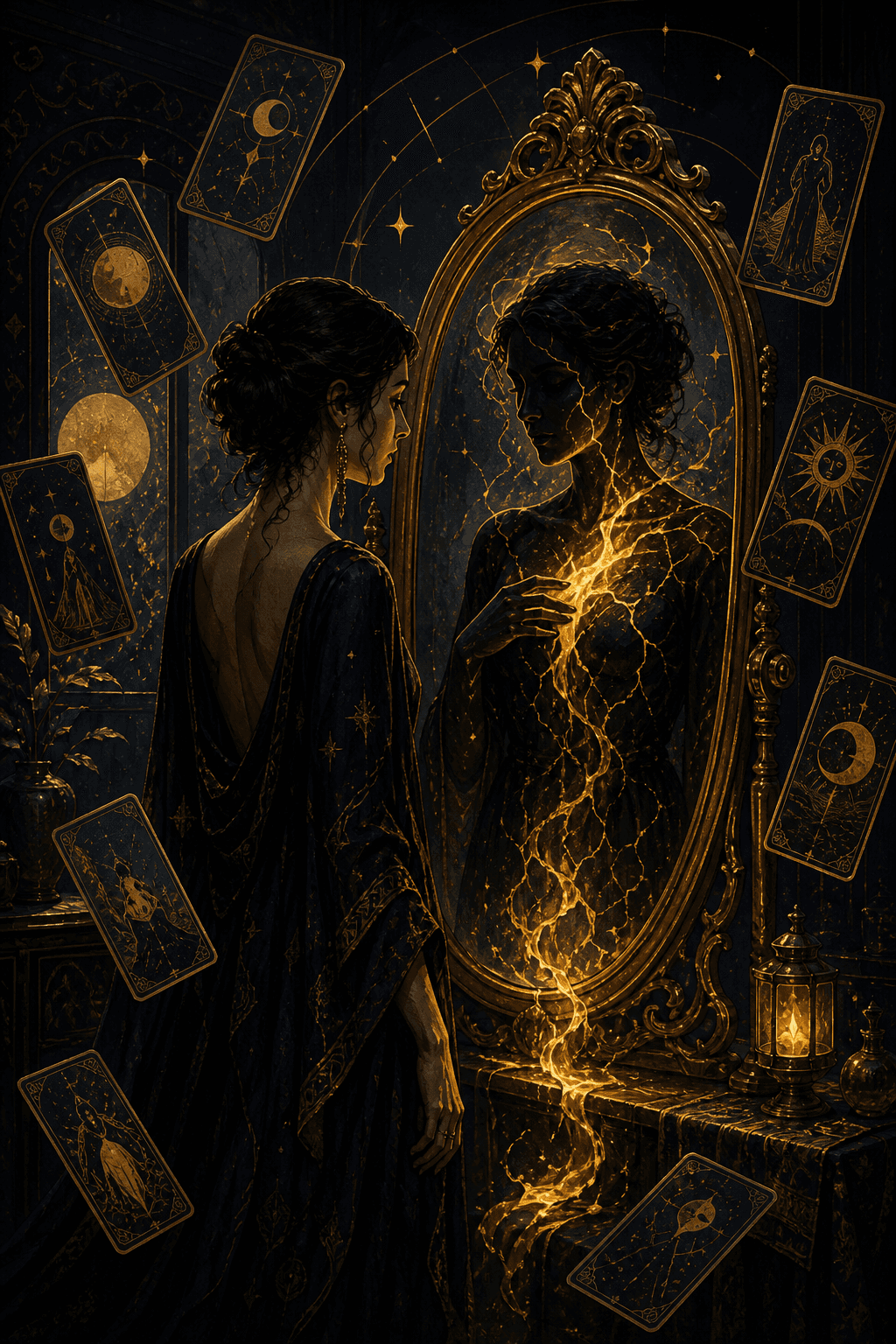
Post-Retrograde Tarot: Spreads and Timing for Action
The calendar says the retrograde is over, yet your inbox is still a minefield, the contract remains unsigned, and the cards on your table refuse to give you a clean green light.
If you have ever pulled a spread on the exact afternoon Mercury, Venus, or Mars stationed direct—expecting a triumphant appearance from The Chariot or the Ace of Wands—only to stare down The Hanged Man or the Eight of Swords, you have encountered one of the most misunderstood thresholds in divination. Popular culture treats the end of a retrograde like a light switch flipping from off to on. Observational astronomy and traditional tarot practice know better. A planet turning direct does not leap into a sprint; it grinds to a dead halt before slowly cranking its cold engine back to life across weeks of contested territory.
Most resources treat tarot and astrology as separate languages, offering generic five-card spreads for "moving forward" that ignore the actual mechanics of the sky. This guide bridges that gap. Designed as a comprehensive manual for readers who want to sync their decks with real celestial geometry, it replaces superstition and calendar-watching with a rigorous diagnostic system for the days and weeks following any planetary station.
In the pages ahead, you will learn how to read the subtle shift from retrograde excavation to forward momentum without falling for false starts. We will cover:
- The Physics of the Station and Shadow: Why the exact day a planet turns direct is actually the heaviest, most immobile point of the cycle, and how to track the three-act "echo phase" across your spreads.
- Archetypes of Velocity and Renewal: How to distinguish between cards that demand sudden kinetic release (like the Eight of Wands) and those calling for slow, structural masonry (like the Knight of Pentacles or Justice).
- Bespoke Post-Direct Spreads: Architectural layouts built specifically to audit retrograde debris, untangle relationship static, and time career launches.
- Beyond Mercury: How to adjust your interpretive lens when slower, heavier bodies—Venus, Mars, Saturn, and Pluto—grind to a halt.
- Astrological Timing Protocols: How to map zodiacal degree crossings directly onto the Minor Arcana using Golden Dawn decan correspondences.
- Diagnostic Roadblocks: What it really means when the sky is completely clear, yet your deck still throws up walls of resistance.
Whether you are sitting with a client eager to text an ex the moment Venus wakes up, or waiting to sign a lease as Mercury clears its shadow, this guide will teach you how to read the terrain before you hit the gas.
The Anatomy of a Station: What Direct Motion Actually Means
Look at any digital calendar or astrology feed on the day a retrograde ends, and you will see language borrowed from modern transit: lights turning green, bottlenecks clearing, engines firing up. The collective sigh of relief is almost audible. You are told that the delays are finished, that communication lines have snapped back into alignment, and that you are finally free to sign contracts, send vulnerable messages, or launch projects that have gathered dust since the planetary backslide began.
In the tarot reading room, this optimism often produces a distinct kind of client: someone who arrives on the very afternoon of a station, spreads their cards across the cloth, and expects to see immediate, unhindered forward propulsion.
Astrological reality—and the symbolic architecture of the tarot—tells a much quieter, more demanding story.
The Geometry of the Illusion: What a Station Actually Is
To understand why a planet "turning direct" does not create an immediate burst of speed, you have to peel away the language of celestial choreography and look at the physical geometry.
No planet in our solar system ever stops in its tracks. None shifts gears, and none travels backward along its elliptical orbit. What we observe from our vantage point on Earth is an optical artifact born of differing orbital velocities. Picture two trains running side by side on parallel tracks. If you sit in the faster train as it overtakes the slower one, the slower train appears to drift backward against the distant horizon.
Apparent Planetary Motion Across the Zodiacal Backdrop
----------------------------------------------------------------------
Direct Motion:       ------>------>------>
Station Retrograde:                    [ || STOP || ]
Retrograde Motion:                     <------<------<------
Station Direct:      [ || STOP || ]  <-- (Apparent standstill: Zero Velocity)
Resumed Direct:      ------>------>------> (Slow acceleration through shadow)
----------------------------------------------------------------------
A planetary station occurs at the two visual turning points of that overtaking maneuver: the moment the planet appears to halt its eastward crawl through the constellations, reverse course westward (stationing retrograde), and weeks or months later, grind to a halt once more before resuming its normal drift (stationing direct).
The key word is grind. A planetary station is not a flick of a switch; it is a point of apparent zero velocity. Viewed against the backdrop of the zodiac, the planet’s daily motion drops from fractions of a degree down to minutes, seconds, and finally an apparent dead stop. For several days—or in the case of outer planets like Saturn or Jupiter, several weeks—that celestial body camps out on an exact degree of the sky.
If retrograde motion represents a subterranean excavation, the station is the moment the shovel strikes deep bedrock and rests there. The planet is at its heaviest, its slowest, and its most concentrated. Far from being a green light, a station is the thickest, most stationary point of the entire transit.
The Cold Engine: Why Direct Motion Is Not an Instant Sprint
Think of a fully loaded freight ship cutting its engines mid-ocean. It does not pivot on a dime the moment the captain orders full ahead. Even after the propellers begin to churn in the opposite direction, the immense mass of the hull continues to slide through the water on residual momentum.
When a planet stations direct, it is an engine turning over in sub-zero weather. The machinery has sputtered to life, but the oil has not circulated, the gears are stiff, and forcing the accelerator to the floor does little more than flood the engine.
Astrologers measure this sluggish recovery through the post-retrograde shadow—what writer and astrologer Eric Francis has referred to as the "echo phase." The shadow period covers the exact degrees of the zodiac that the planet retrograded across. Until the planet crawls all the way forward to the degree where it first made its backward turn, it is still retracing old footsteps, kicking up silt, and clearing out the debris left behind by its previous passes.
THE THREE-PHASE RETROGRADE ARC
Phase 1: Pre-Shadow       ------> [Reaches Degree X]
Phase 2: Retrograde Arc   <------ [Retreats to Degree Y]
          ↳ Station Direct: The Pivot Point (Apparent Zero Velocity)
Phase 3: Post-Shadow      ------> [Crawls back from Y to X]
          ↳ True Momentum Restored only after Degree X is cleared
When you pull cards for yourself or a client during this window, expecting clean momentum is a fundamental error. The atmosphere is not yet clear. The dust kicked up by the retrograde is suspended in the air, catching the light, and settling onto surfaces you have not yet examined. Direct motion marks the decision to face forward; it does not constitute movement.
The Post-Direct Trap: False Starts and Predictive Misfires
The days immediately following a direct station are notorious for false starts. In practice, this period catches people off guard far more often than the retrograde itself. During the retrograde, caution is built into the cultural narrative; people expect miscommunications, double-check travel itineraries, and hesitate before signing leases.
Once the calendar announces direct motion, however, that vigilance evaporates. People burst through the gates like racehorses, only to discover that the track is still ankle-deep mud.
In a tarot reading, this mismatch between human expectation and energetic reality creates acute confusion. A querent will ask, "Now that Mercury (or Venus, or Mars) is direct, should I send this email?" They draw a card hoping for an unqualified confirmation, perhaps attempting a quick /tarot/yes-or-no spread, only to receive cards saturated with delays, second thoughts, or obscured information.
The reader who relies strictly on textbook keywords might stumble here. Why is the road blocked if the retrograde is over?
The road is not blocked; it simply has not dried out yet. When you consult the deck during a station or early post-shadow, the cards are not showing you an eternal verdict. They are showing you the friction of an object attempting to accelerate from absolute zero. If you misinterpret that initial resistance as a permanent refusal from the universe, you risk abandoning viable ideas simply because they failed to ignite on day one. Conversely, if you force the matter, you carry unresolved retrograde baggage straight into your fresh start.
Suspension and Awakening: The Hanged Man and the Eight of Swords
The tarot maps this threshold between apparent stillness and tentative reorientation with remarkable psychological precision, particularly through two archetypes: The Hanged Man and the Eight of Swords.
         THE ANATOMY OF REORIENTATION
-----------------------------------------------------
[12. The Hanged Man]   --->   [Eight of Swords]
Voluntary Suspension          First Tentative Step
Stillness / Altered Sight     Residual Mental Fog
The Planet at Station         The Early Post-Shadow
-----------------------------------------------------
In the traditional sequence of the Major Arcana, The Hanged Man represents the station itself. Suspended by his ankle from the living wood of the world tree, his posture is entirely passive, yet his face shows neither agony nor panic. Around his head gleams a soft, nimbus-like halo—the unmistakable symbol of illumination achieved not through conquest or effort, but through absolute, radical surrender to non-doing.
The Hanged Man understands what our productivity-obsessed culture refuses to accept: certain truths can only be apprehended when momentum drops to zero. He is the planetary station made visible. His foot is bound; he cannot pace, sprint, or build. In that suspension, gravity inverts his perspective. What once seemed critical drops out of his pockets; what he ignored rises into his line of sight.
When you draw The Hanged Man as a planet stations direct, the card serves as a warning against cutting yourself down from the tree prematurely. You do not leave the station with your old worldview intact. The station requires you to hang until the insight has completely saturated your awareness. Dropping to the ground before the shift has taken root merely leaves you bruised.
If The Hanged Man is the station, the Eight of Swords captures the awkward, tender reality of the early post-shadow.
Examine the Pamela Colman Smith illustration carefully. A woman stands bound in red cord, surrounded by eight upright blades stuck into wet, marshy soil. Her eyes are covered by a cloth. At first glance, it looks like an image of helpless imprisonment.
Look closer at the physical facts of the card:
- The cords wrapping her torso and arms are loose, looped gently rather than knotted tightly into the flesh.
- The swords do not form an impenetrable wall; they stand behind and beside her, leaving the path directly in front of her open.
- The gray castle of her past sits far behind her on a distant hill; she has already walked away from it.
- The water pooled at her feet is shallow—a stream of intuition and memory that she can easily wade through.
This is precisely what direct motion feels like in its opening days. The acute restrictions of the retrograde have fallen away, but the blindfold remains. The bindings are loose enough that she could shrug them off with a single firm movement, yet she pauses. She tests the mud with her bare foot. She cannot yet see where the path leads, because her senses are still adjusted to the inward, reflective dark of the preceding weeks.
To understand how these cards behave when laid out across a cloth, you can explore the structural foundations in our guide to card meanings and see how timing shifts alter their tone in various spread geometries.
The Eight of Swords is not a card of permanent victimhood; it is a card of waking up from a trance. It depicts the awkward moment when you realize that the external forces stopping you have dissolved, yet your own muscles have not quite remembered how to stride forward with confidence. You are free, but you are still shivering.
That hesitation is not a moral failure; it is an intelligent, somatic adaptation to a changing terrain. Direct motion gives you permission to test the ground beneath your feet. It does not demand that you sprint into the fog.
Demystifying the Post-Retrograde Shadow Period and Echo Phase
Popular astrological culture tends to treat a planetary station direct like the drop of a checkered flag. The date arrives on the calendar, memes proclaim survival, and people rush to send the fraught email, sign the stalled contract, or schedule the difficult conversation they put off for three weeks.
Then the email bounces. The contract contains an errant clause on page four. The conversation flares up over the exact miscommunication everyone thought was settled.
In tarot practice, reading right at the station without accounting for the post-retrograde shadow is one of the most reliable ways to mistake a pause in the storm for clear skies. Planets do not jump from reverse into a highway sprint; they crawl, halt, shudder, and slowly retrace every inch of territory they contested over the preceding weeks. If the retrograde itself is an excavation, the post-retrograde shadow—often called the retroshade or echo phase—is the period where you inspect what you dug up, sweep the floor, and haul away the debris before attempting to build anything new.
The Geometry of the Retroshade: Retracing the Degrees
To understand why your spreads may still look hesitant after a planet stations direct, you have to look at the mechanics of the retrograde loop.
An apparent retrograde is not an isolated event; it is a three-act transit across an identical stretch of the zodiac.
- The Pre-Retrograde Shadow: The planet crosses a specific degree of the zodiac—let us call it Degree A—moving forward. Weeks later, it slows down and stops at Degree B, where it turns retrograde.
- The Retrograde Proper: The planet backs up across that exact same span, traveling from Degree B all the way back to Degree A, where it halts again. This second halt is the station direct.
- The Post-Retrograde Shadow: The planet shifts forward once more at Degree A, traveling across those contested degrees a third and final time until it crosses Degree B.
       [Pre-Shadow Phase] --------->
Degree A ============================== Degree B
       <--------- [Retrograde Phase]
       [Post-Shadow / Echo] ------->
The post-retrograde shadow is that third crossing. The territory is familiar, but the landscape has changed. If Degree A was an unresolved budget dispute when Mercury first crossed it six weeks ago, and the retrograde forced an audit of your accounts between Degree B and Degree A, the post-shadow crossing from A back to B is when you sit down with the revised balance sheet and actually correct the figures.
Astrologer Eric Francis coined the term "echo phase" for this window because unresolved events from the station often reverberate like sound off a canyon wall. You are not dealing with entirely new crises; you are hearing the lingering acoustic traces of what happened while the planet was traveling backward. Until the planet clears Degree B—the exact degree where it first turned retrograde—the book is not closed on that cycle.
The Psychological Reality: Recalibration, Cleanup, and Missed Details
Why does the echo phase feel so distinctly sluggish? The friction is largely psychological.
During the retrograde itself, your attention turned inward. Whether you realized it or not, your subconscious was indexing doubts, noticing structural faults, and revising internal narratives. When the planet stations direct, that inward pressure releases, but your external reality has not caught up with your internal adjustments.
The post-shadow is the phase of administrative and emotional cleanup. It is mundane work:
- Re-reading the email draft with fresh eyes to remove passive-aggressive phrasing.
- Discovering the missing shipping receipt slipped beneath the desk calendar.
- Following up with someone who went silent during the station to clarify what they actually meant.
In a personal tarot reading, this shows up when someone asks for a definitive yes-or-no on a project or partnership immediately after a station. The cards often refuse to give a simple green light. Instead, they present cards of quality control and sorting: the Eight of Pentacles showing a craftsman checking each coin against the original template, or the Four of Swords suggesting that the mind is still shedding fatigue.
The retroshade demands what surveyors call a re-run: walking the boundary lines a second time with the compass calibrated, making sure the stakes are driven into genuine earth rather than loose gravel.
Two Distinct Windows: The Station Pivot vs. The Final Clearance Degree
To read timing accurately during this phase, you must separate the calendar into two distinct operational chapters: the station pivot window and the clearance phase.
STATION PIVOT (Days 1–5)             CLEARANCE PHASE (Weeks 1–3)
┌───────────────────────────────┐   ┌─────────────────────────────────────────┐
│ Planet sits near 0° velocity  │   │ Planet builds daily orbital speed       │
│ Sensation: Thick mud, heavy   │   │ Sensation: Gaining traction             │
│ Tarot: Suspended, unmoving    │   │ Tarot: Deliberate step-by-step progress │
└───────────────────────────────┘   └─────────────────────────────────────────┘
1. The Station Pivot Window (Roughly 48 to 96 Hours Around the Station)
At the exact moment a planet stations direct, its apparent velocity drops to zero. From Earth’s perspective, it is a stationary point of light in the night sky. In astrology, a stationary planet is loud, concentrated, and immovable.
If a planet is stationary, its themes are intensified, not resolved. A Mercury station direct often coincides with the most bizarre technology failures or communication knots of the entire cycle. A Venus station direct often brings relationship tension to an absolute peak of stubbornness.
When conducting a tarot reading inside this narrow window, expect cards of high tension, immobility, or profound perspective shifts. You will frequently pull The Hanged Man, which mirrors the stationary planet perfectly: a voluntary or involuntary suspension in place, where physical motion is impossible and the only available action is changing how you view the situation.
2. The Clearance Phase (Spanning Weeks)
Once the planet shakes off the station, it begins building daily speed. For inner planets like Mercury, this phase lasts roughly two weeks; for Venus, around three weeks; for Mars, it can stretch across two full months.
During clearance, forward momentum returns, but it operates under probation. You are operating with partial clarity. Each day, the planet covers more minutes of arc, and each day, your spreads will reflect an increasing capacity for sustainable action.
The moment of true liberation occurs at the clearance degree: the exact degree where the retrograde originally began. Once the planet sails past that coordinate into fresh zodiacal degrees, the echo falls silent. The cycle has concluded its transit, and new themes take root.
Tarot Diagnostics: Reading Shadow Drag vs. Cleared Momentum
When you lay out cards during a post-retrograde period, how do you determine whether your querent is dealing with lingering shadow drag or operating with cleared momentum? You look at the interaction of card velocity, suit conditions, and directional orientation.
┌────────────────────────────────────────────────────────────────────────┐
│                        TAROT DIAGNOSTIC SPECTRUM                       │
├───────────────────────────────────┬────────────────────────────────────┤
│ SHADOW DRAG INFLUENCE             │ CLEARED FORWARD MOMENTUM           │
├───────────────────────────────────┼────────────────────────────────────┤
│ • Swords dominated by internal    │ • Decisive, piercing Swords        │
│   stagnation (4, 7, 8)            │   (Ace, Knight)                    │
│ • Pentacles showing review/repair │ • Wands moving unobstructed        │
│   (Pentacles 8, reversed 3)       │   (Wands 8, Chariot)               │
│ • Majors of atmospheric ambiguity │ • Majors of outward manifestation  │
│   (18-TheMoon, 12-TheHangedMan)   │   (01-TheMagician, 07-TheChariot)  │
│ • Court cards looking backward or │ • Court cards facing forward or    │
│   hesitant in posture             │   poised for deliberate movement   │
└───────────────────────────────────┴────────────────────────────────────┘
Diagnostic 1: The Character of the Swords
The suit of Swords reflects the mental faculties governed primarily by Mercury. During the post-retrograde shadow, Swords in a spread rarely point straight ahead.
- Shadow Drag: You will see cards that deal with mental clutter, cautious reassessment, or defensive thinking. The Seven of Swords frequently appears here—not as malice, but as the need to carefully salvage what is useful while tiptoeing away from a messy situation. You may also see the Eight of Swords, signaling that while the exterior obstacles have begun to dissolve, the querent is still acting as if they are hemmed in by old assumptions.
- Cleared Momentum: The swords sharpen. The Ace of Swords cuts through ambient noise, delivering the sudden, unambiguous breakthrough that was unavailable during the retrograde. The Knight of Swords charges outward without second-guessing his heading.
Diagnostic 2: The Element of Fire and Card Velocity
In any card assessment, velocity is revealed through Fire (Wands) and explicit motion cards.
- Shadow Drag: Wands appear tangled, defensive, or depleted. The Nine of Wands is a classic post-shadow marker: you have survived the worst of the cycle, but you are leaning on your staff, bandaged, waiting for another complication before you drop your guard.
- Cleared Momentum: The arrival of the Eight of Wands is the gold standard of cleared shadow. In the traditional Smith-Waite imagery, eight staves fly freely across an open landscape with zero human figures or obstacles to impede their trajectory. When this card appears in an outcome or timing position, the echo has dissipated; your communications, travels, and negotiations will pick up rapid speed. Similarly, The Chariot indicates that divergent drives (the black and white sphinxes that refused to coordinate during the retrograde) are harnessed to a unified intent.
Diagnostic 3: Atmospheric Majors
Major Arcana cards pulled during this transition tell you whether the underlying spiritual currents are still resolving past material or opening fresh ground.
If you draw The Moon, the post-shadow is still active. The path between the towers is damp; shadows are long; your sensory instruments are not yet providing reliable data. The directive is to move slowly and avoid premature commitments.
Conversely, when The Magician lands on your table, the station's drag is finished. With one hand raised to the sky and one pointing to the earth, all four elemental tools rest firmly on the table, intact and ready for deployment. The tools are no longer being repaired or audited; they are ready for use.
You can study these shifting archetypes in detail across our tarot card meanings library, or test how these influences map onto your specific calendar using structured layouts from our tarot spread directory. Tracking these diagnostic cues lets you advise yourself or your clients with nuance: neither freezing in unnecessary terror nor charging blindfolded across terrain that still needs sweeping.
Tarot Archetypes of Forward Velocity and Structural Renewal
When a planet stations direct, the sky does not flip a switch; it slowly releases a brake. As we established in the exploration of shadow periods and echo phases, the turn from retrograde to direct motion begins in near-immobility. In the cards, that gradual thawing reveals itself through specific symbolic engines—archetypes that describe how kinetic energy returns to a stalled life, how clarity pierces cognitive fog, and how structural integrity gets rebuilt after weeks of revision.
If you lay out cards during a planetary station, you are looking for how momentum reorganizes itself. Some cards register as an exhilarating rush of wind; others act as heavy masonry settling into plumb lines. Understanding which archetype has stepped forward helps you match your actual pace to the subtle physics of the moment.
The Chariot and the Eight of Wands: Restored Vectors and Sudden Velocity
Two cards in the deck embody pure directional force, but they handle velocity through entirely different mechanics.
The Chariot represents conscious, harnessed propulsion. Notice the iconography in the Pamela Colman Smith illustration: the charioteer does not hold reins. He directs the black and white sphinxes through sheer willpower, intent, and balance. The sphinxes pull in opposing directions—much like the competing impulses you feel right as a retrograde concludes, where the urge to plunge ahead fights against residual hesitation.
The Chariot is not effortless speed; it is mastery over conflicting forces. In the context of a station direct, pulling this Major Arcanum signals that structural alignment has been achieved. The vehicle holds. The armor is strapped on. Whatever was recalibrated during the retrograde (especially Mars or Saturn stations) is now ready to bear weight. The Chariot tells you that movement requires decisive steering; you cannot drift into post-retrograde progress.
       THE CHARIOT                       EIGHT OF WANDS
 [ Directed Will / Alignment ]     [ Uninhibited Kinetic Release ]
   Sphinxes harnessed, armor on        Staves flying through open air
   Traction through focus              Velocity through absent friction
By contrast, the Eight of Wands is velocity liberated from friction. In traditional decks, it is one of the few Minor Arcana devoid of human figures. Eight blossomed staves slice through clear, open air toward a fertile valley. There are no obstacles, no reins, no steering mechanisms to deliberate over.
When Mercury or Mars clears its station and begins gaining daily speed, the Eight of Wands often shows up in a tarot reading to mark the sudden clearing of logjams. Emails get answered. Suspended contracts arrive signed. The conversational static of the preceding three weeks vanishes. Where The Chariot asks, Can you hold these horses on the road?, the Eight of Wands says, Duck your head and let the current carry the message. It is swift, catalytic, and occasionally dizzying.
Judgement and the Eight of Cups: Shedding Baggage and Answering the Call
Momentum is useless if you are still dragging obsolete cargo. Retrogrades are famous for unearthing unfinished emotional business, half-abandoned projects, and structural weaknesses. But once the planet stations, the work shifts from diagnosis to eviction.
The Eight of Cups captures the quiet, nocturnal moment of departure that makes forward motion possible. A cloaked figure walks away from eight golden chalices carefully stacked in the foreground, turning toward a barren, moonlit ridge. The cups are not broken; they are simply exhausted of meaning.
In a post-retrograde landscape—particularly after Venus or Neptune stations—this card demands honest triage. What did the retrograde expose as dead weight? You might have spent weeks trying to re-patch a broken operational routine or salvage a dynamic that ceased functioning months ago. The Eight of Cups reminds you that leaving is an act of preservation, not failure. You do not kick the cups over; you walk uphill toward higher ground because staying in the marsh will rot your boots.
Where the Eight of Cups is a quiet turning of the back, Judgement is an unmistakable, brass-toned summons. The angel’s trumpet sounds across gray waters, and figures rise naked from their stone sarcophagi, arms outstretched.
+-------------------------------------------------------------+
|                      THE POST-STATION SHIFT                 |
|                                                             |
|   Eight of Cups                 -->    Judgement            |
|   (The Conscious Departure)            (The Definitive Awakening)
|   Walking away from what               Stepping out of the stone box
|   exhausted its vitality               into absolute moral clarity
+-------------------------------------------------------------+
Judgement is the quintessential echo-phase card. It represents the sudden, undeniable perspective that arrives once a planet crosses the degree where it first turned backward. You see the entire cycle in a single panoramic flash: what went wrong, why it stalled, and who you must be now that the trial is finished. The sarcophagus is stone-cold certainty; stepping out of it means refusing to live inside an outdated version of your life. Judgement does not ask for subtle tweaks. It calls for total resurrection.
Pacing the Engine: Knight of Swords vs. Knight of Pentacles
Once you have cleared the debris and felt the initial surge of direct motion, a practical question arises: at what speed do you build traction? Within the court cards, two figures define the extremes of post-retrograde pacing.
The Knight of Swords gallops headlong into a gale. His horse is wild-eyed, his sword held aloft, his cloak whipped backward by the wind. He represents the intoxicating rush of regained mental clarity. The retrograde brain fog lifts, and suddenly you want to execute twelve initiatives before Tuesday.
This Knight is invaluable when a window of opportunity is narrow—such as sending an urgent proposal during the brief window between Mercury’s direct station and its departure from the shadow zone. But his weakness is his contempt for terrain. He rides hard without checking the horse’s shoes. If you channel only the Knight of Swords when a planet turns direct, you risk creating a fresh batch of logistical errors that will haunt the next retrograde cycle.
                  POST-RETROGRADE CATALYSTS

  KNIGHT OF SWORDS                 KNIGHT OF PENTACLES
  -----------------                -------------------
  • Swift ideological strike       • Methodical load-bearing
  • High risk of burnout           • Low risk of repetition errors
  • Breaks deadlocks instantly     • Consolidates long-term gains
  • Best for: acute action         • Best for: sustainable rhythm
The corrective counterpart is the Knight of Pentacles. He sits motionless atop a heavy, dark plough horse, gazing calmly at a single gold coin cradled in his hand. The field around him is cleanly furrowed. He is the archetype of sustainable traction.
During the post-retrograde shadow period—when the planet is technically moving direct but still retracing old degrees—the Knight of Pentacles is usually your safest ally. He understands that genuine structural renewal happens one furrow at a time. He does not confuse frantic motion with progress. Where the Knight of Swords charges across the field, trampling the crops, the Knight of Pentacles inspects the seedbed, repairs the harness, and guarantees that the harvest will actually materialize.
If your spread pairs a swift card like the Eight of Wands with the Knight of Pentacles, the message is clear: let communication move fast, but keep your operational execution deliberate and rooted.
Reading Reversals at the Station: Structural Block or Internal Lag?
Reversals take on acute diagnostic power during a planetary station. When a card appears inverted while the sky is righting itself, it rarely means a simple "no" (for quick determinations on immediate queries, practitioners often turn to dedicated frameworks like a /tarot/yes-or-no layout). In post-retrograde spreads, an inverted card acts as a pressure gauge: it shows where the energy has failed to turn direct along with the planet.
To read these reversals accurately, ask a fundamental diagnostic question: Is this an architectural bottleneck, or is it psychological inertia?
1. Architectural Bottlenecks (Reversed Pentacles and Swords)
When earth and air cards appear reversed after a station, the impediment is usually external, technical, or systemic.
- Reversed Swords (e.g., Eight of Swords reversed or Ace of Swords reversed): Lingering misinformation or communication infrastructure that has not yet updated. The contract still contains ambiguous clauses; the software patch caused a secondary bug.
- Reversed Pentacles (e.g., Three of Pentacles reversed or Eight of Pentacles reversed): Logistical drag. Budgets are stalled in committee, or materials have not cleared transit. The planet may be direct, but physical matter moves slowly. Do not force the construction until the foundation dries.
2. Psychological Inertia (Reversed Cups and Wands)
When water and fire cards invert during this phase, the sky has moved on, but your nervous system is still bracing for impact.
- Reversed Wands (e.g., Four of Wands reversed or Knight of Wands reversed): Hesitation masked as exhaustion. The fear that starting a creative venture will invite another breakdown. You are waiting for absolute, risk-free certainty that will never come.
- Reversed Cups (e.g., Four of Cups reversed or Nine of Cups reversed): Emotional residue from retrograde conflicts. You are still chewing over an apology that was poorly phrased two weeks ago, refusing to accept the quiet peace now available.
                       DIAGNOSING REVERSALS AT THE STATION
                                       |
          +----------------------------+----------------------------+
          |                                                         |
     SWORDS & PENTACLES                                        CUPS & WANDS
   [ External / Mechanical ]                               [ Internal / Emotional ]
   Look at: Systems, contracts,                            Look at: Habits, resentment,
   timelines, budget bottlenecks.                          apprehension, self-doubt.
   Action: Re-audit the blueprints.                        Action: Reset the nervous system.
To explore how these card combinations interact across specific diagnostic layouts, our guide to learn spreads offers tailored templates designed specifically for station and shadow phases. If you need to refresh your understanding of individual card meanings before reading them in motion, consult our comprehensive directory to learn cards.
The Core Architecture: A Spread for Moving Forward Post-Direct
When a planet stations direct, the sky does not instantly clear. If you have ever watched heavy freight trains shift gears, you know the violent shudder that runs through the couplings before the wheels find traction. The retrograde may be technically over, but the stationary point—that apparent halt against the backdrop of the stars—demands its own ritual of orientation.
Rushing into an open-ended spread right after a station often yields confusing cards. The deck mirrors the sky: static, pressurized, thick with unresolved particulate matter. To cut through that atmospheric haze, you need a spread built around the mechanics of the planetary turnaround.
The seven-card Station-to-Stewardship Spread translates the transition from backwards spin, through the standstill, and out across the post-retrograde shadow into a clear tactical map. You can lay this spread on a dedicated cloth during an intentional tarot reading or use it whenever you need to gauge the true friction left in a project after weeks of delay.
Anatomy of the Station-to-Stewardship Spread
This layout avoids symmetric crosses or standard ladders. Instead, it mirrors the visual shape of a planetary loop: three cards forming a descending foundation on the left (the retrograde descent), an apex anchor in the center (the station), and three rising cards on the right (the ascent through the shadow into clear sky).
               [ Card 4 ]
            (The Stationary Pivot)

   [ Card 2 ]                    [ Card 6 ]
(The Sediment)               (The Shadow Test)

[ Card 1 ]                          [ Card 5 ]
(The Unmasking)                 (First Acceleration)

         [ Card 3 ]       [ Card 7 ]
       (The Real Cost)  (The Clear Horizon)
- Card 1: What Was Unmasked. Placed bottom-left. The foundational illusion or structural fault exposed while the planet was retracing its steps.
- Card 2: The Sediment. Placed mid-left. What settled to the bottom when the commotion died down—the hard, unglamorous reality left in the pan.
- Card 3: The Real Cost. Placed lower-center-left. What you traded, spent, or surrendered during the retrograde phase.
- Card 4: The Stationary Pivot (The Current Standstill). Placed top-center, reigning over the spread. The exact, precarious balance of the present moment. This card reveals the tension between momentum and resistance right now.
- Card 5: First Acceleration. Placed lower-mid-right. The specific gear to engage first; the initial point of safe mechanical contact.
- Card 6: The Post-Shadow Test. Placed upper-right. The exact echo scenario you will meet again as the planet repasses the degree of its original retrograde station.
- Card 7: The Clear Horizon (Stewardship). Placed bottom-right, anchoring the future wing. The nature of the territory once you completely leave the shadow behind.
If you are exploring other layouts for liminal periods, our guide to learn spreads details how structural geometry changes how cards converse with one another across a table.
Position Analysis: From Debris to Horizon
Position 1: What Was Unmasked
Retrogrades do not break things; they reveal what was already rotted beneath the veneer. This card represents the structural fault line that became impossible to ignore over the prior three to six weeks. If a major arcana card lands here, the revelation involved an identity crisis or an unyielding systemic reality. If a minor pip appears, look at the suit: a Pentacle points to neglected resources or physical wear; a Cup reveals an emotional leak you plugged with denial. Treat this card not as an open wound, but as an accurate diagnostic report.
Position 4: The Stationary Pivot (The Current Standstill)
This is the fulcrum of the entire spread. Planetary stations feel quiet, but they carry enormous potential energy. Think of the split-second pause of a pendulum at the apex of its arc. The card in this position tells you why things feel frozen despite the calendar saying the retrograde has ended. It marks the precise quality of patience required of you today. An active fire card here does not mean run; it warns of burning out your clutch while the brakes are still engaged. An earth card suggests deliberate, physical grounding before attempting motion.
Position 6: The Post-Shadow Test
Astrologers often warn about the "echo phase"—the post-retrograde shadow period during which the planet travels across the degrees where it first tripped up. Card 6 acts as an early warning radar for that echo. It illustrates the re-emergence of an old dispute, a revived contract draft, or a familiar psychological pitfall. This card is not an omen of failure; it is an open-book exam. Because you already know what was unmasked in Position 1, Card 6 shows you how the universe checks whether you actually learned the lesson or merely waited out the storm.
Position 7: The Clear Horizon
The final card grounds your stewardship. When the planet finally exits the shadow degrees, what does sustainable operation look like? This is rarely a blank slate; retrogrades remodel existing architecture rather than clearing empty lots. Card 7 defines the long-term posture required to maintain what you have repaired. It is your benchmark for whether forward movement is genuine progress or just the resumption of old bad habits.
Technical Modifiers: Elemental Dignity and Station Modalities
A spread is more than seven disconnected islands. To extract high-resolution insight, apply two traditional interpretive layers: elemental friction and the astrological modality of the direct station.
1. Elemental Dignity Across the Wings
Compare the left wing (Cards 1–3, the descent) against the right wing (Cards 5–7, the forward movement).
- Active Elements (Fire & Air): These favor rapid translation, debate, quick adjustments, and outward expansion. If Fire and Air dominate the right wing, the post-shadow recovery will accelerate rapidly once the station passes.
- Passive Elements (Water & Earth): These require physical digestion, emotional integration, and concrete evidence. If Water and Earth dominate the right wing, do not mistake a slow response from the world for a lack of progress.
Pay particular attention to the contact point between Card 4 (The Pivot) and Card 5 (First Acceleration):
- Friendly Dignity (e.g., Fire + Air, Earth + Water): The transition from standstill to motion happens smoothly. The insight of the station translates directly into the action of Card 5.
- Unfriendly Dignity (e.g., Fire + Water, Air + Earth): Expect friction. If Card 4 is Water (emotional stillness, grief) and Card 5 is Air (intellectualizing, immediate business correspondence), you risk cutting off your own process prematurely. The engine will sputter until the elemental demands of Card 4 are fully respected.
ELEMENTAL RELATIONSHIP CHEAT-SHEET FOR POSITIONS 4 & 5:
- Fire + Air: Combustion; swift, clean takeoff.
- Earth + Water: Germination; quiet, fertile, steady pacing.
- Fire + Water: Scalding steam; impulsive action masks unresolved feelings.
- Air + Earth: Dust storms; endless planning without concrete execution.
2. Modality Modifiers: Cardinal vs. Mutable Stations
The zodiacal sign in which the planet stations direct fundamentally changes how you read the court cards and pips in this spread.
-
Cardinal Direct Stations (Aries, Cancer, Libra, Capricorn): Cardinal energy demands immediate, structural leadership. In a Cardinal station, the cards in Positions 5 and 7 require decisive operational choices. Court cards represent actual decision-makers who must draw hard lines. Minor cards like the Two of Swords or Four of Pentacles become calls to break stale compromises and establish new operational ground rules without waiting for collective consensus.
-
Mutable Direct Stations (Gemini, Virgo, Sagittarius, Pisces): Mutable energy operates through dispersal, editorial adjustment, and linguistic nuance. A Mutable station rarely offers clean breaks; instead, it demands calibration. Cards in Positions 5 and 6 should be interpreted through the lens of revision. Swords indicate editing documents, refining terms, or untangling mixed messages. Cups suggest letting emotional currents dissipate gradually rather than damming them up. If an aggressive card lands in Card 5 during a Mutable station, it counsels tactical flexibility, not a frontal assault.
Case Walkthrough: A Mutable Station in Practice
To see the Station-to-Stewardship Spread in operation, consider this real-world reading conducted for an editorial director whose team collapsed into bitter miscommunication during a Mercury retrograde stationing direct in Gemini.
               [ Card 4: Two of Wands ]
                 (The Stationary Pivot)

   [ Card 2: 8 of Cups ]            [ Card 6: Page of Swords ]
     (The Sediment)                   (The Shadow Test)

[ Card 1: The Tower ]                  [ Card 5: Knight of Pentacles ]
   (The Unmasking)                       (First Acceleration)

         [ Card 3: 5 of Swords ]      [ Card 7: 3 of Pentacles ]
             (The Real Cost)             (The Clear Horizon)
The Reading
The descent wing tells a harrowing but familiar story. At Card 1 (What Was Unmasked) sits The Tower. The retrograde shattered a brittle editorial hierarchy. A project built on unspoken expectations and rushed deadlines suffered a public, embarrassing failure.
At Card 2 (The Sediment), the Eight of Cups confirms that key contributors checked out emotionally; the illusion of team unity evaporated, leaving cold, bare stone. Card 3 (The Real Cost) reveals the Five of Swords—hollow victories in Slack channels, broken trust, and an atmosphere where everyone felt defensive.
The reading pivots dramatically at Card 4: Two of Wands.
Here is the stationary point. The figure on the battlement holds the globe, looking out over the sea, but remains behind stone parapets. He has not walked out the gate. The Two of Wands captures the direct station perfectly: the storm has passed, the damage has been logged, but leaving the castle immediately would be foolish. The elemental dignity here is crucial: Fire (Wands) stationing in Mutable Air (Gemini). The querent felt an overwhelming urge to send a sweeping, defensive company-wide manifesto to clear the air. The Two of Wands says: Hold the perimeter. Survey the landscape. Do not mistake having a vantage point for possessing an open road.
Look at the transition to Card 5 (First Acceleration): Knight of Pentacles.
Fire (Wands) meets Earth (Pentacles). This is an unfriendly, heavy pairing. The querent wants to move fast, but the Knight of Pentacles reins his horse to an absolute walk. The first gear to engage is decidedly unglamorous: auditing spreadsheets, rewriting project scopes, and scheduling dull, one-on-one operational check-ins. No grandiose speeches. The only remedy for the structural ruin of The Tower is methodical, stone-by-stone labor.
The real warning lies in Card 6 (The Post-Shadow Test): Page of Swords.
As Mercury repasses its shadow degrees in Gemini, the Page appears: brisk, suspicious, wielding a sharp blade with immature hands. This card predicts that as soon as the revised project resumes, an echo of the original dispute will arise—likely through a snippy email, leaked critique, or passive-aggressive message from an anxious junior colleague.
Because the querent knows this test is coming, they can change the outcome. In the past, they would have met the Page of Swords with their own defensive blade, triggering the old Five of Swords dynamic. Armed with this reading, the querent recognizes the Page not as an enemy, but as a symptom of leftover anxiety. The posture required is that of the Knight of Pentacles: steady, unprovoked, clarifying terms patiently without raising the temperature.
Finally, Card 7 (The Clear Horizon) reveals the Three of Pentacles.
The contrast with Card 1 is striking. The Tower was an arrogant structure built without proper stonework, destined to tumble. The Three of Pentacles shows the architect, the monk, and the artisan conferring beneath an archway, blueprints in hand. Once the shadow period clears, the reward is not effortless ease, but genuine craftsmanship, shared technical standards, and earned mutual respect.
The spread reframed the client's week: it transformed a frantic scramble to fix their reputation into a disciplined, quiet exercise in building things to last.
Post-Retrograde Relationship Clarity: Miscommunication and Exes
A phone lights up at 11:42 PM on the night a planet stations. It is almost always a name you haven’t seen across your lock screen in fourteen months, carrying a message that sounds entirely innocuous: Saw this and thought of you. Hope you’re doing well.
During planetary stations—those days when Mercury or Venus appears to freeze against the backdrop of the stars before shifting direction—the boundary between memory and reality wears thin. Old lovers return not because destiny has staged an encore, but because retrogrades pull the mind backward into unresolved loops. When a planet stations direct, that backward pull halts abruptly. The optical illusion of reverse motion dissolves, and suddenly you are left holding the raw material of whatever washed up on your shore.
Navigating the aftermath of these reunions requires stepping out of the romantic fog and looking at the architecture of the connection. Once direct motion resumes, the real test begins: does this rekindled spark possess the structural integrity to survive forward momentum, or was it merely an echo stirred up by planetary friction?
The Station Doorway: Why the Past Knocks When Planets Halt
Astrologically, a planetary station is an intensification point. Think of a train applying its brakes: the friction generates heat, noise, and weight in one localized spot. When Mercury stations retrograde, communication turns inward, prompting review and re-evaluation. When it stations direct weeks later, all that suppressed reflection rushes outward. Similarly, Venus retrograde reopens the ledger of value, self-worth, and desire, pulling old attachments out of cold storage to ask whether their debts were ever truly settled.
People reach out during stations because their psychological filters drop. The ex who texts you as Mercury stations direct is usually reacting to a backlog of unspoken thoughts that crystallized during the backward phase.
        RETROGRADE PHASE                  THE STATION (PIVOT)               DIRECT & SHADOW
[ Internal review & rumination ] ---> [ Impulse reaches peak; ] ---> [ Harsh daylight returns; ]
[ Unresolved memories resurface]      [ The late-night text   ]      [ Does it hold real weight? ]
When the planet pivots, the atmosphere shifts. The retrospective mood clears, and the practical question of daily living returns. If an ex reappeared during the retrograde, the direct station reveals their actual capacity. Were they looking for closure, seeking a temporary analgesic for loneliness, or genuinely prepared to build something new?
This is where turning to a targeted tarot reading clarifies what pure emotional intuition often obscures.
The Objective Diagnostic: The Two of Cups, The Lovers, and The Three of Swords
To cut through the emotional static of a retrograde reunion, you must strip certain cards of their sentimental clichés. Three cards in particular appear with relentless frequency during post-retrograde relationship queries: the Two of Cups, The Lovers, and the Three of Swords. Reading them accurately demands evaluating their structural reality rather than their surface romance.
+--------------------------------------------------------------------------+
|                     POST-RETROGRADE DIAGNOSTIC TRIAD                     |
+--------------------------------------------------------------------------+
|  Two of Cups             |  The Lovers               |  Three of Swords  |
|  (/learn-cards/          |  (/learn-cards/           |  (/learn-cards/   |
|   37-TwoOfCups)          |   06-TheLovers)           |   52-ThreeOfSwords|
|                          |                           |                   |
|  * Immediate exchange    |  * Long-term alignment    |  * Surgical truth |
|  * Equal vulnerability   |  * Consequence of choice  |  * Historical cut |
|  * Receptivity in moment |  * Values over attraction |  * Necessary grief|
+--------------------------------------------------------------------------+
Two of Cups: The Quality of Exchange
The Two of Cups is often misread as a guarantee of lasting soulmate union. In practice, it represents parity of exchange in the immediate moment. Notice the imagery: two figures, equal in stature, holding vessels at the exact same level. The winged lion of passion floats above the caduceus of healing.
In a post-retrograde reading, this card does not mean you should remarry your ex. It indicates that both parties are currently speaking the same emotional dialect. The communication is reciprocal. If you sent a vulnerable message, they met it with equal vulnerability. However, cups carry water; they do not build foundations. The Two of Cups confirms emotional goodwill and genuine mutual affection right now, but it requires Pentacles or Emperors to sustain that goodwill through Tuesday morning logistics.
The Lovers: The Burden of Alignment
Where the Two of Cups deals with emotional attraction, The Lovers (Key 6) operates on the level of existential choice and core values. Standing beneath the angel Raphael, the figures in the garden must integrate conscious will with subconscious drive.
When The Lovers surfaces after a direct station, it pulls your attention away from whether you miss someone and points directly at compatibility of path. Retrograde nostalgia tricks you into believing that intense chemistry equals shared trajectory. The Lovers forces the question: does choosing this person require you to abandon the ethical or personal ground you won during the breakup? If this card lands reversed or is flanked by rigid cards like the Four of Pentacles, the reunion is an indulgence of habit that compromises your long-term alignment.
Three of Swords: The Surgical Removal of Illusion
Few cards trigger as much reflexive dread as the heart pierced by three iron blades against a backdrop of storm clouds. Yet in post-retrograde clarity, the Three of Swords is often your most reliable ally. Swords represent the intellect, clarity, and the principle of cutting through deception.
When assessing a reconciliation, the Three of Swords does not always announce fresh betrayal. More frequently, it acts as an architectural audit, showing that the original rupture remains unhealed. It reveals that the sweet text message you received did not address the structural crack that broke the vessel in the first place. It demands sober acknowledgment of grief rather than a desperate rush to patch things over. If you pull this card while asking about an ex's intentions, the tarot is giving you a definitive yes-or-no boundary: the pain that existed before the retrograde is still fully intact beneath the apology.
Diagnostic Spreads: Testing the Ground Post-Direct
When evaluating rekindled connections, broad, open-ended layouts tend to invite wishful projection. You need spreads with clear diagnostic functions designed to probe mechanics, accountability, and trajectory. You can explore more foundational layouts across our tarot spreads guide, but the following two architectures are calibrated specifically for post-retrograde conditions.
The Mercury Direct: Clearing the Signal (4 Cards)
Use this spread when an ex resurfaces via text, email, or a sudden mutual conversation, or when a current relationship suffered from chronic misunderstandings during the backward cycle. It isolates what was spoken from what was actually meant.
       [Card 1: The Static]
                 |
  [Card 2: The Core Message] <---> [Card 3: Unspoken Motive]
                 |
     [Card 4: Forward Vector]
- Card 1: The Static. What communicative baggage from the retrograde is distorting the interaction? (e.g., lingering assumptions, defensive armor, unresolved resentment).
- Card 2: The Core Message. What is being said at face value? The plain, objective fact of their outreach.
- Card 3: The Unspoken Motive. What psychological reality prompted the contact? Look for whether this card reflects genuine remorse, sudden loneliness, or boredom.
- Card 4: The Forward Vector. The immediate, practical trajectory of this dialogue over the next two weeks as the shadow phase finishes.
The Venus Direct: The Structural Weight Spread (5 Cards)
Venus direct demands cold evaluation of relational foundations. Run this spread when feelings have reignited and you must determine whether the partnership can support actual life on the calendar.
         [Card 1: The Lure]
                 |
   +-------------+-------------+
   |                           |
[Card 2: The Root Cause]  [Card 3: Current Capacity]
   |                           |
   +-------------+-------------+
                 |
       [Card 4: The Cost]
                 |
     [Card 5: Structural Fate]
- Card 1: The Lure. What specific nostalgic chord or fantasy was struck during the retrograde cycle?
- Card 2: The Root Cause. The foundational issue that initially broke the connection. Has it fundamentally mutated, or is it merely dormant?
- Card 3: Current Capacity. The other person’s actual emotional and logistical availability today—not their potential, but their current bandwidth.
- Card 4: The Cost. What part of your autonomy, peace, or personal momentum must be traded away to let this person back into your space?
- Card 5: Structural Fate. The honest prognosis once the planet clears its post-retrograde shadow and normal life resumes.
Autumn Alignments and the Mercury-Venus Conjunction Aftermath
The most deceptive reconciliations occur when Mercury and Venus lock into conjunctions while stationing, particularly during autumn cycles. As the light wanes in the Northern Hemisphere, late-September and October retrogrades carry an innate somatic urgency. The biological instinct to nest collides with mental processing.
When Mercury (the storyteller) merges with Venus (the desire principle) near a station, our internal narrative engine goes into overdrive. We construct elaborate rationalizations for why this time is different. A casual coffee date is retrofitted into an epic tale of fated reunion.
If you are dealing with the fallout of an autumn Mercury-Venus direct alignment, look for Court Cards and Pentacles in your spreads to anchor your judgment:
- Watch the Suit Distribution: If your post-direct spreads are dominated by Cups and Major Arcana, the connection is running on pure emotional electricity and archetypal projection. It lacks terrestrial ballast.
- Seek the Pentacles: A sustainable reconciliation requires grounding cards. Seeing the Three of Pentacles or Eight of Pentacles tells you that both parties understand reconciliation is unglamorous repair work: attending therapy, rebuilding broken trust day by day, and altering communication habits.
- Examine the Court Figures: A Knight of Cups arriving right after a station offers poetic apologies and heart-melting gestures, but he frequently rides away once the emotional crest breaks. You want the maturity of the Queen of Swords—someone who loves with clarity, assesses the past without flinching, and keeps her boundaries drawn until actions match words over sustained time.
When the planetary stations pass and the sky clears, you are never obligated to accept what washed up on the tide. Use the cards not to validate longing, but to inspect the wood of the ship before you agree to set sail again. For a deeper understanding of card mechanics across every suit, consult our card directory.
Career, Contracts, and Action: Tarot for Decisive Movement
When Mercury stations direct, the collective impulse is to hit the accelerator. Inboxes fill with delayed replies, job candidates scramble to follow up on cold leads, and founders rush out term sheets that languished in draft folders for three weeks.
Tarot offers a sobering counterweight to that frantic rush. As established in our look at planetary stations, a planet halted in the sky carries zero apparent velocity. In the material world of work, contracts, and career pivots, zero velocity means the dust has stopped churning, but it has not settled to the floor. If you sign an employment agreement the exact hour a planet stations, you are not acting with cosmic momentum; you are pinning your signature to a moment of total suspension.
Transitioning from review to execution requires calibrated pacing. Tarot serves here not as a crystal ball to predict whether a venture will turn a profit, but as an operational diagnostic tool: revealing whether your contracts hold hidden liabilities, whether your hesitation is strategic or purely neurotic, and when to drop the hammer on a critical decision.
The Green-Light Protocol: Timing Signatures, Pitches, and Pivots
A common pitfall after a retrograde cycle is treating motion as binary: red light yesterday, green light today. Real progress moves through gears. To manage major professional moves—launching an enterprise, changing careers, signing a lease, or sending a critical pitch—you can employ a three-tier timing protocol using a quick three-card pull from your deck or a targeted tarot reading.
   [Card 1: The Foundation]      [Card 2: The Terms]      [Card 3: The Trajectory]
     (Station to Echo)           (Mid-Echo Window)          (Post-Shadow Clear)
1. The Station Window (Days 1–3 post-direct)
During these initial days, pull for The Foundation. You are looking for stability cards: Four of Wands, Two of Pentacles, or The Emperor. If this position turns up active disruption—such as The Tower or the Five of Pentacles—the administrative fallout of the retrograde is still active. Use this window strictly for internal alignment: clean your spreadsheets, calibrate your pitch decks, and audit your personal balance sheet. Do not send binding documents.
2. The Mid-Echo Window (Clearing the station degree)
As the planet regains average speed, pull for The Terms. This card reflects the counterparty: the hiring manager, the landlord, or the prospective client. A card of mutual investment like the Three of Pentacles or clear structural equity like Justice signals that communications are clean and incentives are aligned. If you draw illusory minors like the Seven of Cups, the counterparty is still operating on speculative assumptions; request another round of revisions.
3. The Shadow Clear (Returning to the pre-retrograde degree)
The final card checks The Trajectory. Forward-driving cards—such as The Chariot, the Eight of Wands, or the Three of Wands—serve as your green light. They confirm that the initiative has organic momentum behind it. If this position reveals stalling energies like the Four of Swords, wait. The external conditions may be cleared, but your internal reserves or the organization’s operational bandwidth are not ready to sustain the push.
The Threshold Spread: Clarifying Terms and Weighing Risk
When the post-retrograde fog clears, choices that appeared identical two weeks ago suddenly display their sharp differences. Counteroffers arrive with conflicting compensations; two distinct career paths open up at once.
To evaluate these offers without falling back on vague intuition, work with a focused four-card layout. This framework uses the analytical lenses of the Ace of Pentacles (material viability, cash flow, concrete reality) and Justice (equitable contracts, cause-and-effect, legal rigor) as its twin anchors.
                  [Card 3: Justice / Contractual Equity]
                                    |
[Card 1: The Residual Blindspot] ---+--- [Card 4: The Strategic Action]
                                    |
                [Card 2: Ace of Pentacles / Material Terms]
- Card 1: The Residual Blindspot (What was obscured during the station). This card exposes the detail that slipped under the radar while Mercury was moving backward. An Eight of Pentacles here might indicate that while the title is prestigious, the daily labor will be far more repetitive than advertised.
- Card 2: The Material Baseline (The Ace of Pentacles lens). What are the tangible, measurable facts of this choice? Look at the suit: Pentacles show real liquidity; Wands show creative capital without guaranteed revenue; Swords show intellectual stimulation that could carry high administrative friction; Cups show cultural fit that might mask lower compensation.
- Card 3: Contractual Equity (The Justice lens). Does this agreement hold up under scrutiny? In Rider-Waite-Smith iconography, Justice balances the scales with her left hand while holding an upright double-edged blade in her right. She demands reciprocity. A healthy card here (such as the Six of Pentacles or the Ten of Pentacles) promises that value given will equal value returned. Troubled cards (like the Five of Swords) warn of fine print weighted heavily against you.
- Card 4: The Strategic Action (Where to apply leverage). This is your immediate marching order. If it is the Knight of Swords, press for immediate resolution. If it is the Page of Pentacles, request an audit, a trial period, or a formal revision before making a binding commitment.
You can learn more structural layouts for complex crossroads in our guide to learning spreads.
Swords in the Clearing: Discerning Caution from Lingering Paralysis
During a retrograde, caution is sensible. You back up hard drives, re-read contracts, and pause before hitting "Send All." But when the cycle breaks, that protective stance can calcify into operational paralysis. In tarot, the Suit of Swords reflects this mental battlefield. When Swords dominate a post-retrograde career spread, you must separate a genuine warning from simple cognitive inertia.
+------------------+----------------------------------+------------------------------------+
| Card             | Operational Reality (The Fact)   | Residual Anxiety (The Fiction)     |
+------------------+----------------------------------+------------------------------------+
| Two of Swords    | Missing data; terms require      | Refusal to choose due to fear of   |
|                  | verification before moving.      | closing off alternate options.     |
+------------------+----------------------------------+------------------------------------+
| Four of Swords   | The team is depleted; execution  | The belief that you are never      |
|                  | will fail due to fatigue.        | ready enough to begin.             |
+------------------+----------------------------------+------------------------------------+
| Eight of Swords  | Bureaucratic red tape or legal   | Learned helplessness; self-imposed |
|                  | strictures that require a proxy. | limitations without real barriers. |
+------------------+----------------------------------+------------------------------------+
| Nine of Swords   | Impending missed deadlines or    | Late-night catastrophizing over    |
|                  | unaddressed financial deficits.  | worst-case scenarios.              |
+------------------+----------------------------------+------------------------------------+
Take the Two of Swords. Traditional imagery shows a woman blindfolded, holding two heavy blades across her chest against a churning sea. In a career reading, this rarely means "do nothing forever." It indicates that the scales lack balance because one critical variable is withheld. The correct response is not to abandon the project; it is to identify the missing metric, demand it from the other party, and remove the blindfold.
Conversely, the Eight of Swords depicts a figure bound loosely, surrounded by blades planted in the mud, with open ground stretching straight ahead. In a post-retrograde career context, this card usually signals that the external danger has passed, but the mental habit of restriction remains. The corporate policy you think forbids your pivot often doesn't exist outside your assumptions. The swords are not touching you; step forward and let them drop.
If you are struggling to interpret whether a specific sword denotes a hard block or a mental phantom, cross-examine it with a quick yes or no pull focused strictly on action: "Does this issue require a contractual change before I proceed?"
High-Action Majors vs. Hesitant Minor Pips: Resolving the Friction
One of the most perplexing readings during the post-retrograde shadow occurs when high-velocity Major Arcana cards clash directly with stalling or protective Minor pips.
Picture this draw for an executive transition:
[07: The Chariot]   +   [Four of Pentacles]   +   [Seven of Pentacles]
 (Strategic Drive)        (Resource Hoarding)       (Long-Horizon Delay)
At first glance, the cards seem to argue with one another. The Chariot demands forward conquest, armor strapped on, reins in hand. Yet right alongside sit the Four of Pentacles—a figure clutching a coin to his chest, feet pinned to his assets—and the Seven of Pentacles, leaning on his hoe to watch grapes ripen on the vine.
Beginner readers often panic here, assuming the reading has cancelled itself out. It has not. Tarot uses a clear hierarchy to communicate operational complexity:
- Major Arcana establish the strategic mandate. They point to the macro cycle you are entering, the thematic necessity that cannot be avoided.
- Minor Arcana establish the operational logistics. They show the day-to-day conditions, the friction coefficients, and the state of your supplies on the ground.
In the example above, The Chariot guarantees that the career pivot is necessary, inevitable, and ultimately successful. The destination is fixed. However, the Minors place firm conditions on how you travel. The Four of Pentacles insists that you do not burn your bridges or surrender your equity to fund the move; cash preservation is critical. The Seven of Pentacles warns that while the new title or business registration can happen today, the return on investment will unfold across months, not days.
The synthesis? Push forward aggressively on strategy, but remain conservative on capital expenditure.
Consider another common clash: The Magician alongside the Two of Swords and the Five of Wands. The Magician tells you that you possess every tool, skill, and resource needed to build the initiative from scratch. But the Minors warn that launching a public campaign right now will drag you into petty stakeholder turf wars (Five of Wands) while critical parameters remain unresolved (Two of Swords). The cards are not telling you to abandon your vision. They are instructing you to build the architecture in private, resolve the internal team rivalries, and wait for the echo phase to conclude before publishing your work to the world.
When reading mixed signals in your career spreads, avoid forcing the cards into a false harmony. Let the tension stand. Acknowledge the ambition of your Majors, balance it against the caution of your Minors, and advance with measured, deliberate steps.
Beyond Mercury: Direct Stations of Venus, Mars, and Outer Planets
Mercury earns the bulk of popular cultural dread because its missteps are noisy: lost packages, crashed hard drives, and missed connections. Yet in astrological mechanics, Mercury is merely the courier. When the heavier bodies halt and change direction, the landscape itself shifts beneath your feet.
Personal planets like Venus and Mars retrograde far less frequently than Mercury, making their direct stations visceral and disruptive. Outer planets—Jupiter out to Pluto—spend roughly four to five months of every year in apparent backward motion. When an outer giant stations, it lingers on a single degree of the zodiac for weeks, grinding against your natal chart like a slow tectonic plate.
Reading tarot effectively through these larger post-retrograde windows requires trading the quick-fire tactical advice of the Minor Arcana for the enduring, structural mandates of the Major Arcana.
       ASTROLOGICAL RETROGRADE CYCLES & TAROT FREQUENCY
┌───────────┬────────────────────┬─────────────────┬──────────────────────────┐
│ Planet    │ Retrograde Every   │ Retro Duration  │ Primary Golden Dawn Card │
├───────────┼────────────────────┼─────────────────┼──────────────────────────┤
│ Venus     │ ~18 months         │ ~40 days        │ III. The Empress         │
│ Mars      │ ~26 months         │ ~60–80 days     │ XVI. The Tower           │
│ Jupiter   │ ~12 months         │ ~120 days       │ X. Wheel of Fortune      │
│ Saturn    │ ~12 months         │ ~140 days       │ XXI. The World           │
│ Uranus    │ ~12 months         │ ~150 days       │ 0. The Fool              │
│ Neptune   │ ~12 months         │ ~160 days       │ XII. The Hanged Man      │
│ Pluto     │ ~12 months         │ ~160 days       │ XX. Judgement            │
└───────────┴────────────────────┴─────────────────┴──────────────────────────┘
Mars Stationing Direct: Reigniting Stalled Willpower Without Burnout
A Mars retrograde feels like driving with the emergency brake engaged. The friction smells like scorched rubber: unexpressed resentment, muscle fatigue, projects stalled in endless bureaucratic limbo, and libido converted into irritability. When Mars stations direct, that brake snaps open. The danger is not that forward movement fails to return, but that you floor the accelerator while the transmission is still cold.
In the Hermetic Order of the Golden Dawn tradition, Mars is attributed to the Hebrew letter Peh and represented by The Tower. Popular tarot culture paints The Tower exclusively as sudden disaster, but its Mars attribution reveals a more precise mechanical function: it is the discharge of built-up pressure through calcified forms.
          [ Mars Retrograde ] ──> Pressure compresses internally
                 │
                 ▼
          [ Direct Station ]  ──> The lightning strike
                 │
                 ▼
          [ Post-Shadow ]     ──> Rebuilding on clear ground
During a Mars retrograde, your ego defends positions that are no longer viable. When Mars stations direct, The Tower strikes. It shatters the projects you forced out of pure obstinacy and strips away your counterfeit ambitions.
If you pull The Tower as Mars stations direct, do not look for an external catastrophe. Look at where your willpower has been trapped behind a wall of your own making. The lightning bolt is a release valve.
To work with this energy without scorching your nervous system:
- Watch for Minor Arcana pressure gauges. The suit of Wands mirrors Mars' physical trajectory. The Seven of Wands (Mars in Leo) during the direct station warns against fighting phantom enemies born of retrograde paranoia. The Eight of Wands indicates the exact moment the dam breaks and raw momentum resumes.
- Temper force with structural restraint. If your querent asks a high-stakes timing question during a Mars station, test the impulse with a focused inquiry through a yes or no spread. A direct station gives the green light on intent, but execution must be paced. Treat your ambition like cast iron: heat it slowly, or it cracks.
Venus Stationing Direct: Financial Ledgers and Artistic Rebirth
Venus retrogrades occur roughly every eighteen months, lasting about forty days. While Mercury scrambles logistics, Venus interrogates value. What do you consider worth your labor? Whose company actually nourishes you, and who are you placating out of habit? What is the real cost of your aesthetic choices?
When Venus stations direct, the fog of nostalgia clears. The ex-partner who re-emerged three weeks ago suddenly looks like what they actually are: an unresolved lesson rather than a second chance.
In the Golden Dawn system, Venus is assigned to the Hebrew letter Daleth (meaning "door") and embodied by The Empress.
   [Daleth / The Door] ──> Filter what enters your garden
            │
            ▼
   [III. The Empress]  ──> Cultivate genuine aesthetic and financial value
            │
            ▼
   [Post-Direct Shift] ──> Transition from audit to conscious generation
The Empress is not passive sweetness; she governs the laws of organic generation, sensory delight, and material yield. When Venus turns direct, The Empress opens her door outward again. The introspective audit ends; creation resumes.
This station typically produces two distinct practical movements:
- Financial Reconciliation: If your expenditures went sideways during the retrograde, the direct station brings cold, necessary arithmetic. This is the moment to look at your ledger with the clear eye of the Four of Pentacles or the evaluative pause of the Seven of Pentacles. The valuation is complete; now reallocate your resources.
- Artistic Rebirth: Creative projects that felt stale during the retrograde suddenly find their rhythm again. You cut away the ornamental fluff and return to what has genuine weight.
When reading on relationships or creative contracts immediately following a Venus direct station, lay down an archetype from the Pentacles alongside The Empress. You are looking for proof that romantic or artistic impulses can anchor themselves into material reality.
Outer Planet Stations: Macroscopic Paradigm Shifts
Outer planets do not micromanage your daily routine. Uranus, Neptune, and Pluto represent the collective weather systems—cultural, technological, and spiritual—within which personal lives unfold. Jupiter and Saturn act as the bridge, governing civic structures, institutional time, and ideological expansion.
Because these planets spend months in retrograde, their direct stations mark turning tides rather than sudden jolts. In client readings, these stations consistently correlate with Major Arcana clusters that dominate the spread, pushing minor concerns to the margins.
       OUTER PLANET DIRECT STATIONS AS ARCHETYPAL PIVOTS

  Jupiter Direct  ───>  X. Wheel of Fortune   ───>  Systemic bottlenecks dissolve
  Saturn Direct   ───>  XXI. The World        ───>  Accountability crystallizes
  Uranus Direct   ───>  0. The Fool           ───>  Sudden systemic rupture
  Neptune Direct  ───>  XII. The Hanged Man   ───>  Spiritual clarity emerges
  Pluto Direct    ───>  XX. Judgement         ───>  Irreversible psychic purge
Jupiter Direct: X. Wheel of Fortune
Attributed to the Hebrew letter Kaph, Jupiter governs systemic expansion and philosophical coherence. When Jupiter stations direct, the systemic bottlenecks that choked your growth begin to loosen.
In a tarot reading, this shows up as external doors unlocking. You stop pushing against administrative gridlock; the legal document clears, the funding round closes, or your perspective expands beyond a myopic problem.
Saturn Direct: XXI. The World
Attributed to Tav—the final letter of the Hebrew alphabet, signifying completion and the boundary of reality—Saturn represents limits, time, and structural consequence. A Saturn retrograde feels like renovations on a building's foundation: invisible, expensive, and frustrating.
When Saturn stations direct, the scaffolding comes down. The World appears in readings to mark the consolidation of a hard-won boundary. The limits you tested are now permanent fixtures of your psychological architecture.
The Modern Trans-Saturnians: Uranus, Neptune, and Pluto
Classical Golden Dawn doctrine assigned the seven visible planets to specific trumps, leaving the three elemental letters (Aleph, Mem, Shin) to Air, Water, and Fire. Modern esoteric practice frequently maps the trans-Saturnian discoveries to these elemental trumps:
- Uranus Stationing Direct (Aleph / The Fool): The breakthrough ceases to be a theoretical rebellion and demands an actual leap off the cliff. Stalled innovation breaks its banks.
- Neptune Stationing Direct (Mem / The Hanged Man): The spiritual or creative fog lifts. Illusions that felt intoxicating during retrograde reveal their cost; genuine surrender replaces escapist numbness.
- Pluto Stationing Direct (Shin / Judgement): Deep psychological decay has finished its fermentation. The horn blows; what died must be buried, and what survived must step out of the tomb.
The Precision Matrix: Golden Dawn Attributions in Practice
To bring these planetary movements into real readings, watch for the interplay between astrological timing and your card pulls. When a planet stations direct, its attributed Major Arcana card serves as an astrological beacon:
            PLANETARY STATION OCCURS
                       │
                       ▼
          Shuffle and Lay the Spread
                       │
       ┌───────────────┴───────────────┐
       ▼                               ▼
Attributed Trump Appears    Attributed Trump Absent
       │                               │
       ▼                               ▼
Direct station is hitting    Station is running in
core life path; major        the background; minor
structural reset             refinements suffice
If you are unfamiliar with how astrological signs and decans map to the minor cards, you can study the full system across our card meaning directory.
When you build a table layout for a client during an outer planet station, place the planet’s attributed Trump at the head of the cloth as an intentional anchor. Draw three supporting cards beneath it using one of our foundational spread layouts:
- The Fossil: What calcified during the retrograde that must remain behind.
- The Pivot Point: The exact behavior, contract, or belief currently shifting direction.
- The Horizon: Where the forward momentum will expend its energy over the next six months.
By linking the specific astrological station to its Golden Dawn archetype, you stop guessing whether an experience is personal bad luck or seasonal friction. You read the weather as it actually is: a massive, mechanical engine re-engaging its gears, asking you to match its pace.
Astrological Timing Protocols: Mapping Degree Crossings to Arcana
Timing is where tarot readers and astrologers often talk past each other. A querent asks when a stalled project will finally gather momentum, and an astrologer gives a calendar date marked by an ephemeris crossing, while an intuitive reader might pull a card and speak in poetic seasons. Yet the two disciplines share a structural backbone that makes precise timing possible: the 36 decans of the zodiac, mapped directly onto the Minor Arcana pip cards (Twos through Tens).
When a planet stations direct, it does not instantly spring forward at full speed. As established earlier, it crawls out of its stationary degree, slowly retracing the degrees it traveled during its retrograde phase until it clears the shadow point—the exact zodiacal degree where the initial retrograde station occurred. By translating these mathematical degrees into their corresponding Minor Arcana cards, you can track a planet's physical progress across the sky using your cards as a visual and symbolic clock.
Retrograde Station Degree ───[ Retrograde Motion ]───► Direct Station Degree
          │                                                    │
     Shadow Exit                                         Shadow Entry
          ◄──────────────────[ Direct Motion ]─────────────────┘
                             (Post-Shadow Phase)
Tracking Decans and Planetary Degrees Through Minor Arcana Pips
The standard astrological wheel contains twelve signs of 30 degrees each. The Western esoteric tradition divides each 30-degree sign into three 10-degree segments called decans (or faces). The 36 decans correspond systematically to the 36 Minor Arcana cards from Two to Ten across the four suits:
- Degrees 0°00′ to 9°59′ represent the first decan of a sign (card value varies by sequence).
- Degrees 10°00′ to 19°59′ represent the second decan.
- Degrees 20°00′ to 29°59′ represent the third decan.
Under the traditional system inherited from the Hermetic Order of the Golden Dawn, the sequence begins at 0° Aries with the Two of Wands (Mars in Aries), moving through the Three of Wands (Sun in Aries) and the Four of Wands (Venus in Aries), and continues through the astrological year following the ancient Chaldean order of planetary rulers (Saturn, Jupiter, Mars, Sun, Venus, Mercury, Moon).
| Sign | First Decan (0°–9°59′) | Second Decan (10°–19°59′) | Third Decan (20°–29°59′) |
|---|---|---|---|
| Aries | Two of Wands (Mars) | Three of Wands (Sun) | Four of Wands (Venus) |
| Taurus | Five of Pentacles (Mercury) | Six of Pentacles (Moon) | Seven of Pentacles (Saturn) |
| Gemini | Eight of Swords (Jupiter) | Nine of Swords (Mars) | Ten of Swords (Sun) |
| Cancer | Two of Cups (Venus) | Three of Cups (Mercury) | Four of Cups (Moon) |
| Leo | Five of Wands (Saturn) | Six of Wands (Jupiter) | Seven of Wands (Mars) |
| Virgo | Eight of Pentacles (Sun) | Nine of Pentacles (Venus) | Ten of Pentacles (Mercury) |
| Libra | Two of Swords (Moon) | Three of Swords (Saturn) | Four of Swords (Jupiter) |
| Scorpio | Five of Cups (Mars) | Six of Cups (Sun) | Seven of Cups (Venus) |
| Sagittarius | Eight of Wands (Mercury) | Nine of Wands (Moon) | Ten of Wands (Saturn) |
| Capricorn | Two of Pentacles (Jupiter) | Three of Pentacles (Mars) | Four of Pentacles (Sun) |
| Aquarius | Five of Swords (Venus) | Six of Swords (Mercury) | Seven of Swords (Moon) |
| Pisces | Eight of Cups (Saturn) | Nine of Cups (Jupiter) | Ten of Cups (Mars) |
To use this in post-retrograde timing, consult an ephemeris to locate the specific degree where the retrograde began and where it stationed direct.
Suppose Mercury stations direct at 8° Virgo and will clear its shadow at 21° Virgo.
- At 8° Virgo, Mercury sits in the first decan of Virgo, governed by the Eight of Pentacles. The energy demands patient, repetitive ground-level craft.
- As it advances past 10° Virgo, it enters the second decan, mirrored by the Nine of Pentacles: practical efforts begin to show self-sustaining stability.
- Finally, it crosses past 20° Virgo into the third decan, ruled by the Ten of Pentacles, where the full material framework clicks into place and the shadow clears.
By pulling these three cards from your deck during a tarot reading, you lay out the exact developmental milestones of the planet's return journey.
Calculating the Shadow Exit Date with an Ephemeris
An ephemeris is a mathematical table recording the daily positions of celestial bodies. While a reading gives you the qualitative landscape, the ephemeris supplies the hard temporal anchors. Calculating the post-retrograde timing protocol requires three discrete steps:
- Identify the Pre-Retrograde Shadow Point: Note the exact degree and minute where the planet originally began its retrograde journey. (For example, Mars stations retrograde at 25°38′ Gemini).
- Note the Station Direct Degree: Note the point where backward motion ceases and forward movement resumes. (Mars stations direct at 08°08′ Gemini).
- Locate the Re-crossing Date: Scan down the ephemeris columns until the planet's longitude matches or exceeds the initial station degree (25°38′ Gemini). That specific calendar day marks the exit from the shadow period.
Mars Retrograde Example:
Station Retrograde: Oct 30 (25°38′ Gemini) ──► Ten of Swords territory
Station Direct:     Jan 12 (08°08′ Gemini) ──► Eight of Swords territory
Shadow Exit:        Mar 15 (25°38′ Gemini) ──► Returns to Ten of Swords
Between the direct station and that exit date, you are in the integration corridor. To integrate this with tarot, separate your deck into the twenty-two Major Arcana and the fifty-six Minor Arcana.
Keep the decanic pip card that rules the shadow exit degree on your table as an anchor card (in the Mars example above, the Ten of Swords, which covers 20°–29°59′ Gemini). Then draw a Major Arcana card to describe the underlying psychic condition required of you before that date arrives. If you pull Strength, the planetary motion indicates you cannot force external outcomes before mid-March; endurance and steady emotional restraint must govern your calendar.
Synthesizing Suits and Elemental Modes for Velocity Forecasting
Planetary transits do not move in an emotional vacuum. When you ask a timing question without an ephemeris in hand, or when you want to measure the momentum of an initiative, synthesize the Tarot Suit (the element) with the Astrological Modality (the mechanical quality of motion).
You can easily reference these dynamics when exploring learn-cards resources:
1. The Suits (Elements of Manifestation)
- Wands (Fire): Rapid, spontaneous combustion. Fire moves fast but can burn out before completion. Velocity is immediate, often measured in days or dynamic bursts.
- Swords (Air): Linear, communicative, atmospheric. Air operates on the speed of thought, negotiation, and formal signatures—weeks or designated scheduling cycles.
- Cups (Water): Fluid, cyclical, tidal. Water ebbs and flows according to emotional processing and relational openness. It rarely moves in a straight line; expect movement aligned with lunar phases (months).
- Pentacles (Earth): Dense, structural, gravitational. Earth takes the longest to shift because it deals in physical contracts, real estate, budgets, and physical infrastructure. Velocity is deliberate, measured in quarters or seasonal shifts.
2. The Modalities (The Architecture of Movement)
Every card in the Minor Arcana also belongs to a cardinal, fixed, or mutable sign:
- Cardinal (Twos, Threes, Fours of Wands/Cups/Swords/Pentacles in their respective signs): Instigating energy. Velocity starts abruptly. Cardinal cards indicate that the stall has broken and the primary obstacle is behind you.
- Fixed (Fives, Sixes, Sevens): Inertial energy. High resistance to change. A fixed card appearing after a direct station cautions that even though the planet is moving, old stubborn patterns remain locked. Resolution requires consistent, repetitive pressure.
- Mutable (Eights, Nines, Tens): Transitional, dispersing energy. Things change quickly, but unpredictably. Decisions fluctuate until the planet entirely exits the mutable sign or decan.
When a reading yields the Three of Wands (Sun in Aries, Cardinal Fire), expect swift, proactive expansion within days of the direct station. Conversely, if you pull the Seven of Pentacles (Saturn in Taurus, Fixed Earth), progress will feel microscopic; the seeds are alive beneath the soil, but you will not see measurable growth until several weeks past the final shadow point.
The Decan Transit Spread: Mapping Realistic Velocity
To assess how a stalled project will progress as a planet moves through its post-retrograde shadow, use this four-card layout. Instead of asking a binary question on a /tarot/yes-or-no basis, this layout constructs a developmental runway across the degrees.
       [Card 2: The Direct Station]
                    │
[Card 1: Current Drag] ───┼─── [Card 3: The Intermediate Crossing]
                    │
        [Card 4: The Open Horizon]
Card Positions and Function
-
Card 1: The Residual Drag (The Station Degree)
- What it reveals: The specific habit, conversation, or administrative bottleneck that stalled during the retrograde and is still clearing its tracks.
- Interpretation: Often reflects the decan where the retrograde station occurred. Look closely at the figures in the card: are they looking backward or hemmed in by their immediate surroundings?
-
Card 2: Ground-Level Reorientation (The First 5 Degrees Forward)
- What it reveals: The practical adjustment required right now while the planet gathers speed.
- Interpretation: If this is a Swords card, such as the Four of Swords, the instruction is mental quiet and strategic revision rather than public launches.
-
Card 3: The Intermediate Crossing (Mid-Shadow Decan Transit)
- What it reveals: The test of momentum that occurs halfway through the shadow phase.
- Interpretation: This position marks the threshold where you will be tempted to revert to pre-retrograde assumptions. A card like the Chariot here warns that while forward movement is underway, conflicting forces still require firm, conscious steering.
-
Card 4: The Open Horizon (Post-Shadow Clear Degree)
- What it reveals: The realistic operating environment once the planet fully clears the retrograde shadow degrees.
- Interpretation: This card represents your project's true timeline for unobstructed execution. If an Earth suit lands here, settle into long-term infrastructure building; if Fire or Air appears, prepare for rapid implementation.
To learn more about tailoring geometric frameworks for personal practice, browse the structured layouts in learn-spreads. Using timing spreads anchored in concrete astrological decans replaces anxious guesswork with an objective map of forward motion.
Diagnostic Roadblocks: When the Cards Still Show Resistance
The ephemeris tells you the planet crossed its storm degree three days ago. The post-retrograde shadow has officially dissolved. By all astrological accounts, the road is clear, the traffic lights have cycled from amber to green, and the gears of daily life should be grinding smoothly forward.
Then you sit down for a tarot reading, shuffle your deck, and lay out three cards to chart your immediate next step.
Instead of the Eight of Wands or The Chariot, you turn over cold limestone, heavy soil, and figures turned resolutely away from the horizon. The cards look just as stuck, defensive, or exhausted as they did during the station retrograde four weeks prior.
It is tempting to throw your hands up and assume the astrology was wrong, or worse, that some unnamed cosmic friction has targeted you personally. But when a spread refuses to budge after an astrological aspect clears, the cards are rarely predicting external disaster. They are diagnosing an internal lag.
The Psychological Hangover: When the Sky Clears Before the Body
Planetary transits move on a clockwork mathematical grid, but human nervous systems do not.
During an intense retrograde—particularly one involving personal planets like Mercury or Mars—we spend weeks in a defensive crouch. We learn to double-check every sentence, brace for canceled flights, hold off on signatures, and anticipate misinterpretation. When that period ends, we experience a psychological hangover. The mental habit of bracing outlives the threat that provoked it.
Celestial Transit:  [ Retrograde ] ---> [ Station Direct ] ---> [ Clear Shadow ]
Human Nervous System: [    Bracing    ] ------------> [ Hypervigilance ] ---> [ Slow Thaw ]
When you pull cards with that lingering hypervigilance humming in the background, the deck mirrors your state of posture, not the mechanics of the sky. If you sit at the table expecting a sudden ambush, a simple question like "What happens if I send this proposal today?" will often yield cards that look guarded. The deck is not saying the recipient will shred your email; it is showing you that your hand is trembling while you hover over the send button.
Recognizing this gap between celestial time and biological time is the first step in reading post-retrograde resistance accurately.
Reading Persistent Delay Cards in a Direct Chart
When delay and pause cards surface after an astrological all-clear, look closely at their mechanical symbolism. Each classic "halt" card holds a distinct diagnostic signature that tells you precisely where the friction lives.
+---------------------------+-----------------------------------+-------------------------------------+
| Card                      | Mechanical State                  | Diagnostic Prescription             |
+---------------------------+-----------------------------------+-------------------------------------+
| Four of Swords            | Unpaid somatic exhaustion         | Enforced cognitive rest             |
| Seven of Pentacles        | Asymmetrical effort vs. yield     | Audit growth before replanting      |
| The Hermit                | Disconnect between self and noise | Verify personal truth in solitude   |
+---------------------------+-----------------------------------+-------------------------------------+
Four of Swords: The Unpaid Rest Debt
In the Smith-Waite tradition, the knight rests atop his own tomb in effigy, hands folded in prayer beneath three stained-glass swords, with a fourth carved into his sarcophagus. The posture is rigid, quiet, and insulated from the world outside the sanctuary.
When the Four of Swords shows up in a nominally direct spread, it is usually calling in an unpaid debt. Retrogrades demand an enormous amount of subconscious triage. If you spent the entire cycle firefighting logistical glitches and emotional flare-ups instead of taking the intended retrospective pause, your system is running on fumes.
The card does not say you cannot move forward; it says you are trying to sprint with a sprained ankle. The resistance is physical and cognitive fatigue. Step away from the screen for twenty-four hours before you mistake exhaustion for a bad omen.
Seven of Pentacles: Evaluating the Crop
Here, a young farmer leans heavily on his spade, gazing down at six ripe pentacles clinging to a thick bush, while a seventh sits between his feet. His expression is contemplative, not triumphant. He has put in the work, but he is calculating whether the energy expended matches the harvest in front of him.
After a retrograde, the Seven of Pentacles appears when a project has changed during the transit. You might have your clearance to resume work, but the original plan no longer makes financial, emotional, or structural sense. The delay here is not external blockage; it is good judgment demanding an audit. Do not push the button until you determine whether this vine is actually producing what you need, or if you are simply continuing out of momentum.
The Hermit: Finding Footing in the Dark
An old man stands on a frozen peak, holding a staff in his left hand and a lantern housing a six-pointed star in his right. He looks downward, casting light only on the very next stone before his boots.
When The Hermit shows up after a station direct, external counsel has become counterproductive. You may have collected too many opinions during the retrograde chaos—asking friends for advice on a relationship, polling colleagues about a resume, or consuming endless astrological commentary. The Hermit halts your forward momentum because your inner authority has been drowned out by outside noise. The road is open, but you will stumble if you rely on someone else's headlights to find your path.
Dismantling Magical Thinking: Tarot as a Strategic Diagnostic Mirror
One of the most persistent hazards in modern divination is treating the cards as a permission slip or an atmospheric weather report you are powerless to challenge.
When people see difficult cards after a retrograde, they often slip into fortune-teller tropes: "Mercury may be direct, but Saturn must be blocking my path," or "The universe is telling me it's not meant to be."
This is magical thinking, and it breeds passive fatalism. It turns both astrology and tarot into convenient scapegoats for our own reluctance to take responsibility for our choices.
Magical Thinking:      Card Shows Delay ----> "The cosmos forbids this action." (Disempowerment)
Strategic Diagnostic:  Card Shows Delay ----> "Where am I hesitating, and why?" (Agency)
Tarot does not manufacture circumstances; it maps the architecture of your current engagement with reality. When you pull cards to decide on an action, you are not asking an oracle if you have permission to exist. You are using an ancient system of visual archetypes to scan for blind spots, structural rot, and emotional hesitation.
If you lay down cards for a contract signing and see the Five of Swords, do not assume the deal is cursed by the stars. Ask yourself:
- Did you gloss over a clause in section four because you were tired of arguing?
- Is there an underlying power imbalance between you and the other party that you hoped would quietly resolve itself?
- Are you rushing the signature simply to prove to yourself that the retrograde cannot hold you back?
The cards show resistance because your subconscious mind has already registered a red flag that your conscious ego wants to overlook. When you treat the deck as a strategic diagnostic mirror rather than an arbitrary arbiter of fate, delay ceases to be an insult. It becomes useful intelligence.
If you find yourself stuck in an endless loop of over-analyzing whether to move, it can help to step back to simpler spread frameworks or run a crisp, single-card yes or no inquiry focused strictly on your immediate motivation rather than complex timelines.
The Self-Alignment Checklist
Before you shuffle your deck for your final post-retrograde spread, wrap your cards, and step into full external motion, run through this five-point diagnostic audit. It strips out lingering astrological anxiety and grounds your practice in practical reality.
-
1. Audit the Nervous System
Are you drawing cards from a state of curiosity, or are you checking the deck for reassurance because you expect things to break? If your pulse is fast and your jaw is tight, close the deck and drink a glass of water first. -
2. Check for Secondary Gain
Does remaining "stuck" protect you from an uncomfortable consequence? Stalling behind a retrograde excuse is often easier than stepping out into direct motion, where you are solely accountable for the results. Name what inaction is saving you from facing. -
3. Separate Material Facts from Predictive Dread
Has an actual obstacle emerged in your physical world—a rejected invoice, a flat tire, an explicit refusal? Or are you reacting entirely to the mood of the cards? Address physical bottlenecks with practical tools; address symbolic bottlenecks with introspection. -
4. Verify the Scope of Your Action
Are you trying to leap all the way to the finish line on day one of direct motion? If you are drawing cards about a five-year outcome when you only need to decide what to do this afternoon, scale back your inquiry. Ask for the next single step, not the entire map. -
5. Release the Planetary Scapegoat
Acknowledge that the sky has handed agency back to your hands. The transit provided the incubation period, the stress-test, and the review. What you build with the remaining materials is entirely up to you.
A planet stationing direct is not a magic wand that erases the previous weeks of friction; it is an invitation to build with the materials you just spent a cycle excavating. When you stop demanding instant velocity from the exact day of a station, the apparent contradictions in your tarot spreads disappear. You begin to see the difference between a permanent roadblock and a road that simply needs a few more days to dry out.
As you integrate these timing protocols and diagnostic cues into your practice, keep three core principles close at hand:
- Respect the zero-point. The 48 to 96 hours surrounding a direct station belong to The Hanged Man. Use the deck for perspective and illumination during this window, not for forcing Ultimatums.
- Work the shadow, don't fear it. The post-retrograde echo phase is where the real administrative and emotional repairs happen. When the Eight of Pentacles or Temperance appears, take up the tools and finish the audit before chasing the Knight of Swords.
- Let the cards check the calendar. Even after a planet clears its final shadow degree, human nervous systems take time to thaw. If the Nine of Wands or Four of Swords shows up in an outcome position, honor the fatigue in the room over the green light in the ephemeris.
Your most immediate next step is simple. Look up the most recent planetary station on an ephemeris or astrology calendar and identify where you are right now: sitting in the thick mud of the station pivot, retracing steps through the post-shadow degrees, or standing past the final clearance point. Pull three cards before you make your next major commitment—one for what the retrograde exposed, one for what still needs sweeping up, and one for the pace your next step requires.
If you want help mapping that transition without doing the astronomical math alone, bring your question to a tarot reading on Tarot & Balance. Our AI-assisted platform blends traditional symbolic depth with precise structural spreads, helping you weigh the exact friction of your situation—whether you need a full diagnostic layout from our spread directory or a quick check on our card meanings library. The sky has turned forward; take a breath, check your footing, and move when the ground is ready to hold your weight.
Sources
- Stationing Planets: The Retrograde's Shadow, Explained
- Welcome! / Mercury retrograde: permission not to freak out — Kat Bula - Roots/Americana musician & teacher - down to earth astrologer
- When Mercury Retrograde Ends — and What Happens Next | Astrology.com
- Planetary Stations | Astrology | Jove Spucchi
- An Expert’s Guide to Mercury Retrograde – Astrology from Planet Waves by Eric Francis
- Mercury Retrograde Explained: What It Is and Isn't
- Mercury Direct July 23, 2026: What Happens Now
- What is the retrograde shadow period?
- Mercury retrograde shadow period: meaning, history, symbols and practices
- Mercury Retrograde: Dates, Shadows and Clear Windows to 2050 ⊹ ASTROFIX
Continue Your Journey
Ready to go deeper? You can: